Saturday, March 31, 2012

Save the males! Sex has become too cheap for them

A topic that is not new by any means to this blog and, as a male, I am not sure whether it is my pleasure to add one more post to that collection, or whether I ought to regret this :)

Hanna Rosin, about whom I have blogged before, is getting ready to publish her book, which means, naturally, we can expect quite a few opinion essays like this one that she has authored in the Wall Street Journal.  Rosin writes there about how sexual freedom has transformed women's success:
In the 1970s the sexual revolution was really mostly about sex. But now the sexual revolution has deepened into a more permanent kind of power for women. Young women in their sexual prime—that is, their 20s and early 30s—are generally better off than young men. They are better educated and earn more money on average. What made this possible is the sexual revolution—the ability to have temporary, intimate relationships that don't derail a career. Or to put it more simply, to have sex without getting married.
If women are more ready than ever to have sex with men without forcing them to get married, then there is an important corollary: the evolutionary argument is that males have to work a great deal to have sex.  If they don't have to work hard to gain sexual favors, then, well, they don't have to, for instance, work hard for their grades and try to have successful careers, do they?
sex is clearly cheap for men. Women's "erotic capital," as Catherine Hakim of the London School of Economics has dubbed it, can still be traded for attention, a job, perhaps a boyfriend, and certainly all the sex she wants, but it can't assure her love and lifelong commitment.
Rosin writes that this lack of love or lifelong commitment doesn't hassle women all that much.  Their unhappiness comes from having way too many choices now, in the bedroom and on their way to the boardrooms!

Someday, the GOP, too, will begin to understand that we are way past the Eisenhower era :)


Photo(s) of the day: Maasai warriors playing cricket

Caption at the source:  
Maasai warriors from the Laikipia region in Kenya train before a cricket match at the 'Last Man Stands' championships in Cape Town, South Africa. Cricket is being used to 'empower the youth in Maasai communities', while campaigning against ills like child marriages and female circumcision. Photo: AP
The Atlantic has a wonderful collection of photos as well, of which my favorite is the one below:


But then, there is nothing without any controversy:
Trainer Steve Tikolo says he wants the novice players to wear cricket whites.
But they want like to wear sandals made from recycled tires, beads and bracelets and a traditional "shuka" wrap, which they wrap around the body.
The team, called the Maasai Warriors, is preparing for the Last Man Stands Twenty20 Championship in South Africa.
"It's not just a bunch boys going to play cricket, they will also be promoting Kenya's image by playing in their traditional attire, adding some African flavour to the tournament,'' Aliya Bauer, who established the Maasai Warriors in the Rift Valley Province five years ago, told the BBC .
In case you are wondering, yes, there is cricket in the US also, where the game was once "one of the more popular sports in America in the mid-19th century" until, in a typically American way, baseball marketed itself as less British and more American!  Anyway, in the latest tournament, which was a qualifier for a world championship, the US did win two of its matches!

Friday, March 30, 2012

Obamacare overturned in a 5-4 vote. Game over!


So, if the court does end up overturning it--partially or completely--in a 5-4 vote as projected by this team, will it affect the credibility, or even the legitimacy, of the Supreme Court?  But then (ht):
Who, after all, is going to lead the charge against the Court?  Liberal journalists like Linda Greenhouse and Dahlia Lithwick, whose human capital is invested in covering the Court?  The fraternity of elite liberal  lawyers who served as Supreme Court clerks, for whom undermining the Court’s legitimacy means undermining the value of their own prized credential?  Liberal constitutional law professors, who are as invested as anyone in the Court’s significance?  (It’s hard enough to get people to read one’s latest article on “A Kantian/Weberian Approach to the Fourth Amendment” when the Court is as important as it is now!)  Liberal activist groups and think-tankers, who still treasure the Court’s rulings on abortion, due process rights for terrorism suspects, term limits, and more, and who hope that a future Court will recognize a right to gay marriage?  Liberal Congressmen, when Congress’ popularity rating is well below the Court’s, and who have hardly shown themselves to be constitutional scholars? (Not to mention that journalists like Lithwick are on record suggesting that it’s “weird” for members of Congress to be considering the constitutionality of legislation.  “Isn’t it a court’s job to determine whether or not something is, in fact, constitutional?” wrote Lithwick.)
At most, a ruling against the ACA will have the same effect as Bush v. Gore or Citizens United, or Roe v. Wade and Boumediene for that matter; a fair amount of caterwauling, with the Court as an institution remaining unscathed.
I can't imagine any legitimacy issues even if the court overturns the entire act: most Americans don't ever seem to be bothered to understand that the court is the third leg of the government stool and, therefore, don't pay much attention to it anyway.  An overturning will merely translate to Obama's and the Democrats' electoral losses, and the Republicans look at enormous setbacks if the court ends upholding the law if both Kennedy and Roberts end up siding with liberal bloc.

No lefties and gays in India? Where are they?

Having lived in the US for 25 years means that I naturally draw comparisons based on what I might expect to typically experience here.  Thus, for instance, I felt rather strange to be amidst a whole lot of male passengers when in local flights in India--the passengers were overwhelmingly male, with very few female passengers, in contrast to the typical flight here in the US where there isn't that kind of a gender imbalance.  It was similar gender ratios in restaurants.  Of course, it does not mean that there are no women in India; it is just that they are not as "visible" as their numbers would suggest.

If females are flying under the radar (yes, a bad pun!) then could it be a similar situation with gays and left-handed people in India? 

I rarely ever met a lefty during the hundred days in India, and nobody I interacted with was any self-declared gay either.  Surely they do exist, no?

Even way back in my school days, left-handed students were rare.  One classmate, "K," I do remember favoring his left hand and he was so much an exception that even when we recalled him at the reunion, to brush up one's memory all we had to say was "remember, he was the lefty?" 

Using the left hand was considered gauche by many cultures and perhaps more so in India where eating was/is also with hands.  No utensils--no forks or spoons or chopsticks--means that there is a sensitivity to making sure that the the hand that delivers food to the mouth is not the same as the one that cleans one's bottom in the traditional ways without toilet-paper. 

That age-old shying away from using the left hand is understandable to some extent, particularly in olden times where many kinds of irrational beliefs prevailed.  But, we live now in a world that is very different from the past.  In India too.  Yet, even left-handed children were rarer a sight than a polar bear walking down the road in Chennai.

If that is the case with left-handedness, then what about gays and lesbians?  Surely not everybody in India is heterosexual! 

Of course, it is always possible that I have zero gaydar abilities and, therefore, was oblivious to the loud gay classmates at the reunion, for instance.  After all, I still remember that one funny episode during my second year in graduate school when apparently I was the only one who had no idea that another student in our group was bisexual. 

A few months ago, India's courts declared that homosexuality is not a crime.  While the legality has been cleared, I suppose there is very little public acceptance of homosexuality. Not surprising, given that even a divorce is spoken of in hushed tones as if it is the "d" word.  After a few instances when I joked about my divorced state, I realized that the jokes were simply falling flat--not something to be joked about.  If that is the case with the "d" word, then perhaps it is a long way to go for the "h" word?

Imagine then the complicated life for a left-handed lesbian in India!

Thursday, March 29, 2012

I will transmit this information to Vladimir ...


FP has a collection of eight hot-mic political moments from around the world

Republicans are under the shirt and over the bra?

தயிர் சாதம் explains how the US doesn't get the confidence in India and China

Way, way, back, once during the annual trip to grandma's home, I met a distant relative, then in his mid-twenties (I was barely into double digits!) who had spent a year or so working in West Germany.  To write that I was impressed would be a terrible understatement.

I returned home when the holidays ended only to discover from a conversation with my father about this German-returned guy that he had worked as a waiter there.  The balloon was quickly deflated.  But, still, in Germany!

Whether it was waiting tables in Germany, or engineering work in Nigeria, or petroleum-related jobs in Saudi Arabia, or university teaching in the US, there was a distinct deference to the ones with foreign flavors.  There was something they had that we locals did not have.  They had seen places that we had not.

More than anything else, they seemed to walk about with confidence that we did not seem to have.

That was then.

Now, with every visit to India, I sense a level of confidence that is infinitely more than whatever little that prevailed years ago.

Rare is a middle-income family that does not have immediate foreign connections.  But, even more than that, the middle-income households like the one in which I grew up have generated children and grandchildren who lead remarkably successful and remunerative professional lives even while living in India.  Yes, without having to go to Germany to wait tables, or to toil away in the harsh Arabian desert.

A foreign tag is no longer magical, and has become quite pedestrian.  As a matter of routine, these descendants of the old socialist India jet around the world for professional reasons, and to have family vacations.  Who woulda thunk that, forty years ago!

A friend "R" explained to me a simple parameter he uses to gauge how things have changed, and how India's confidence levels have transformed.  The parameter is nothing but "தயிர் சாதம்"--the good ol' yogurt rice, which is all things Tamil!

In the early years of the IT outsourcing business, visiting clients were be provided with accommodations at the most expensive hotels in Chennai, said "R," who is a senior executive in that field.  The clients almost always patronized only the European continental cuisine there.  Meanwhile, it was quite common for the local IT professionals to hide and consume their தயிர் சாதம் at lunch.

In the IT evolutionary process, big firms started to build their own large campuses.  Visiting clients from abroad were offered continental food catered by those expensive hotels in town.  தயிர் சாதம் for locals continued.

The campuses then introduced cafeterias.  Continental food was prepared in-house for the foreign clients.  But, along with that a small window offered தயிர் சாதம் also.

Now?

தயிர் சாதம் and local meals are mainstream offerings in those cafeterias.  Visiting clients eat a lot more local food, including தயிர் சாதம், than their more familiar foods.  When the Indian IT professionals go abroad, they feel at ease to mix rice and yogurt at restaurants and make their own தயிர் சாதம் at the table!

The transformation of the mental approach to தயிர் சாதம் is, to "R," a measure of how far the confidence levels have shot up: from practically hiding it to boldly broadcasting it.  Indian professionals are singing their own version of "anything you can do, I can do better."

I have never been to China, and even if I did, I doubt whether I will be able to understand the confidence boosts they have gone through within their cultural framework.  I am able to fully appreciate the தயிர் சாதம் metric only because it is a part of my DNA. (As my parents know all too well, I rarely eat தயிர் சாதம் anymore!)

Most politicians and news people in the US--at least in their public statements--don't display a sense of their understanding of this phenomenal confidence levels in India (and China, too.)  They seem to think that regular people in these countries are like the old stereotypes in movies: impressed that the White man has a magical device that produces fire when flicked.  If only they understood sooner than later that it is a brave new world!

Wednesday, March 28, 2012

The age of aquarius, er, innocence. No, the age of ignorance!

How about the following list as evidence that we are well into a brave new age of ignorance?
Christians are persecuted in this country.
The government is coming to get your guns.
Obama is a Muslim.
Global Warming is a hoax.
The president is forcing open homosexuality on the military.
Schools push a left-wing agenda.
Social Security is an entitlement, no different from welfare.
Obama hates white people.
The life on earth is 10,000 years old and so is the universe.
The safety net contributes to poverty.
The government is taking money from you and giving it to sex-crazed college women to pay for their birth control.
Stranger things have happened!

Think about this: Science is only a small part of human capability

One of my favorite living intellectuals, Freeman Dyson, yet again delivers an essay in which he so easily weaves his polymath nature and his interactions with many remarkable people in his long life.  All in what one would expect to be a dull and boring topic of physics at the fringe, when pursued by amateurs.  In a book review essay in the NYRB, Dyson places science in its place:
[Science] is only a small part of human capability. We gain knowledge of our place in the universe not only from science but also from history, art, and literature. Science is a creative interaction of observation with imagination. ... Imagination by itself can still enlarge our vision when observation fails. 
"creative interaction of observation with imagination" ... Isn't that a lovely description?  If only most science teachers would keep that in mind when they teach their students, from elementary school to college.

Dyson reminds us that there are limits to imagination, and goes after string theorists who conjure up visions that seem to be no different from those offered by highly creative amateurs without solid scientific backing:
The fringe of physics is not a sharp boundary with truth on one side and fantasy on the other. All of science is uncertain and subject to revision. The glory of science is to imagine more than we can prove. The fringe is the unexplored territory where truth and fantasy are not yet disentangled. Hermann Weyl, who was one of the main architects of the relativity and quantum revolutions, said to me once, “I always try to combine the true with the beautiful, but when I have to choose one or the other, I usually choose the beautiful.” Following Weyl’s good example, our string cosmologists are making the same choice.
What is wrong with string cosmology?
String cosmology is a part of theoretical physics that has become detached from experiments. String cosmologists are free to imagine universes and multiverses, guided by intuition and aesthetic judgment alone. Their creations must be logically consistent and mathematically elegant, but they are otherwise unconstrained.
The disconnect from "observation" is sometimes the case even when I listen to faculty colleagues or politicians, whose imaginations simply run amok :)

Tuesday, March 27, 2012

Minimalist economics posters: The Invisible Hand

Pretty darn good!
More here
ht

(Mis)Reading history: North Korea v. South Korea, and India v. China

As a graduate student in the late 1980s, which feels like a lifetime ago, I came across quite a few studies that contrasted two pairs of countries for their development trajectories: India and China, and the two Koreas.

Back then, the divergence between India and China--at least on the economic scene--was just about emerging.  The Korean situation, however, was very clear: North Korea was rapidly falling behind South Korea's success.

That divergence between the two Koreas is clear in the chart below, which I picked up from Daniel Drezner's blog:

The divergence was obvious to us grad students only because we were looking at it after the roads had forked.  Drezner quotes Nicholas Eberstadt,
Around the time of Mao Zedong's death (1976), North Korea was more educated, more productive and (by the measure of international trade per capita) much more open than China. Around that same time, in fact, per capita output in North Korea and South Korea may have been quite similar. Today, North Korea has the awful distinction of being the only literate and urbanized society in human history to suffer mass famine in peacetime. 
and then wisely suggests that we keep such charts in mind:
whenever anyone confidently asserts the obvious superiority of a particular model of political economy.  Because, I assure you, there was a point in time when such superiority was far from obvious.
One of my professors from grad school, Peter Gordon, notes in his blog post, which is also on very much a similar point:
It is a cliche that you can never know enough history.  Picking up on Smith, North, Acemoglu, Lal and others, we see that economists can never know enough history. 
Yep. In many posts, like in this one, I have explored the contrasts between India and China.  Yes, there is enormous divergence now.  But, imagine if there is one heck of an unraveling of the Chinese social contract, and the Communist Party loses control, leading to economic declines similar to what happened to Russia after the collapse of the Soviet Union ... Looking back in time after such a situation, will the divergence be that obvious?

Monday, March 26, 2012

Who shouldn't go to college and end up with huge debt?

Judith Scott-Clayton asks over at Economix who should not go to college:
While college may be a great investment, it’s not like investing in the stock market: a prospective student can’t just fork over some money and let someone else worry about how to make it grow. For college to have any payoff, students must participate in the process by going to class and engaging with course materials, peers and instructors.
The cost of college includes not just monetary costs but psychological costs, which are highest for those who either strongly dislike classroom instruction or have to work particularly hard to get anything out of it. Individuals with high psychological costs who enroll anyway because that is what they believe they “should” do may end up with the worst of both worlds: forgoing income (and possibly accumulating debt) without accumulating skills. 
The downside to all this?  Student debt that now has hit the trillion dollar mark, and worse:
we've reached a point where two-thirds of college seniors now graduate in debt, where a total of 37 million Americans now owe money on their education. Sixty-seven percent are between the ages of 18 and 39, but recent research suggests the fastest growing group of borrowers may be in middle age -- people who have been laid off from jobs or are afraid their professional skills aren't fresh enough to keep up with a changing economy. [...] For young graduates -- or dropouts, for that matter -- the debt will drag on their finances well into adulthood. For the adults, it's an investment they may not have a time to recoup. Many are already being overwhelmed by what they owe. The NY Federal Reserve believes that more than a quarter of all borrowers with due loans are now delinquent on some of their payments.


My climate has changed!

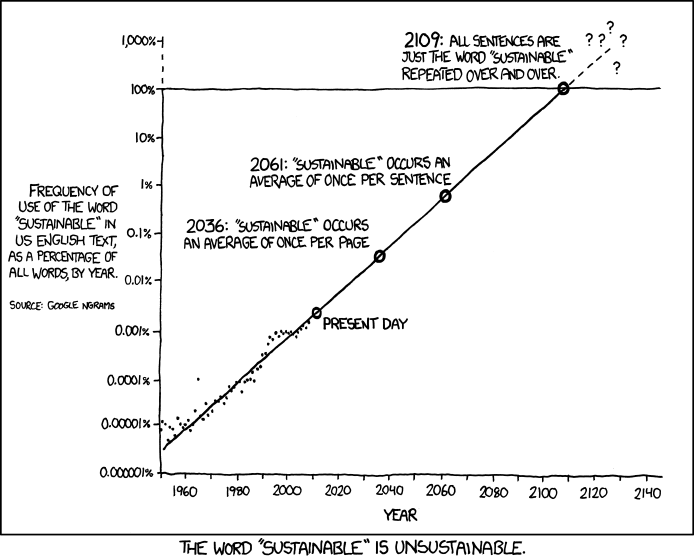
The following cartoons are a neat way to follow-up on this blog post:


It is just about sunrise time where I am and at a crispy 36 degrees F, while it will be nearly a 36 degrees C high at where I was less than three days ago!  Extrapolating from this, perhaps the solution to global warming and climate change is for humans to seek a cooler planet, and then start warming things up there, eh!