Saturday, March 17, 2012

Email of the day: (mis)use of class time!

In an email from the provost:
In the past week, a parent of a currently enrolled student called to complain on behalf of his daughter.  The complaint was directed at a faculty member who used considerable class time to espouse a personal opinion about the Presidential campaign.  The class and course were unrelated to political policy or current events and the student complained that class time was being spent on topics irrelevant to her learning and the stated course objectives.  Please remember the following statement from The Faculty Handbook (p. 11):
As citizens, faculty members have every right to become involved in the political affairs of the nation, state, and community.  The campus and its resources, however, being a state institution, cannot be used to support any specific candidate or cause without offering the same opportunity to anyone else who might wish to do so.
I would think that we faculty cannot misuse the class time even if the campus were not a state institution.

BTW, what an awkward sentence structure that is:  "The campus and its resources, however, being a state institution"  Shouldn't such a document drafted by PhDs have impeccable grammar?  Oh well, perhaps I am  asking for too much--after all, I have seen one too many horrendous usages, like, "sweat shops" instead of "sweatshops" :)

Friday, March 16, 2012

St. Patrick's Day in Chennai?

Oddest sighting yesterday while walking around in Pondy Bazaar here in Chennai: a young woman, with South Indian looks and perhaps in her early twenties, with a t-shirt on that read "Irish Girls Rock."

Was that an accident, or was she really celebrating St. Patrick's Day?

I tell ya, India is way too complicated!

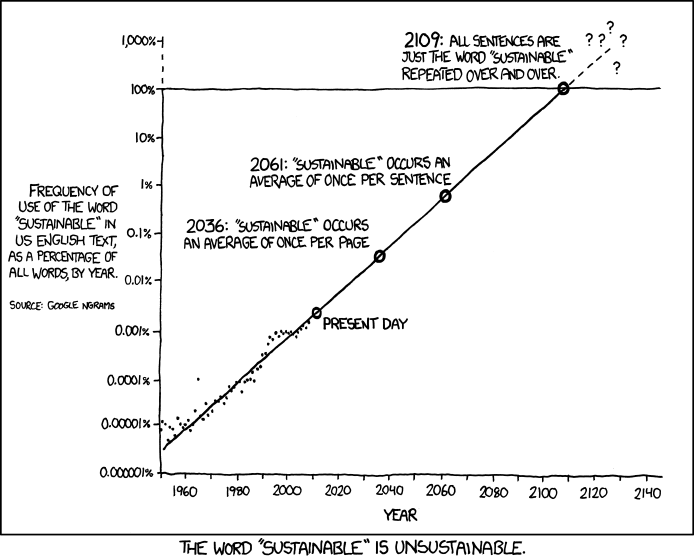
So, ... sustainable or unsustainable?

Source

The Hindi kolaveri continues on in Tamil Nadu. No "veri" for Tamil, however.

Way, way, back when I was a kid, I thought it was exciting to hear all about how Hindi was being imposed on Dravidians and the Tamil Nadu politicians all worked up against it.  The natural inclination to join the fight against anything imposed started, as far as I can recall, from this absurd promotion of Hindi as the national language. 

As a teenager, when I was associated with a political movement about which I am not at all proud of--perhaps the worst sin I have ever committed--I asked the leader why he was often talking to us in Hindi.  He replied that English is an European language, which did not belong to this land.  I told him that Hindi did not belong in Tamil Nadu.  He did not like it.  In any case, soon I was off that political movement as well.

A lot has changed over the decades.  But, after all the travels within this country, it does seem like there is very little Hindi usage in Tamil Nadu even now.  It is not that there is a whole lot of love and affection for the Tamil language; after all, as my experiences with the Mozhi t-shirt showed, while there is a great deal of rhetoric about love for Tamizh, in reality, however, kids and teenagers in Chennai seem to converse more often in English than Tamizh, while adults don't seem to worry about the language all that much.

Walking around in the busy shopping streets of T-Nagar, very, very rarely do I hear any Hindi.  A lot of English and Tamizh, and a good smattering of Telugu, Kannada, and Malayalam--all South Indian languages.

Hindi being rare a sound is such a contrast to my experiences in the places I traveled.  Even in the busy Connaught Place in New Delhi, even youngsters were mostly talking in Hindi--though they often did say "hi" to each other.  It was quite common an experience for me when I attempted to chat with auto and taxi drivers to find out that they knew even less English compared to taxi drivers in Ecuador!

At the IIT campus in Delhi, when I asked the taxi driver to stop at a roundabout so that I could ask a gentleman who was formally attired about the directions to my friend's office, I was quite shocked that he first replied in Hindi.  When I asked him again, he decided to address the taxi driver instead--in Hindi.  Yep, that was the case even at a campus of a leading university.  Now, of course, one swallow doesn't make a summer.  But, hey, I can't discount this experience either.

In train compartments and at airports, when in Tamil Nadu, children seem to be excited to talk to their parents in English.  But, in the other places north of the state, kids and parents conversed mostly either in the local language or in Hindi.

I do not assume that there is a conscious effort to keep Hindi away from Tamil Nadu.  It is not anything like the 1960s and 1970s when there were systematic efforts to drive Hindi out because of a real worry that it was being imposed.  Personally, the kid and the teenager in me who actively sympathized with the anti-Hindi emotions continues to be happy that Hindi has not become the lingua franca.  And, the fact that the younger population gravitate towards English is also an asset when it comes to the global economic marketplace. 

But, ... if only the youngsters were equally passionate about Tamizh! 

While I may have lost the fluency I once had in the language--the fluency and interest that drove me to read a whole lot of Tamizh literature even though I did not formally study the language in school after the primary years--there is, I suppose, always an emotional attachment to the language that we first learnt.  But, more than mere emotions, I am afraid that by not having a passion for Tamizh, the youngsters deprive themselves of a phenomenal opportunity to gain a little bit of understanding of the oldest living language with a rich literature past and with a very, very long history. 

A few weeks ago, dad gave me an article to read in which the author lamented about having watched a television show in which they went around asking people who Bharathidasan was.  The author seemed to be livid with the the ignorance on display, and I agreed with his feelings.  One, he wrote there, even replied that Bharathidasan was a former governor of the state!  That is a reflection of how much there is scant interest in Tamizh.   

I hope the tide will change. Soon.

I am a rock. At least, here :)


You see me?  Or, has the dark tanned-me merged with the stone sculptures in the background?  If so, then the punchline will be, "I am one with the Buddha"

Wednesday, March 14, 2012

Oh, Jon Stewart: How I miss thee! :(

Will catch up soooooon :)

Visitors come to my blog searching for ... "Tamil Penis" ... WTF!

Three visitors reached my blog because of that search keyword?  Whatever did they find in my blog, right?


Maybe ... just maybe ... this post somehow enlarged the scope of the topic of interest and visitors, I imagine, found it hard to comprehend how and why that boring narrative on a hermit and monkeys was supposed to be exciting.  But then, enough with pounding on this silly topic is what I think :)

Tuesday, March 13, 2012

"Driver Chacha" and I, and the cosmos. All about life ... and death

The cellphone text message informed me that I will be met by "Driver Chacha" at the Aurangabad station, and that he will carry a sign with my name on it.  Another bit of detail about him: doesn't speak English.

Over the years, I have gotten used to having delightful conversations with taxi drivers who speak little to no English. (But then perhaps my students also think that I speak little to no English, eh!)  Even after all these years, I can still picture in my mind the taxi driver in Italy who took us to a quaint restaurant outside of Florence.  I knew no Italian, while he at least knew a few words in English through which he described "beautiful California."  I was excited he had been to California, which is where I lived back then.  "No, saw on TV" he replied.

I got off at Aurangabad after the train stopped there at pre-dawn hours.  There was an older man, a couple of inches even shorter than me, holding a piece of paper that said "Mr. Sriram."  Aha, this was Driver Chacha!  He had on a white Islamic skullcap, and gave me a polite smile as I stopped beside him.

Over the two days, we "talked" a lot as he drove me to the fantastic destinations that I had planned on visiting.  Sometimes, Driver Chacha suggested we go to a certain touristy place, and we did even if I told him I was not keen on it.  He was hell bent on making sure I had a great time. 

"Ellora ke paas ek mandir hai (near Ellora is a temple)" is all I understood before he added a lot more in Hindi.  I told him that I didn't want to go to Shirdi--I worried we were going to make some serious detours and end up skipping things from my list. 

He smiled big time.  "Shirdi nahin. Ellora se dho kilometer ... (Not Shirdi.  Two kilometers from Ellora.)

It was quite an interesting scene: a Muslim driver keen on taking an atheist to a Hindu temple. 

I left my shoes and socks and backpack behind in the car, and walked with my camera to the temple entrance.  Of course, there was a board that made it clear that taking photos was not allowed.  "Can I take photos from the outside?" I asked the security guy there and invited his scathing look and a harsh negation. 

I wanted to head back to the car, but went in only because Driver Chacha was so keen on me going there.

Am glad I did, though.  For the first time in my life, I saw devotees performing the puja themselves, without going through an intermediary--the priest.  Even more fascinating it was to see that it was mostly women doing the puja, while the accompanying men stood or knelt down with folded hands. 

I didn't go inside into the inner sanctum because of the requirement that men had to remove all clothing from the upper half, and I was not ready to be a topless tourist there.  Once was enough for this trip--when I went with my sister and brother-in-law to the temple at Sucheendram :)

I reached the car after chugging down a cold soda to rehydrate myself on that hot and humid afternoon.  I handed Driver Chacha a cold Coca Cola I bought for him.  "Thanks, sir" he said.  And then added in Hindi that he would have that later with dinner at home, with the kids.  It was yet another reminder to me that drinking a Coke can be a special event to many here in India.

As we started driving back to Aurangabad, we passed what seemed like a couple of huge tombstone memorials.  Driver Chacha observed me staring at them through the passenger window. 

He gave me a long detailed explanation in between a couple of sarcastic chuckles, which I understood as: "they are the grave sites of a father and son, one of whom worked as the Regional Transport Officer.  They made money (illegally) and had built these for themselves.  While the Emperor Aurangazeb lay in a simple tomb, these small people want such huge memorials!"

Most people, be they small or big, seem to walk around with a mistaken notion that they are far too important, not understanding that the cosmos couldn't care.  As for my end, I visualize that the remains after my cremation will be scattered in the Willamette River. I will become one with the cosmos.

Qutb Minar, as seen by father and son ... 57 years apart!

It is a typical warm afternoon in Chennai, and I am way too wiped out to roam around in the heat anymore.  So, I was looking through another set of photographs--my father's collections that are from his professional life.

There, I see his photo of the Qutb Minar from 1955 or so:


I, too, had taken a photo from almost the same spot, when I was there a few weeks ago:


Pretty neat, eh!

Monday, March 12, 2012

Will pay gazillions for linsanity. But, not a dime for CEOs?

I have ranted blogged many times about the ridiculousness in the supersized payouts for athletes, actors, singers and other entertainers (like here).  And pointed out the irony in the ardent supporters of these gazillionaires being vehement critics of corporations and their CEOs.  But, who cares for what Sriram says, right?

But, what about when the eminently qualified Ken Rogoff makes that same point?  Will you listen to him then?  If so, here is what he writes:
What amazes me is the public’s blasé acceptance of the salaries of sports stars, compared to its low regard for superstars in business and finance. Half of all NBA players’ annual salaries exceed $2 million, more than five times the threshold for the top 1% of household incomes in the United States. Because long-time superstars like Kobe Bryant earn upwards of $25 million a year, the average annual NBA salary is more than $5 million. Indeed, Lin’s salary, at $800,000, is the NBA’s “minimum wage” for a second-season player. Presumably, Lin will soon be earning much more, and fans will applaud.
Yet many of these same fans would almost surely argue that CEOs of Fortune 500 companies, whose median compensation is around $10 million, are ridiculously overpaid. 
The US values entertainment way too much for its own good.  But, hey, that is the story within academia too--football and basketball rule, while the liberal arts get flushed down the dirtiest toilet :(

Oh well ...

Facebook blocked in India

So, ... it finally happened.  The federal government that was annoyed with the freedom to criticize political leaders, especially Sonia Gandhi, went to court against Facebook.  As a result, no access to Facebook as of this morning.

One web site offers this explanation:
I wonder what will happen now to those forty million users; I remember all too well Tunku Varadarajan's tongue-in-cheek report a while ago:
Social media was invented for Indians, says Sree Sreenivasan, a digital media professor at Columbia and co-founder of SAJA, the South Asian Journalists Association. "They take to it naturally and with great passion. It allows them to do two things they love: Tell everyone what they are doing; and stick their noses into other people's business."
If I see a few people walking around saying "like" or searching for a "comment" ... well, FB-detox awaits :)

"Arre, what is the मज़ा (fun) when you travel alone!"

As the train picked up speed, the conversations also slowly picked up.  Naturally, the first question I tackled was "you are from?"

Over the past few weeks, I have come to understand that Indians immediately see me as a foreigner who once grew up in India, while foreign tourists are sometimes even surprised that I am a foreigner.  One Australian couple, who seemed to be in their late sixties, thought that I didn't have even a little bit of any American accent to show for the twenty-five years I have been in the US.

So, when the older Indian fellow passengers asked me that question, I promptly said "from America."  And then added after a pause "my parents live in Chennai."

"Do you speak Hindi?" was his follow-up, perhaps calculating that he might find conversation in that language easier than to continue on in English.

"Very little."

"So, only English and Tamil?"

"Yes" I replied with a smile.

After a few minutes of a lull period, he began "Chennai was good until Kamaraj Nadar.  MGR was ok. Even the lady now is ok.  But that other fellow, Karunanidhi was bad for Tamil Nadu."

I agreed with him.  I didn't want to qualify my agreement with how much I think MGR was also bad for Tamil Nadu.  I recalled the Nagercoil taxi driver strongly declaring that the state went to the dogs ever since the rise of the DMK and ADMK.

He then switched over to talking in Telugu with his relative, and from the names of people used, I understood that they were discussing Tamil Nadu politics.

He turned to me again and wanted to know where I was going.  "Aurangabad.  I want to see Ajanta and Ellora" I replied.

"I am very happy you are going to those places even though you are now in Amrika."  He appeared to be genuinely happy over the fact that I was going there.  "We are going to Shirdi" he added.  I suppose we were on our own versions of pilgrimages.

"Your family?"

I was very happy he asked the question as "your family?" as opposed to "your wife?"  With this question, I didn't have to deal with any lying, and I simply said "in America."

"You traveling alone?"

I smiled and nodded a yes.

"Arre, what is the मज़ा (fun) when you travel alone!" he remarked.

I merely smiled.  I didn't want to tell him that such traveling anymore is a reflection of my single status, and not something I had worked towards.  And, internally, I know that there is a lot less मज़ा when alone, and a lot more anxiety as well.  But, we play with the cards we are dealt with.

As long as the मज़ा is more than the stress, my travels will continue. And, of course, until there is money in the bank.  No money, no मज़ा for sure :)


Strangers fed me. At my dinner time. May their tribe increase!

"X" and "Z" came with me all the way to the railway station platform to see me off.  I was immensely happy they did, because I have no idea when I would see them again.  Waving one's hand as the train leaves friends or relatives behind seems like a real goodbye, which no airport experience can duplicate.

We reached the designated spot for my coach just as the train's engine made its appearance.  Right on time we were.  Even before the paranoid me could get to the chart to ensure my name was there, "X" and "Z" spotted it, where all the passengers' names were listed in Hindi.  "They have your last name as "खे" instead of "के" remarked "Z" prompting an explanation of how I ended up preferring "Khé" over "" in changing to the identity that is now almost twelve years old. 

After dropping off my bag, I stepped out of the coach to spend the remaining minutes with X and Z.  "There are two older women there, and my lower berth seat has been taken" I told them.  It seemed like the coach was full of older people, perhaps all on their way to Shirdi.  After a few minutes of chit-chat, I jumped back into the coach and stood by the door as the engine's horn tooted, and the train started moving.  I waved out to "X" and "Z" until I could see them no more.

When I returned to my seat, the two older women had now been replaced by three older men.  One asked if I could trade my lower berth for his upper berth on the side.  "No problems" I said.  Perhaps he expected some other response; he started explaining his problem with his knee.  "I will take the upper berth" I interrupted him.  He expressed his appreciation through a firm handshake.

As I settled into my seat, and into the journey, it occurred to me that I hadn't brought anything with me to quieten my stomach at dinner time, which was only a couple of hours away.  I decided to merely sleep it off.

It was just about my usual dinner time when one of the older women, who was originally at my seat, offered me a plate full of lemon rice and a bonda.  "Oh, no, thanks.  I am fine" I politely lied.  She insisted I take it.  The man with whom I traded berths said in his loud voice that they had lots of food and that I ought to eat with them.

From the chit-chat, I knew that they were from Rajahmundry, and I worried that the lemon rice would be hot, hot, chili hot.  I carefully took a spoonful of that rice and ... no chilies at all.  Just the way I like it!

"Perhaps the bonda would be hot" I thought as I bit into it.  Surprise of it all--the filling was sweet.

I slowly ate this delicious meal, which was a wonderful surprise.  I was barely done when the woman appeared again to offer me another helping.  "Oh thank you so much" was all I said.

After dumping in the trashcan the well-cleaned out plate, I thanked the women once again for sharing their tasty food with me.  I then walked over to the gent to whom I yielded my lower berth.  "Thanks for the food" I told him.

When my travels began, I ran into wonderful people and hoped that I would meet only good people along the way.  It has been nothing but the best.  What an awesomely reassuring feeling it is to know that there are such folks, eh!

Yet again, I am reminded of Abou Ben Adhem:

Abou Ben Adhem
By James Leigh Hunt

Abou Ben Adhem (may his tribe increase!)
Awoke one night from a deep dream of peace,
And saw, within the moonlight in his room,
Making it rich, and like a lily in bloom,
An Angel writing in a book of gold:
Exceeding peace had made Ben Adhem bold,
And to the Presence in the room he said,
"What writest thou?" The Vision raised its head,
And with a look made of all sweet accord
Answered, "The names of those who love the Lord."
"And is mine one?" said Abou. "Nay, not so,"
Replied the Angel. Abou spoke more low,
But cheerily still; and said, "I pray thee, then,
Write me as one who loves his fellow men."
The Angel wrote, and vanished. The next night
It came again with a great wakening light,
And showed the names whom love of God had blessed,
And, lo! Ben Adhem's name led all the rest!
May their tribe increase, yes!  Here is to hoping for more such stories when I meet "X" and "Z," whenever that might be.

High tension in Indian cities doesn't matter as it does in US cities?

By high tension in cities, I am not referring to the commonly held belief that life in cities is stressful and that it is all peace and harmony in the rural landscape.  "High tension" as in high voltage transmission lines.

As we drove, I heard "X" say "this is high tension road." I thought I misheard--after all, the traffic was flowing really well, and the road was relatively ok.

I knew it couldn't be my faulty ear either, given that the passenger seat is to the driver's left.  So, when I asked for clarification, "X" said, "this is called high tension road."  Turns out that is the name of the road, because of the transmission lines there.

In the US, people freak out about being anywhere near high voltage transmission lines.  A few years ago, there was all that worry over the hyped up electromagnetic radiation.  The risk calculations in the US are very, very different from how risk is assessed in India by individuals and society as a whole.  

Driving under high tension cables, or living right by a distribution transformer, is, therefore, nothing out of the ordinary in India.  A few weeks ago, the directions "S" gave me included the location of a transformer as a landmark.

In Mumbai, my uncle led me on a short hike up the hill by their home in a suburb.  It was absolutely pretty, and I imagine that soon with all the spring blossoms the hill will come alive with greenery and colors.

In between all that are high tension cables, which run right by the housing development too.


Risks of different types are part of the daily life here in India.  When I climbed up the fort at Aurangabad, I was worried about safety aspects in so many contexts that it will be a lengthy post all by itself.  In the US, not one person would have been allowed past the outer walls of the fort because of the potential legal liabilities when things go wrong, for which there is immense scope.

Risk minimization is a reflection of affluence in a country, and by that measure India has a long, long way to go.  In a way, the controversy over the Kudankulam nuclear power plant is also nothing but a discussion over risk minimization.  The protesters seem to be using a US-type standard in a country where most activities are not governed by US-type safety standards.

The cab driver in Nagercoil put it this way: "the tsunami killed thousands and destroyed many homes, sir.  Abdul Kalam says that Kudankulam going wrong will be the tsunami kind of a very rare event.  But, think about the electricity this will generate, sir.  We have ten hours of power cut now every day."

The tension the cab driver had while offering his strong opinions seemed to be a lot more than the tension in the high voltage cables!

Later, as the full moon came up on the Holi evening, I forgot all about tensions of every possible kind!

Sunday, March 11, 2012

I turned a few heads and eyes towards me. Because of a t-shirt. Yay!

Consistent with my sartorial (non)sense, I have been roaming around in shorts and t-shirts, so much so that dad told me once, "if you don't mind, I will buy you a few decent shirts to wear so that you can be presentable."

We now laugh about that remark :)

Perhaps dad was under the impression that I might wear a dress shirt at least to a formal event to which I had been invited.  It was for an "upanayanam," which is (used to be?) an important step in a Brahmin boy's life.  Like the bar-mitzvah of the Jewish traditions.

He was partially correct in assuming that my attire would be different--I didn't wear shorts, but wore trousers!

No dress shirt though.  Instead, I wore the t-shirt that generated good buzz at least once before, and bad buzz even before I wore it!

At the event, I noticed people looking at the t-shirt.  There is a probability that they wondered about the appropriateness of such a casual attire at a formal, religious, ritualistic gathering.  It is also probable that they looked at it with appreciation because there is practically no t-shirt sold with Tamizh lettering, and that too such a quality t-shirt.  

I was so tempted to poll the people at the event about their views on this unique t-shirt.  Thankfully, I refrained from getting into any serious discussion on this topic.

Later in the evening, I was at a local restaurant with my parents.  The waiter who took our order kept staring at my t-shirt.  A few minutes later, another waiter swung by the table under the pretext of asking whether we needed anything but in reality was merely reading the letters in the t-shirt.

I thought to myself that if a large-chested young woman wore this Tamizh t-shirt, it might be quite a challenge to figure out what the viewer/voyeur was focused on :)

As we were getting ready to leave, two more waiters came by.  One said he was very happy to see a t-shirt with Tamizh letters.  "I have never seen one like this, sir" he added.  The other waiter who came with him seemed ecstatic with the words he read, and commented "that is a wonderful phrase, sir."

"Yes, a profound phrase indeed" I replied.

The phrase, "தமிழ் எங்கள் பிறவிக்கு தாய்," translates (in my crude translation) to "Tamizh is the mother who gave birth to us."

Language and poetry continues to stir passion, which is a healthy sign that people haven't completely fallen hook, line, and sinker for everything that is not good for the soul.  At least, not yet.

On watching an Indian movie in an Indian multiplex. After 26 years!

A few months ago, my cousin "V" recalled a movie experience and asked if I remembered it.  I, of course, drew a complete blank.  She was surprised that I didn't remember how "we went to watch a movie in thiruvalam and came out because of bedbugs in our seats!!!!!!!"

Perhaps that is why I never went to movies in India that much :)

The bedbug experience was before I left for the US.  To the best of my recollection, over the last 25 years, I haven't been to any Indian movie--neither in the US nor during my visits to India.  Of course, I don't count films by people like Mira Nair as truly Indian.

This time around, I thought it might be a fun experience to watch one.  A friend, "S," recommended a Tamizh movie.  But, I chickened out at the thought of three-plus hours of movie watching.

Eventually, I took the plunge when "X" and "Y" seemed enthused enough. They assured me that it would be a good one, especially because Irfan was in it.

I had no idea about Irfan.  And it was a Hindi movie at that.  But, I was game for it, and off we went.

The movie was Paan Singh Tomar

As we walked into the hall, the larger seating capacity itself was a reminder that I was not in the US.  I made sure I didn't lose my footing in the dim lighting.

When the movie started and Irfan appeared on the screen, I recognized him from The Namesake and Slumdog Millionaire.  I liked his acting in both those films, and I could now sense why "X" and "Y" were confident about an Irfan movie. 

As the story developed, I got even more excited.  Not because I followed the dialogs.  The excitement was because a good chunk of the story is set in the Chambal Valley, where I was only a month ago.  A sense of "I know this place" made me sit up even straighter.  I recalled driving over a river a little outside of Gwalior and wondered aloud whether that was the Chambal, and it was.  I hurriedly took a photo:


And then I thought that perhaps I might even get to see men walking around with huge shotguns on their backs.  Sure enough, soon there was one.  He was pedaling away on his bicycle, with an automatic rifle tied around his back and a magazine across his shoulder.  I didn't dare to take a photo of him, however, lest he unloaded a few bullets on me.

Anyway, in the movie, in one context, a character referred to the place Bhind.  I couldn't control my excitement; I turned to "X" and said, "Oh my god, Bhind!"

My thanks to "X," "Y," and "Z" for all the excitement related to this movie, and for the experience of watching an Indian movie after all these years.

Oh, about the movie itself?  It was definitely not your stereotypical Bollywood product, with mindless singing and dancing and running around in the Alps.  There is, of course, a lot of melodrama, which could have been easily eliminated for a much tighter storytelling at within 100 minutes.  I would rate Paan Singh Tomar a B+.  And an A- it will be if I factor in all my excitement :)

"Stop crying now, ... or do you want me to smack you?"

The train was a half hour late.  By the time the "express" started moving, it was five minutes past ten at night. 

The three people across from me were already in their beds.  Next to me was a kid, perhaps about eight or ten years old.  And then her mom and dad.  They too had boarded the train at the same station and we were all settling into our seats, and were waiting for the ticket inspector. 

The kid and the mother were all decked up.  The kid asked for her book.  The father hemmed and hawed, and the mother opened up the bag and took the book out.  The kid seemed excited.  So excited that she merely held the book in her hand, and didn't bother to read it.

Soon the ticket inspector came by, and we were all clear to hit the bed.

The dad told the kid it was time for her to climb up to the top most berth.  The kid dragged herself, like the kids when they sing "so long, farewell" in The Sound of Music.

She took the book with her.  And that is when her problems began.

The dad told her it was way past her bedtime and that she had to put the book away.

It was sad to see the kid's reactions.  The excited, happy, joyful girl started crying.  Without big sounds.  Her shoulders started shaking and tears rolled down.

It is so bloody difficult to watch a kid cry.  And that too a young girl who only a minute earlier was such a radiant bundle.  But, parents need to do what parents need to do, I suppose.

The father sternly told her to stop crying.  She simply couldn't.  Which is when he issued an ultimatum:"Stop crying now, ... or do you want me to smack you?"

The mother tactfully whispered something to her daughter, and then asked her if she wanted to go to the bathroom before bed.  And off they went.

When they returned, the kid wasn't crying at all.  She was normal. All ok.  Kids are awesome that way.

She climbed up to the berth where her father had already done up the bed.  She lay down.

Meanwhile, we put up the middle berth where the mother was to sleep.  I got my stuff organized in the lower berth.

The kid called her father and said in English, "a cockroach is here."

"Not roaches again" I thought to myself.

But, she didn't cry about it.  Now, that is one brave girl!

There is another Taj Mahal in India? Ahem, yes. And, ahem, no :)

Ok, first the original, which is at Agra:


And now the second one, which is at Aurangabad:


The original is the "real McCoy" ... there is the Taj, and then there is everything else ...