Like so:
More here
And, yet, defense expenditures are off the table!
Sriram Khé, blogging since 2001 ........... ............ And back again since June 2008
Saturday, July 23, 2011
"That was what you did. You died." Tenente lives. War goes on.
A few days back, I read the final words of A Farewell to Arms. (prior posts here and here.)
Felt so empty inside when it ended that I had to wait out a couple of days before blogging this.
Hemingway simply sucked everything out of me with the anti-war story where the American protagonist signs up to serve in the medical corps of the Italian army in order to fight the good war, ends up deserting that only to have the military come after him because of his AWOL status as an officer, flees to neutral Switzerland with his British "wife" who is pregnant ... and then Hemingway lets the wife die after a difficult birth of a stillborn child. That is simply too cruel!
It was like how I used to feel after watching one of those older Malayalam movies back in India. Those days, one could expect nothing but tragedies in those movies, and the cynical joke was that not only the hero and the heroine but the dog also died!
I suppose the consolation is that Tenente survives it all.
Felt so empty inside when it ended that I had to wait out a couple of days before blogging this.
Hemingway simply sucked everything out of me with the anti-war story where the American protagonist signs up to serve in the medical corps of the Italian army in order to fight the good war, ends up deserting that only to have the military come after him because of his AWOL status as an officer, flees to neutral Switzerland with his British "wife" who is pregnant ... and then Hemingway lets the wife die after a difficult birth of a stillborn child. That is simply too cruel!
... So, that was it. The baby was dead. That was why the doctor looked so tired. But why had they acted the way they did in the room with him? They supposed he would come around and start breathing probably. I had no religion but I knew he ought to have been baptized. But what if he never breathed at all. He hadn't. He had never been alive. Except in Catherine. I'd felt him kick there often enough. But I hadn't for a week. Maybe he was choked all the time. Poor little kid. I wished the hell I'd been choked like that. No I didn't. Sill there would not be all this dying to go through. Now Catherine would die. That was what you did. You died. You did not know what it was about. You never had time to learn. They threw you in and told you the rules and the first time they caught you off base they kileld you. Or they killed you gratuitously like Aymo. Or gave you the syphilis like Rinaldi. But they killed you in the end. You could count on that. Stay around and they would kill you.
It was like how I used to feel after watching one of those older Malayalam movies back in India. Those days, one could expect nothing but tragedies in those movies, and the cynical joke was that not only the hero and the heroine but the dog also died!
I suppose the consolation is that Tenente survives it all.
After a while I went out and left the hospital and walked back to the hotel in the rain.
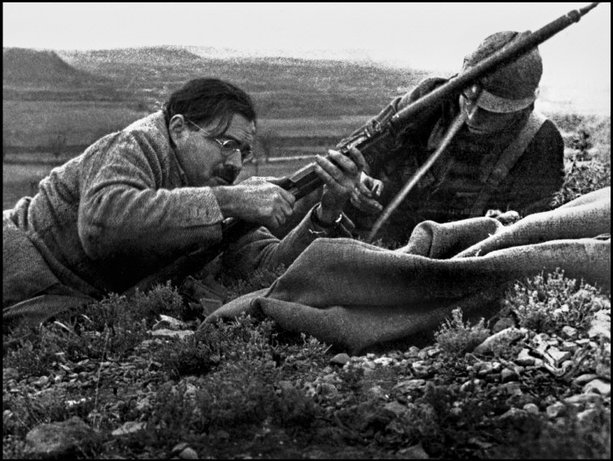
Caption at the source:
MORA DE EBRO, Spain—Hemingway on the front lines with members of Gen. Enrique Lister’s Loyalist 5th Regiment who were holding out against Gen. Franco's offensive, Nov. 5, 1937.
If only alternatives were any better, we would send Obama packing!
Of course, my rantings here don't influence a damn thing (editor: have you forgotten the hate email, which is proof that there are people who read what you write?)
Therefore, it is all the more a consolation when I find that the likes of Krugman and Stiglitz and Sachs and ... write about these in ways that are far, far, far more influential. Here is Sachs (ht):
As Congressman Barney Frank said:
How much do we spend on the military?
Therefore, it is all the more a consolation when I find that the likes of Krugman and Stiglitz and Sachs and ... write about these in ways that are far, far, far more influential. Here is Sachs (ht):
[At] every crucial opportunity, Obama has failed to stand up for the poor and middle class. ... Obama is on the verge of abandoning the poor and middle class, by agreeing with the plutocrats in Congress to cut spending on Medicaid, Medicare, Social Security, and discretionary civilian spending, while protecting the military and the low tax rates on the rich (if not lowering those top tax rates further according to the secret machinations of the Gang of Six, now endorsed by the president!)If everything--including social security--is on the table, why then is military off the table? On a special velvet-cushion chair all by itself? Sipping a martini while expenditures over at the civil society are being shredded?
As Congressman Barney Frank said:
Scoffing at the suggestion that “everything is on the table’’ in budget negotiations between the Obama administration and congressional leaders, Frank said, “The military budget is not on the table. The military is at the table, and it is eating everybody else’s lunch.’’A double-martini lunch, indeed!
How much do we spend on the military?
The "war on terror" is a failure
The Economist has a neat way of summarizing the Norway terrorism:
Relative to Norway’s population, the two attacks taken together are of a similar magnitude to the September 11th hijackings in the United States.Norway's dead from the twin attacks are proportionally worse, strictly on the basis of population. Norway has a shade under five million people, while the US is home to more than sixty times that number.
Soon after the news of the explosion, pundits were theorizing about Islamic fundamentalist militants and even Kurdish and Uighur elements. When, as was the case in the Oklahoma City violence, it was "home-grown" terrorism.
Apparently this extreme right winger boasted about having been in contact with the English Defence League. Thanks to the New Yorker's profile of this outfit and its leader, only a couple of weeks ago, I can understand why the EDL might have such fanatics.
One of the many aspects of this atrocious violence in Oslo is that the Bush/Cheney "War or Terror" as a response to 9/11 was one of the worst things they could have done. And for Obama to continue to wage that war against terror, as if it is something like an identifiable army that can be defeated, is a tragedy.
I am all the more reminded of the television program I watched when I was in India a couple of years ago. It was in one of those news channels, and was a talk show featuring some wannabe public intellectuals. The question for this panel was this: "all Muslims are not terrorists, but all terrorists are Muslims." I had to force myself to watch it for a while. It was awful to hear most of them assert that all terrorists are Muslims.
They conveniently forgot all kinds of non-Islamic terrorism within India's borders alone, leave alone the rest of the world. Two prime ministers were assassinated, and neither was caused by terrorists who were Muslims. Indira Gandhi was felled by bullets fired by a Sikh, and Rajiv Gandhi was blown to pieces by a Srilankan Tamil suicide bomber. In contemporary India, Maoist guerrillas use violence, and these are not driven by any religion, Islam or otherwise.
Yet, there was only the Islamic terrorism that was discussed.
It seems to be a similar story in the rest of the world, and definitely in the West. Even when unfortunate events like in Oslo repeatedly point out that terrorism comes in all flavors.
A rational rethink might then question the War on Terror that the US continues to fight. But, apparently not.
A violent crime proportionally greater in magnitude than the 9/11 event. I recall being depressed for a few days after that happened. I can't begin to imagine the emotions among Norwegians now ...
Friday, July 22, 2011
Correction: Not George Obama, but Barack Nixon?
Looks like today I can't get away from wondering why Republicans are so upset with President Obama when he has been a better conservative than many of the past Republican presidents themselves!
Here is Bruce Bartlett making the case:
I don't think there is any political future for us Libertarian-Democrats :(
Here is Bruce Bartlett making the case:
Although Republicans routinely accuse him of being a socialist, an honest examination of his presidency must conclude that he has in fact been moderately conservative to exactly the same degree that Nixon was moderately liberal.It is reflection of the Faux-Noose stupidity that the conservative Obama is labeled a socialist!
Here are a few examples of Obama's effective conservatism:
- His stimulus bill was half the size that his advisers thought necessary;
- He continued Bush’s war and national security policies without change and even retained Bush’s defense secretary;
- He put forward a health plan almost identical to those that had been supported by Republicans such as Mitt Romney in the recent past, pointedly rejecting the single-payer option favored by liberals;
- He caved to conservative demands that the Bush tax cuts be extended without getting any quid pro quo whatsoever;
- And in the past few weeks he has supported deficit reductions that go far beyond those offered by Republicans.
Further evidence can be found in the writings of outspoken liberals such as New York Times columnist Paul Krugman, who has condemned Obama’s conservatism ever since he took office
Conservatives will, of course, scoff at the idea of Obama being any sort of conservative, just as liberals scoffed at Nixon being any kind of liberal. But with the benefit of historical hindsight, it’s now obvious that Nixon was indeed a moderate liberal in practice. And with the passage of time, it’s increasingly obvious that Clinton was essentially an Eisenhower Republican. It may take 20 years before Obama’s basic conservatism is widely accepted as well, but it’s a fact.
I don't think there is any political future for us Libertarian-Democrats :(
War uninterrupted, under Barack O'Bush. Or is it George Obama?
The best way to settle this: we will call them Tweedledum and Tweedledee!
Up until the 2008 elections, progressives were furious with President Bush for dragging the country not only into Iraq, but into a War on Terror. Candidate, Senator Obama promised hope and change. "We are the ones we have been waiting for" the messiah proclaimed.
That was the story then.
Three years later?
We are very much there in Afghanistan.
We will continue to have a significant presence in Iraq for generations more, it seems like.
Afghanistan? Better not to even talk about it anymore.
The drone attacks in Pakistan have vastly increased under Obama
As if these are not enough to worry us over the what has turned out to be the third term of President Bush, the War on Terror has been increased in its geographic reach
According to The Nation:
Thus, under O'Bush, we have expanded military operations in Yemen, Somalia, and Libya.
Would you then hypothesize that the US is more popular in the Arab World after the election of Obama, or Was Bush's America more popular?
Glenn Greenwald answers:
Up until the 2008 elections, progressives were furious with President Bush for dragging the country not only into Iraq, but into a War on Terror. Candidate, Senator Obama promised hope and change. "We are the ones we have been waiting for" the messiah proclaimed.
That was the story then.
Three years later?
We are very much there in Afghanistan.
We will continue to have a significant presence in Iraq for generations more, it seems like.
Afghanistan? Better not to even talk about it anymore.
The drone attacks in Pakistan have vastly increased under Obama
As if these are not enough to worry us over the what has turned out to be the third term of President Bush, the War on Terror has been increased in its geographic reach
According to The Nation:
As part of its expanding counterterrorism program in Somalia, the CIA also uses a secret prison buried in the basement of Somalia’s National Security Agency (NSA) headquarters, where prisoners suspected of being Shabab members or of having links to the group are held. Some of the prisoners have been snatched off the streets of Kenya and rendered by plane to Mogadishu. While the underground prison is officially run by the Somali NSA, US intelligence personnel pay the salaries of intelligence agents and also directly interrogate prisoners.I suppose the advantage that Obama has over Bush is this: as a constitutional law professor, Obama doesn't need any minions like Yoo to write legal briefs and make arguments in favor of his monarchy.
Thus, under O'Bush, we have expanded military operations in Yemen, Somalia, and Libya.
Would you then hypothesize that the US is more popular in the Arab World after the election of Obama, or Was Bush's America more popular?
Glenn Greenwald answers:
A new poll released today of six Arab nations -- Egypt, Lebanon, Jordan, Saudi Arabia, the United Arab Emirates and Morocco -- contains even worse news on this front:Hey liberals, progressives, Democrats, whatever you call yourselves ... happy now?
The hope that the Arab world had not long ago put in the United States and President Obama has all but evaporated.What's striking is that none of these is among the growing list of countries we're occupying and bombing. Indeed, several are considered among the more moderate and U.S.-friendly nations in that region, at least relatively speaking. Yet even in this group of nations, anti-U.S. sentiment is at dangerously (even unprecedentedly) high levels.
Two and a half years after Obama came to office, raising expectations for change among many in the Arab world, favorable ratings of the United States have plummeted in the Middle East, according to a new poll conducted by Zogby International for the Arab American Institute Foundation.
In most countries surveyed, favorable attitudes toward the United States dropped to levels lower than they were during the last year of the Bush administration . . . Pollsters began their work shortly after a major speech Obama gave on the Middle East . . . Fewer than 10 percent of respondents described themselves as having a favorable view of Obama.
Wednesday, July 20, 2011
Pervez Musharraf ... he is baaaack on The Daily Show :)
Ah, remember that wonderful interview back when the world wanted to know where Osama bin Laden was? No? You can always revisit that later.
For now, watch Musharraf talking with Jon Stewart three months after the death of OBL:
And it continues:
For now, watch Musharraf talking with Jon Stewart three months after the death of OBL:
And it continues:
More on utilitarianism in education policies
After reading my post on whether the utilitarian cost-benefit analysis that governs government policies killed liberal education, a high school classmate, "J," who lives and teaches in India comments:
"J" also provides this lengthy excerpt from Hard Times:
Hard Times by Charles Dickens, that is.
Not to be confused with the 1975 movie by the same name.
Though, it does seem like the movie, which is set in the Great Depression era, is also apt for now--when we are still struggling with the Great Recession's aftershocks:
Dickens' 'Hard Times' speaks exactly about this kind of utilitarianism in Education. It is a pity that we are still facing the crisis more than a century later.Not only it is apt, I would think it is worse--utilitarian calculations seem to govern everything now.
"J" also provides this lengthy excerpt from Hard Times:
... Mr and Mrs M’Choakumchild never make any mistakes themselves, I suppose, Sissy?’
‘O no!’ she eagerly returned. ‘They know everything.’
‘Tell me some of your mistakes.’
‘I am almost ashamed,’ said Sissy, with reluctance. ‘But today, for instance, Mr M’Choakumchild was explaining to us about Natural Prosperity.’
‘National, I think it must have been,’ observed Louisa.
‘Yes, it was. — But isn’t it the same?’ she timidly asked.
‘You had better say, National, as he said so,’ returned Louisa, with her dry reserve.
‘National Prosperity. And he said, Now, this schoolroom is a Nation. And in this nation, there are fifty millions of money. Isn’t this a prosperous nation? Girl number twenty, isn’t this a prosperous nation, and a’n’t you in a thriving state?’
‘What did you say?’ asked Louisa.
‘Miss Louisa, I said I didn’t know. I thought I couldn’t know whether it was a prosperous nation or not, and whether I was in a thriving state or not, unless I knew who had got the money, and whether any of it was mine. But that had nothing to do with it. It was not in the figures at all,’ said Sissy, wiping her eyes.
‘That was a great mistake of yours,’ observed Louisa.
‘Yes, Miss Louisa, I know it was, now. Then Mr M’Choakumchild said he would try me again. And he said, This schoolroom is an immense town, and in it there are a million of inhabitants, and only five-and-twenty are starved to death in the streets, in the course of a year. What is your remark on that proportion? And my remark was — for I couldn’t think of a better one — that I thought it must be just as hard upon those who were starved, whether the others were a million, or a million million. And that was wrong, too.’
‘Of course it was.’
‘Then Mr M’Choakumchild said he would try me once more. And he said, Here are the stutterings — ’
‘Statistics,’ said Louisa.
‘Yes, Miss Louisa — they always remind me of stutterings, and that’s another of my mistakes — of accidents upon the sea. And I find (Mr M’Choakumchild said) that in a given time a hundred thousand persons went to sea on long voyages, and only five hundred of them were drowned or burnt to death. What is the percentage? And I said, Miss;’ here Sissy fairly sobbed as confessing with extreme contrition to her greatest error; ‘I said it was nothing.’
‘Nothing, Sissy?’
‘Nothing, Miss — to the relations and friends of the people who were killed. I shall never learn,’ said Sissy. ‘And the worst of all is, that although my poor father wished me so much to learn, and although I am so anxious to learn, because he wished me to, I am afraid I don’t like it.’
Hard Times by Charles Dickens, that is.
Not to be confused with the 1975 movie by the same name.
Though, it does seem like the movie, which is set in the Great Depression era, is also apt for now--when we are still struggling with the Great Recession's aftershocks:
Tuesday, July 19, 2011
Debt Ceiling: Money talks and bullshit walks!
Forget the pundits and politicians--the best analysis is in the videos here :)
The Senior Economic Analyst explains the importance of this: we will soon hit the bullshit ceiling!
Well, here is the walking bullshit meter, Professor Harry Frankfurt
, who postulated that bullshit will only keep increasing :(
The Senior Economic Analyst explains the importance of this: we will soon hit the bullshit ceiling!
Well, here is the walking bullshit meter, Professor Harry Frankfurt
Did government kill liberal education?
As I noted in an opinion piece a few weeks ago:
However, did this cause, or at least hasten, the death of liberal education?
A few decades ago, when higher education was not linked to explicit training for the professions, As John Armstrong notes, one might have studied:
The involvement of the state, however, means that taxpayer subsidies have to be justified. It does not take a doctorate in logic to figure out how quickly then we descended into a utilitarian framework on the worth of higher education, resulting in colleges and universities becoming centers for job skills.
The net result is that we seem to be less interested in developing thinkers and creative people, and more "invested" in producing worker bees.
It has been an unfortunate unintended consequence.
Martha Nussbaum provides a succinct response in this context:
Education, for the longest time, was not about credentialing for the trades. As one looks back to the days of gurukula in India or Plato's academy, it becomes clear that education was simply about knowing. Preparations for the trades and professions happened elsewhere.The broadening of higher education opportunities, through state involvement, for a lot more in society--not merely to the affluent--was, of course, the right thing to do. Not for the instrumental and utilitarian logic that it delivered economic benefits, but because having a population that thinks a lot more is better than otherwise.
However, did this cause, or at least hasten, the death of liberal education?
A few decades ago, when higher education was not linked to explicit training for the professions, As John Armstrong notes, one might have studied:
the classics at Oxford and Cambridge and go on to be a merchant banker because the institutions have such prestige that being educated there is seen as a sign of high calibre; also, the guy hiring at the bank went to Oxford.In this approach to higher education, academics didn't have to worry about the liberal education they lived and breathed.
The involvement of the state, however, means that taxpayer subsidies have to be justified. It does not take a doctorate in logic to figure out how quickly then we descended into a utilitarian framework on the worth of higher education, resulting in colleges and universities becoming centers for job skills.
The net result is that we seem to be less interested in developing thinkers and creative people, and more "invested" in producing worker bees.
It has been an unfortunate unintended consequence.
Martha Nussbaum provides a succinct response in this context:
The world needs commerce, science and technology more than the humanities. Right or wrong?Armstrong seems to believe that there is a way out of this increasing marginalization of liberal education:
Wrong! Even for commerce and technology to succeed, they need the humanistic imagination and the ability to think critically and rigorously.
Science at its best is closely allied to the humanities because it is creative, highly rigorous and critical. So what the world needs is an alliance between the humanities and creative basic science to foster the skills that produce good citizenship and healthy business cultures.
I am suggesting a change to well-entrenched systems; I say we have a shortfall in speaking to the publicMore from Armstrong:
"If you believe something is important you should try to take it to everyone," he argues. "The humanities don't belong to the elite."Indeed!
And this means presenting ideas and arguments in ways people who aren't academic experts can grasp, of ideas-merchants selling the ideas they stand for, not just talking to each other.
"The marketplace of ideas is a marketplace," he says.
Monday, July 18, 2011
Did Larry Summers really say that about FDR? Yes, he did!
Quick question: was the US economic recovery after the Great Depression a result of FDR's economic policies?
Larry Summers provides the answer (ht) play the embedded video here--it will start from where I have bookmarked. Watch and listen for a minute-plus at least.
Did the "H" word in his response creep you out? The way Summers lays it out?
Larry Summers provides the answer (ht) play the embedded video here--it will start from where I have bookmarked. Watch and listen for a minute-plus at least.
Did the "H" word in his response creep you out? The way Summers lays it out?
Love-hate relationship with Facebook, and technology itself
Quite a few months ago, I informed my Facebook friends (editor: what? you have friends? awshutupalready!) that I was temporarily freezing my account and activities. There is a kind of creepy feeling and shallow interactions that bothered me.
After a blissful existence in the world outside of Facebook, I am now back there again. However, every single day, there is an urge within me to quit Facebook for the same reasons as before. A couple of days ago, in an email to a friend (editor: stop lying. awshutupalready!) "There are moments when I worry about all this social media network and the internet ..."
But, I realize I can't quit Facebook--it is not any addiction on my part. Facebook has, after all, made it easy for me to share old photos with family and friends, and to take in what they have to offer. Every once in a while there is feedback on my blog posts that are automatically routed into Facebook, and the feedback has often led to substantive discussions and learning. And a lot more.
I feel like the heroine in the formulaic Bollywood movies who alternates between yelling "I hate you" to the hero and "I love you" a few minutes after that!
But then this love-hate relationship with so many aspects of technology is not new to me. Not at all.
As much as I am big time technology consumer (within my budgetary constraints, that is,) I way prefer, for instance, the paper-book in my hand instead of reading it on Kindle. Reading the New Yorker magazine even when I get annoyed with the gazillion subscription cards is a lot more of an enjoyable experience than reading it on the computer monitor. Heck, even playing the old vinly LPs is immensely more pleasurable then listening to Pandora. (Well, Pandora is a tough call--I do enjoy the new music that it offers me based on its understanding of my music tastes.)
These personal preferences though are trivial compared to my worries about the role that such rapidly evolving technology has on kids and youth. In my classes, for instance, I tell students that they are adults and that, therefore, it is not my responsibility to instruct them what not to do in the classroom, as long as whatever they do doesn't distract fellow students or me from the activities that bring us together in that room. Thus, I ignore students who seem place their smartphones on the desks and spend a lot more time and attention responding to messages there instead of focusing on the discussions in class.
But, do/should technology developers worry about the broader ramifications? Or, as Isaac Asimov noted about science, there is no way but onwards?
Reading the New Yoker's profile of Jaron Lanier (subscription required) and Lanier's comments there, made me feel all the better about my love-hate relationship with technology and my worries about its effects on the young. Because, Lanier is infinitely more informed than me on this topic, and he seems to be a lot more worried as well.
I then spent forty minutes watching and listening to this talk, available thanks to technology--see, my love aspect again--which is a discussion of his book, You Are Not a Gadget: A Manifesto
,
Lanier makes a number of points that have always bugged me. More than anything else, I am surprised and utterly disappointed that the internet and the Web haven't unleashed the creativity of people that seemed so promising when the primitive world wide web grew up to web2.0. Instead, whether it is students engaging in awful shortcuts to learning--plagiarism made simple--or people posting video clips of cats playing the piano, we seem to have only facilitated laziness and shallow interactions with ideas and people. Instead of creative people working with their brains, it seems equally possible that the kids and youth of today could become more like human automatons.
Lanier argues that the nearly two decades worth of data since the birth of the www ought to make us pause and think about what kind a future we want to have:
BTW, Lanier's observations on Facebook resonate well with me--he says that the older folks get Facebook and the young don't. Amen!
After a blissful existence in the world outside of Facebook, I am now back there again. However, every single day, there is an urge within me to quit Facebook for the same reasons as before. A couple of days ago, in an email to a friend (editor: stop lying. awshutupalready!) "There are moments when I worry about all this social media network and the internet ..."
But, I realize I can't quit Facebook--it is not any addiction on my part. Facebook has, after all, made it easy for me to share old photos with family and friends, and to take in what they have to offer. Every once in a while there is feedback on my blog posts that are automatically routed into Facebook, and the feedback has often led to substantive discussions and learning. And a lot more.
I feel like the heroine in the formulaic Bollywood movies who alternates between yelling "I hate you" to the hero and "I love you" a few minutes after that!
But then this love-hate relationship with so many aspects of technology is not new to me. Not at all.
As much as I am big time technology consumer (within my budgetary constraints, that is,) I way prefer, for instance, the paper-book in my hand instead of reading it on Kindle. Reading the New Yorker magazine even when I get annoyed with the gazillion subscription cards is a lot more of an enjoyable experience than reading it on the computer monitor. Heck, even playing the old vinly LPs is immensely more pleasurable then listening to Pandora. (Well, Pandora is a tough call--I do enjoy the new music that it offers me based on its understanding of my music tastes.)
These personal preferences though are trivial compared to my worries about the role that such rapidly evolving technology has on kids and youth. In my classes, for instance, I tell students that they are adults and that, therefore, it is not my responsibility to instruct them what not to do in the classroom, as long as whatever they do doesn't distract fellow students or me from the activities that bring us together in that room. Thus, I ignore students who seem place their smartphones on the desks and spend a lot more time and attention responding to messages there instead of focusing on the discussions in class.
But, do/should technology developers worry about the broader ramifications? Or, as Isaac Asimov noted about science, there is no way but onwards?
Reading the New Yoker's profile of Jaron Lanier (subscription required) and Lanier's comments there, made me feel all the better about my love-hate relationship with technology and my worries about its effects on the young. Because, Lanier is infinitely more informed than me on this topic, and he seems to be a lot more worried as well.
I then spent forty minutes watching and listening to this talk, available thanks to technology--see, my love aspect again--which is a discussion of his book, You Are Not a Gadget: A Manifesto
Lanier makes a number of points that have always bugged me. More than anything else, I am surprised and utterly disappointed that the internet and the Web haven't unleashed the creativity of people that seemed so promising when the primitive world wide web grew up to web2.0. Instead, whether it is students engaging in awful shortcuts to learning--plagiarism made simple--or people posting video clips of cats playing the piano, we seem to have only facilitated laziness and shallow interactions with ideas and people. Instead of creative people working with their brains, it seems equally possible that the kids and youth of today could become more like human automatons.
Lanier argues that the nearly two decades worth of data since the birth of the www ought to make us pause and think about what kind a future we want to have:
I'm disappointed with the way the Internet has gone in the past ten years" ... "I've aways felt that he human-centered approach to computer science leads to more interesting, more exotic, more wild, and more heroic adventures than the machine-supremacy approach, where information is the highest goal.
BTW, Lanier's observations on Facebook resonate well with me--he says that the older folks get Facebook and the young don't. Amen!
Sunday, July 17, 2011
Cartoon of the day: Tom Friedman
A wonderful caricature of the master manipulator of metaphors :)
As I noted a couple of days ago, it has been a while since I looked for anything by Friedman, and I think it will be better for my health if I stayed away from his writings for a while :)
Subscribe to:
Posts (Atom)