Juniper College Office Hours season 2 begins on March 14th ... a pretty good series of webisodes thus far ...
Sriram Khé, blogging since 2001 ........... ............ And back again since June 2008
Saturday, March 12, 2011
Friday, March 11, 2011
Colbert explains the primary explorations of Gingrich and Pawlenty
How on earth do these people get to be so creative and funny? Zingers after zingers, and awesome visuals ... I am so bloody jealous of them!!!
Why "tax cuts" are not the answer ...
I am no socialist, nor do I sympathize with that political economy. (editor: are you sure such admissions won't upset your colleagues even more? Awshutupalready, I am no Republican either!!!)
But, all one requires is a little bit of attention to the following graphic and wonder what the hell is wrong with the messed up party manifesto of tax cuts for the affluent as as panacea for every problem!
The interesting thing is that while this comes via the "liberal" DailyKos, the graphic is noted as having originated from "The Christian Left" ...
Meanwhile, the President who portrayed himself as being driven by hope and audacity is increasingly operating with the antonyms of those words as his guiding bottom-line, and has started to even disappear from tough budget discussions ...
But, all one requires is a little bit of attention to the following graphic and wonder what the hell is wrong with the messed up party manifesto of tax cuts for the affluent as as panacea for every problem!
The interesting thing is that while this comes via the "liberal" DailyKos, the graphic is noted as having originated from "The Christian Left" ...
Meanwhile, the President who portrayed himself as being driven by hope and audacity is increasingly operating with the antonyms of those words as his guiding bottom-line, and has started to even disappear from tough budget discussions ...
Thursday, March 10, 2011
So, ... Obama wusses out on closing Gitmo. OMG, what audacity!
Glenn Greenwald doesn't mince words, and his entire essay is a must read in order to appreciate how he gets to this observation:
Obama -- for reasons having nothing to do with Congress -- worked from the start to preserve the crux of the Bush/Cheney detention regime. Even with these new added levels of detention review (all inside the Executive Branch), this new Executive Order is little more than a by-product of that core commitment, and those blaming it on Congress either have little idea what they're talking about or are simply fabricating excuses in order to justify yet another instance where Obama dutifully "bolsters" the Bush War on Terror template. Indefinite detention and military commissions are continuing because Obama worked from the start for that goal -- not because Congress forced him to do so.Reason points out:
The new executive order adds to the pile of evidence that Obama, despite his hope-arousing campaign talk about respecting civil liberties and the rule of law, is continuing his predecessor's anti-terrorism policies in almost all important respects.And, therefore, the awful and pathetic situation in which, Greenwald writes, we find ourselves as a country:
As as happened over and over, while progressives and civil libertarians are furious about the new Order, former Bush officials and right-wing Warriors are ecstatic. The anti-Muslim McCarthyite Rep. Peter King (R-NY) issued a statement this morning, as quoted by The Post, which lavished Obama with praise: "I commend the Obama Administration for issuing this Executive Order. The bottom line is that it affirms the Bush Administration policy that our government has the right to detain dangerous terrorists until the cessation of hostilities." That perfectly captures the legacy of Barack Obama on civil liberties.Oh well ...
It's certainly possible to claim that none of this much matters because other issues are more important. It's coherent to argue that -- everyone has to prioritize what matters most -- but that wasn't an argument I ever heard prior to January 20, 2009, when Democrats generally and Obama specifically aggressively touted these issues for substantial political gain.
Wednesday, March 09, 2011
The alarm bells over entitlements, deficits, and debt
And it is not even Halloween yet!
Along with the chart below, the Economist has this quick take:
The chart shows the proportion of GDP spent on entitlements and interest, compared with the proportion of GDP that the government is expected to raise in the form of revenues. ... As can be seen, entitlements and interest will absorb all government spending by 2025. ... In short, the fiscal position is deteriorating rapidly. Where then is the appetite for cutting entitlements or increasing taxes sharply?
Rising gas prices: the feared second dip, or environmentalist cheers?
Gas prices locally are at $3.69 a gallon. In less than two months, the price has gone up from under three dollars to where it is today.
The price of crude oil in the world markets continue to rise, fueled (editor: do you really need this bad pun?) by the unrest in the Middle East and North Africa. So, what does this mean, again, for the economic recovery underway?
The Economist is being ultra-cautious in its tone, which surprises me a little bit, and also worries me that much more:
The price of crude oil in the world markets continue to rise, fueled (editor: do you really need this bad pun?) by the unrest in the Middle East and North Africa. So, what does this mean, again, for the economic recovery underway?
The Economist is being ultra-cautious in its tone, which surprises me a little bit, and also worries me that much more:
At its worst, the danger is circular, with dearer oil and political uncertainty feeding each other. Even if that is avoided, the short-term prospects for the world economy are shakier than many realise. But there could be a silver lining: the rest of the world could at long last deal with its vulnerability to oil and the Middle East. The to-do list is well-known, from investing in the infrastructure for electric vehicles to pricing carbon. The 1970s oil shocks transformed the world economy. Perhaps a 2011 oil shock will do the same—at less cost.David Leonhardt is worried that the oil prices are one of the big reasons why we are "flirting with a repeat of an economic reversal"
An economy typically does not even begin to recover for several years. Our economy has made enough progress that recovery still looks like the most likely outcome this year. But until the recovery is all but undeniable, we should assume that it is in doubt.Ok, these are typical of economists, one might say, to be dismal. Environmentalists ought to cheer the rapidly rising gas prices, right? So, why aren't they?
That's the question that AOL News' John Merline is asking. He takes a look at data from the past few years and the recent increase in gas prices and notes that most green policies have as their goal hiking prices to curtail consumption. And that's exactly what's happening. Bigger costs, economic slowdown, lower rates of travel, fewer imports, you name it. Everything is going the greens' way.
Nevertheless, as NPR noted in a story it did a few years ago, the best environmental groups seem to be able to muster is to "quietly welcome" high gas prices.Whole thing here.
Of course, openly cheering higher prices wouldn't exactly win these groups a lot of friends. Just look at the guff Energy Secretary Steven Chu is taking today for his 2008 comment that "somehow we have to figure out how to boost the price of gasoline to the levels in Europe." Still, whatever happened to having the courage of your convictions?
So come on, greens. Let's hear it loud and proud for higher gas prices.
If all the world's a stage, today is the final scene of an act?
An academic term is coming to an end--this week is the final week of in-class meetings.
The scripts that I have had for my classes are almost done. Most of them turned out well, while there were a few scenes that fell flat.
Today is the final scene in one of my classes. I am appropriately attired to play my role, and so will my students be (I hope, I hope!)
Soon the curtains will fall. Over the next few days we will take our bows, then have an intermission (spring break) after which the next Act will resume.
Here is to hoping that I am far, far away from "sans everything" :)
The scripts that I have had for my classes are almost done. Most of them turned out well, while there were a few scenes that fell flat.
Today is the final scene in one of my classes. I am appropriately attired to play my role, and so will my students be (I hope, I hope!)
Soon the curtains will fall. Over the next few days we will take our bows, then have an intermission (spring break) after which the next Act will resume.
Here is to hoping that I am far, far away from "sans everything" :)
All the world's a stage, And all the men and women merely players: They have their exits and their entrances; And one man in his time plays many parts, His acts being seven ages. At first the infant, Mewling and puking in the nurse's arms. And then the whining school-boy, with his satchel And shining morning face, creeping like snail Unwillingly to school. And then the lover, Sighing like furnace, with a woeful ballad Made to his mistress' eyebrow. Then a soldier, Full of strange oaths and bearded like the pard, Jealous in honour, sudden and quick in quarrel, Seeking the bubble reputation Even in the cannon's mouth. And then the justice, In fair round belly with good capon lined, With eyes severe and beard of formal cut, Full of wise saws and modern instances; And so he plays his part. The sixth age shifts Into the lean and slipper'd pantaloon, With spectacles on nose and pouch on side, His youthful hose, well saved, a world too wide For his shrunk shank; and his big manly voice, Turning again toward childish treble, pipes And whistles in his sound. Last scene of all, That ends this strange eventful history, Is second childishness and mere oblivion, Sans teeth, sans eyes, sans taste, sans everything.
Tuesday, March 08, 2011
Teacher pay, and public outrage ... images of the day
Says a lot, doesn't it? Discussions here ht
Bill Gates says that "state budgets are riddled with accounting tricks that disguise the true cost of health care and pensions and weighted with worsening deficits -- with the financing of education at the losing end."
But, in the public, all these are reduced to ... this?
Bill Gates says that "state budgets are riddled with accounting tricks that disguise the true cost of health care and pensions and weighted with worsening deficits -- with the financing of education at the losing end."
But, in the public, all these are reduced to ... this?
Monday, March 07, 2011
The utter chaos in Pakistan, where the lunatics have taken over
The barbaric killings of Salmaan Taseer and Shahbaz Bhatti now are a horrendous one-two punch in Pakistani politics. And the craziest thing is that neither one actually said or did anything offensive to the religion (not that death sentences are justified for going against religion. But, all we can do is lament, at this point!). Instead, Taseer and Bhatti
Christopher Hitchens was, as usual, on the correct path when he wrote:
In another essay, Hitchens wrote about the massive problem that Pakistani liberals face in a country where Taseer's killer is hailed as a hero:
In a rare column that is not flooded with awful metaphors, Thomas Friedman writes about AfPak against the background of the protests in the Arab world:
confined themselves to making the modest point that Pakistan's death penalty for blasphemy was excessive and barbaric, and that was enough to condemn them. Their killers murdered them for the previously unknown crime of advocating law reform: blew them away for the new offence of blaspheming against blasphemy.What the hell is wrong with these killers!
Christopher Hitchens was, as usual, on the correct path when he wrote:
look at the grinning face of Mumtaz Qadri, the man who last week destroyed a great human being. He did not explain. He boasted. As "a slave of the Prophet," he had the natural right to murder Salman Taseer, the governor of Punjab, not even for committing "blasphemy" but for criticizing a law that forbade it for Muslims and non-Muslims alike. And this sweeping new extension of the divine right to murder not only was not condemned by the country's spiritual authorities; it was largely approved by them. No argument, no arraignment, no appeal—permission to kill anybody can merely be assumed by anybody, provided only that they mouth the correct incantations.The answer to "why kill?" is increasingly nothing but "because." It isn't as if there is a single ideological bottom line (again, not that such a "guiding principle" makes it any better!)
This is only one of the many things that go to make up the hideousness of Islamic jihadism, but I believe that it has received insufficient attention. Amid all our loose talk about Muslim "grievances," have we even noticed that no such bill of grievances has ever been published, let alone argued and defended?
In another essay, Hitchens wrote about the massive problem that Pakistani liberals face in a country where Taseer's killer is hailed as a hero:
"It's very important for us to know: Who is our hero? Salman Taseer—who stood for the rights of human beings—or the person who madly killed him?"This precarious position for Pakistani liberals is emphasized in the Guardian piece as well:
But in Rawalpindi's market, where open gutters and cracked pavements seem like an entirely different country compared with the plush offices of Islamabad's politicians and elite, the decision seems to have already been made.
"Nowadays, he's perfectly heroic," says Imran Shiekh, the owner of a small jewelry store tucked away in the market's depths. "Qadri did the right thing, and he did it well. Ninety-nine percent of Pakistanis would agree."
One Pakistani journalist I spoke to described his fellow liberals as members of a persecuted minority, who now knew that if they spoke out, they would be shot down. Salmaan Taseer's daughter, Shehrbano, wrote a heartbreaking piece for the Guardian in which she despaired of a "spineless" Pakistani elite that was too frightened to praise her father or condemn his murderers.I can't figure out why the US is still out in Pakistan and Afghanistan when we seem to have no influence whatsoever on anything that happens there.
In a rare column that is not flooded with awful metaphors, Thomas Friedman writes about AfPak against the background of the protests in the Arab world:
The truth is we can’t do much to consolidate the democracy movements in Egypt and Tunisia. They’ll have to make it work themselves. But we could do what we can, which is divert some of the $110 billion we’re lavishing on the Afghan regime and the Pakistani Army and use it for debt relief, schools and scholarships to U.S. universities for young Egyptians and Tunisians who had the courage to take down the very kind of regimes we’re still holding up in Kabul and Islamabad.
I know we can’t just walk out of Afghanistan and Pakistan; there are good people, too, in both places. But our involvement in these two countries — 150,000 troops to confront Al Qaeda — is totally out of proportion today with our interests and out of all sync with our values.
Sunday, March 06, 2011
President taps into the strategic reserves?
Crude oil prices are going up and if there is anything most Americans can't stand, well, it is price of gas at the pump. It is a stupid idea that we have that somehow gas ought to be cheap. Irrational, more than stupid. But, hey, politics is all about the irrational and, therefore,
I think I way prefer this analysis from America's Finest News Source though:
The Obama administration is considering tapping the Strategic Petroleum Reserve in response to rapidly rising gasoline prices brought on by turmoil in the Middle East, the White House chief of staff, William M. Daley, said on Sunday.Oh well ... how does the politics of gas price and re-election line up?
One distinction we should make is between a gradual run-up in energy prices — which gives more time for consumers and businesses to adapt, and for the Federal Reserve to mitigate the inflationary effects through monetary policy — and a sudden one: what economists call a ’shock’.Hmmm ...
The first case — a gradual change — can be fairly benign. To some extent, in fact, a modest rise in energy prices can be a byproduct of a recovering economy, since a healthier economy stimulates more demand.
... Almost by definition, however, economic forecasts are not good at accounting for the possibility of sudden and supposedly unexpected changes. Given the instability in the Middle East, there may be an elevated risk of such events.... The economic literature is more definitive about the hazards that this type of price change can pose to the economy. A particularly severe shock could trigger a double-dip recession, at which point Mr. Obama’s prospects for a second term would be greatly imperiled.
This may be one reason that Mr. Obama seems to be treading so carefully in the Middle East.
I think I way prefer this analysis from America's Finest News Source though:
Should I give up, or ...
The question I wish Gaddafi would ask himself ... and decide that he should have given up a long time ago...
The overselling of college education
Hey, this time it is not simply me from here in Oregon, but it is Paul Krugman making the following points:
(Update at 9:06 pm, in italics)
In his column, Krugman expands on his blog post, and writes:
Larry Mishel wrote recently about the overselling of education, pointing out that the college wage premium, after rising sharply in the 80s and 90s, has stagnated lately. Indeed. Here’s the ratio of earnings for full-time working men with college degrees versus those with high school, from the Census:So, who you gonna believe? Me, your own eyes, or Paul Krugman?
Source.![]()
In my mind this raises several questions. One is whether emphasizing education — even aside from the fact that the big rise in inequality has taken place among the highly educated — is, in effect, fighting the last war. Another is how we have a decent society if and when even highly educated workers can’t command a middle-class income.
(Update at 9:06 pm, in italics)
In his column, Krugman expands on his blog post, and writes:
the notion that putting more kids through college can restore the middle-class society we used to have is wishful thinking. It’s no longer true that having a college degree guarantees that you’ll get a good job, and it’s becoming less true with each passing decade.Meanwhile, education gets more and more expensive; here is Mark Kleiman:
Baumol’s model, laid out in his classic “Macroeconomics of Unbalanced Growth,” is straightforward. If one part of the economy – widget-making – enjoys productivity growth, and another part – live chamber music – doesn’t, then the non-progressive sector faces a progressive cost squeeze. The price of chamber-music tickets in terms of widgets has to go up, or the pay of chamber musicians relative to widget-makers has to go down.
As long as teaching is stuck in the one-teacher-one-blackboard-thirty-students model, then education is a classic Baumol enterprise. That’s why we’re spending several times as many real dollars per pupil as we did in 1970, and getting by many standards worse results.
...
The future of education is for students to educate themselves, individually and in groups, with the help of computers, networks of computers, recorded media (including, of course, the greatest educational innovation of all, the printed book), and the skilled facilitation of a relatively small number of live helpers. ...
No, I don’t think this will be easy, or that there won’t be real losses. (A movie isn’t a perfect substitute for a stage play, and even a great CD isn’t the same as a live performance.) But there’s no option, so let’s stop complaining about the future and start inventing it.
And yes, that means universities, too. How many people, right now, are preparing to give a lecture tomorrow in introductory economics or organic chemistry? And how many of those lectures have more educational value than would a video of the best such lecture being given tomorrow? Or, better yet, a professionally-produced lecture on DVD, with hot-links to relevant materials?
... We’re going to need a new financing model for the knowledge-production part of the university’s mission. But we can’t keep operating the universities as technologically backward enterprises, just to maintain teaching jobs as an excuse for supporting scholars.
Remembrance of things past
Takes me back quite a few years ... and into a cultural setting that perhaps doesn't exist anymore even in Tamil Nadu. I was kid when this movie came out, and the song was often sung at many a "nalangu" at weddings
I suppose it is also a reflection of the times--two decades post-independence when India was rapidly industrializing. Owning modern gadgets and clothes was then a mark of having arrived, and the corresponding "keeping up with the Joneses" problems, which is what this song is pretty much about.
Now, almost four decades after this movie, I doubt if girls are even named "Ambujam" :)
I suppose it is also a reflection of the times--two decades post-independence when India was rapidly industrializing. Owning modern gadgets and clothes was then a mark of having arrived, and the corresponding "keeping up with the Joneses" problems, which is what this song is pretty much about.
Now, almost four decades after this movie, I doubt if girls are even named "Ambujam" :)
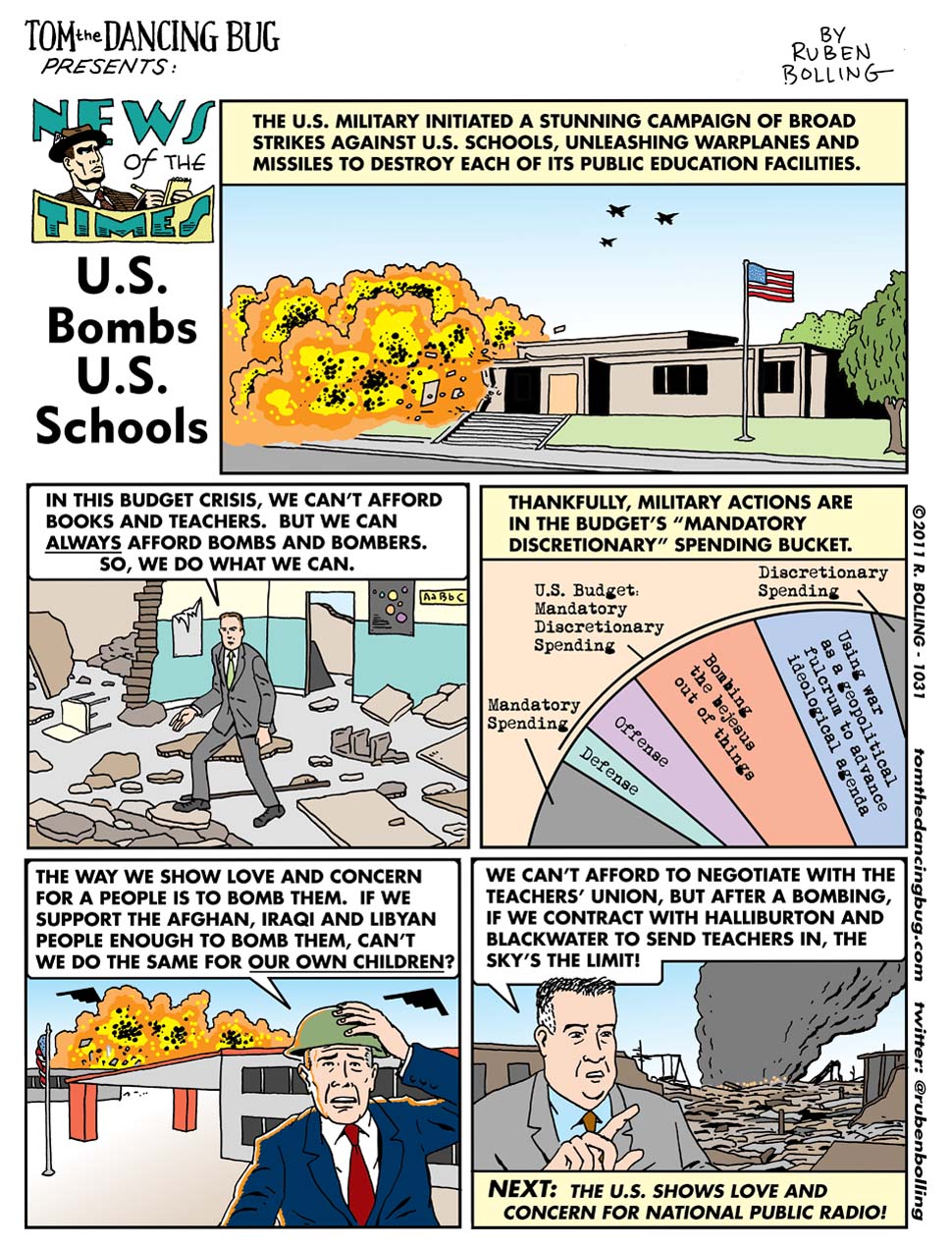
Why is the US unable to do anything re. Libya and elsewhere?
A picture is worth a thousand gazillion words:
It is awful that America went into the Middle East (Iraq) in 2003, when it was not at all warranted, and being trapped there and in Afghanistan has now choked us from being the champion of democracy when the struggle is as grassroots as one could have ever imagined. I suppose future historians won't be kind to America.
Labels:
afghanistan,
iraq,
libya,
obama,
US
Subscribe to:
Posts (Atom)