
Tuesday, November 30, 2010
Graphic of the day: the rich and taxes in 1941
click on the image from the NY Times for clearer and zoomed view

Climate change: the Andean glaciers
In my intro and upper division courses, the final piece of the puzzle, so to say, is almost always the impacts on the environment. I suppose I talk about these in the same dispassionately joking way that I discuss any of the topics. But, most students know well that it is one hell of a serious person buried under all that humor. (I wonder what the students will think if I told them that a faculty colleague accused me of not having a sense of humor--all because I questioned his pomposity! I suppose my students know me way better than most colleagues do!!!)
With water as the theme for Geography Awareness this year, I had highlighted a few water issues through a couple of videos. Apparently that caught the attention of a few students, at least. It is not the polar ice caps melting kind of scenarios that interest me. Because, I think students are by now "enough already with that" attitude--their lives have been saturated with real info, and hyperbolic rhetoric. I am, therefore, more interested in presenting to them the less discussed water and climate change issues. Like how the people in the Maldives are seriously thinking about relocating because of rising sea levels. Or, like the following one:
There are follow-up parts to this video here. I might have a chance to spend a week in Ecuador next summer. I hope that works out. But, I will be far from these glaciers--I am more a city and human experience guy!
Maybe I should show my class the following video of the underwater cabinet meeting that the Maldives government held to highlight the urgency:
With water as the theme for Geography Awareness this year, I had highlighted a few water issues through a couple of videos. Apparently that caught the attention of a few students, at least. It is not the polar ice caps melting kind of scenarios that interest me. Because, I think students are by now "enough already with that" attitude--their lives have been saturated with real info, and hyperbolic rhetoric. I am, therefore, more interested in presenting to them the less discussed water and climate change issues. Like how the people in the Maldives are seriously thinking about relocating because of rising sea levels. Or, like the following one:
There are follow-up parts to this video here. I might have a chance to spend a week in Ecuador next summer. I hope that works out. But, I will be far from these glaciers--I am more a city and human experience guy!
Maybe I should show my class the following video of the underwater cabinet meeting that the Maldives government held to highlight the urgency:
The latest edition of WikiLeaks: voyeurism by an anarchist
I am far from impressed with what has been reported from the latest WikiLeaks dump. "Pentagon Papers" this aint. I am all the more convinced now that Assange and WikiLeaks are, at best, hacker anarchists. There is nothing particularly bad at being an anarchist. But, pretending that this is all in the public interest and nothing but, and the world's papers going along with that song is, well, like the warm piss on oneself on a cold day!
I like what Spiked has:

I like what Spiked has:
This idea that the publication of private conversations and communications is in the public interest – whether it’s done by tabloids or by sanctimonious candidates for the next Pulitzer Prize – is a self-serving attempt to present voyeurism as an important public duty. It is not unlike the claims made by reality TV producers, who frequently argue that their tawdry offerings ‘raise awareness’ and serve the ‘public interest’.
How is the public interest served by the purposeless leaking of information? Since when has it been obligatory for institutions to expose their private deliberations to everyone on the internet? Has the public learnt something important from all this? Has some wrong been put right by the mass dumping of communiqués on to the world wide web? Or is this really a case of the narrow interests of the news organisations involved getting confused with the interests of the public?
Monday, November 29, 2010
Stat/quote of the day: America's military spending
The U.S. defense budget is now about the same as military spending in all other countries combined.That is Gregg Easterbrook (ht) writing about the out of control defense budget, which grows even despite mounting concerns over the deficit and debt. Even under Barack "Change" Obama's presidency:
This year, the United States will spend at least $700 billion on defense and security. Adjusting for inflation, that’s more than America has spent on defense in any year since World War II—more than during the Korean war, the Vietnam war, or the Reagan military buildup. Much of that enormous sum results from spending increases under presidents George W. Bush and Barack Obama. Since 2001, military and security expenditures have soared by 119 percent.And then Easterbrook has this nugget way towards the end of his essay, which has plenty of specifics:
The mindset of top-heavy spending has also infiltrated the realm of counterterrorism and intelligence. For security advice, the president now has a secretary of defense, a secretary of state, a director of national intelligence, a national security adviser, a Central Intelligence Agency, a National Security Council, a President’s Intelligence Advisory Board, a National Security Agency, a Defense Intelligence Agency, separate Air Force, Navy, Marine, Army, and even Coast Guard intelligence commands, a National Counterterrorism Center, an FBI Directorate of Intelligence, a State Department Bureau of Intelligence and Research, a National Reconnaissance Office, and a National Geospatial-Intelligence Agency. Even the Treasury Department has an Office of Terrorism and Financial Intelligence.
The specter of terrorism obviously required an improvement in intelligence. But spending for the sake of spending doesn’t make the nation any safer, while multiple overlapping bureaucracies may only slow reaction time. The new security hierarchies are sagging under the weight of senior-grade officials who spend much of their time in turf battles. Recently, the director of national intelligence, Dennis Blair, resigned after just 16 months on the job, after a sandbox squabble with the CIA over whose name comes first on memos. If that’s how people at the top of the security hierarchy are behaving, imagine how those in the middle are wasting the public’s time.
More on the ponzi scheme, er, graduate school!
Even if students did want to know, job-placement information would be hard to get. Most academic departments in the arts and sciences at universities nationwide don't share those data with students, because they don't keep close track of their Ph.D. graduates. Since prospective students don't demand it, departments don't collect it. And in this vacuum, some departments say they are reluctant to be the first to put their records out there, because they don't know how they would compare. The National Research Council wanted to use job-placement data in its latest rankings of doctoral programs but abandoned the idea when it realized universities didn't have the numbers.That sentence about faculty preferring to teach graduate students more than undergrads is one hell of an understatement in the report from the Chronicle of Higher Education. That preference, and a "status" that goes with grad programs, is also why even our university has grad programs in a few fields. It is a shame that we continue with such schemes :(
...
"Program by program, the placement data provided over the last couple of years have been pretty pathetic," says Peter Conn, an English professor at the University of Pennsylvania and a former interim provost there. "It is not in the graduate faculty's interest to advertise the very, very mediocre results we have been having in Ph.D. programs, particularly as opposed to professional schools. Faculty like teaching graduate students more than they like teaching undergraduates, and graduate students provide them with participants for their seminar classes."
And how about this:
Even academic departments that are ahead of the curve in providing information do not always disclose everything that prospective students might want to know. Because it doesn't want to embarrass anyone, Michigan's English department does not publish information about graduates who don't get jobs. And, like most academic departments, it doesn't say how many students drop out before earning their Ph.D.'s.Ah, yes, higher education is all about the pursuit of truth!
The ‘other’ India fails to get much attention from the West
During the last presidential primaries, Sen. John Edwards, who has since disappeared from the political radar, constantly referred to “two Americas” — one America that struggles to get by and lacks political clout, and another that has plenty of everything, including the ability to shape government policies. While this duality is subject to debate, such a schism is certainly visible all the way across the planet — the “First World” India of commerce, call centers and high technology, versus the poor and backward millions of “Third World” India.
After being ignored by successive American governments all through the Cold War, India now gets considerable attention. We have now had three successive, and successful, presidential visits by Presidents Clinton, Bush and Obama. Of course, the economic and geopolitical angles are what interest the United States, and it is this “First World” India that we are increasingly familiar with. It is also thanks to such a familiarity that NBC now features a sitcom, “Outsourced,” whose context is India and its call centers.
And when the media report about the world’s first billion-dollar house, which will be home to the family of India’s richest individual, Mukesh Ambani, we are certainly impressed — and perhaps made a little insecure, too, by rapidly growing prosperity in a country that for years did not rank that much higher above Ethiopia in our mental impressions of poverty on the planet.
However, poverty has not really gone away; it is, unfortunately, alive and well in “Third World” India.
While it is true that rapid economic growth has lifted quite a few million Indians from poverty, the poor are by no means an insignificant minority. A multidimensional poverty index used by the United Nations Development Program counted 421 million people living in acute poverty in eight Indian states, exceeding in sheer numbers the 410 million in the 26 poorest African countries combined.
This is a staggering number of poor people, a number that does not show up in our calculated economic and geopolitical interests in India. Even those skeptical about the accuracy of the UNDP estimates will not find it difficult to imagine that the number of poor in India will be in the hundreds of millions.
Over the years, this parallel existence of an India that is poor has also resulted in a growing radical and violent movement, whose members are referred to as Maoists. Yes, Mao — as in China’s Mao Zedong, who has been pushed aside ever since Deng Xiaoping opened the Chinese economy in 1979 and declared that “to be rich is glorious.”
It is no surprise that India’s Maoists are active in the same states that are home to the vast numbers of poor tallied in the UNDP study of poverty. Decades ago, in a much poorer India, Maoist “rebels” were present in other states, too.
During my childhood, the adults in the family often spoke in hushed tones about a much older cousin of mine who had suddenly dropped out of college and gone “underground.” As a kid who only knew the literal meaning of the word, I didn’t understand then that “underground” meant that he had joined the radical, and often violent, communist groups.
But now, such groups are almost nonexistent in the southern parts of India that I visit — these states boast of homegrown multinational computer and automobile corporations. Maoists have long exited these regions, which have experienced economic growth and prosperity, and where governments offer considerable support for the economically and socially disadvantaged.
It is also not a mere coincidence that this cousin later on completed his college education, had a successful banking career, and is now a retired grandfather.
It is time for my next trip to India, and it includes spending a couple of days at a conference that will be held in one of those eight states with high poverty — Orissa. The focus of this academic conference is on rural laborers who, without land, property and political weight, find themselves in precarious economic situations.
Through the conference papers and a little bit of traveling, I hope to understand this “other” India, even as I spend most of my time in the successful “First World” India and report as your correspondent.
Published: Monday, Nov 29, 2010 05:01AM
Sunday, November 28, 2010
Hey coffee addicts, add some sugar too :)

Sometimes with cream and sugar.
Sometimes black.
Sometimes it is a cappuccino.
So, naturally, I am delighted with this news:
A cup of coffee activates attentiveness and memory if it is taken with sugar.University of Barcelona scientists found that taking caffeine and sugar together boosts the brain’s performance - more than taking them separately.Researchers now believe each one boosts the effect of the other on brain functions such as attention span and working memory, the Daily Mail reports.
Time for a cortado then :)
Quote of the day: Nuclear power and environmentalists
“I know the environmentalists will not be very happy with my decision, but it is foolish romance to think that India can attain high growth rate and sustain the energy needs of a 1.2 billion population with the help of solar, wind, biogas and such other forms of energy. It is paradoxical that environmentalists are against nuclear energy”
Ramesh is no simpelton politician. Or, to transliterate an Tamil expression, not a "ஒன்னரை அனா" :) (can't figure out how to bring in the correct letters!) Which is why his statement has that much more weight. He has excellent educational credentials--from india's top tier undergrad to America's best univs. Ramesh is one of the technocrat-politicians, who are even more influential in China, who know well what they are talking about ...
Anyway, back to the nuclear power question. The enormous need for energy is real. The constraints imposed by coal and petroleum and natural gas are real. And, it is absolutely the case that with current technology and prices, we can't produce anything significant from solar or wind power ... and the fact that we need to square this off against global warming/climate change is undeniable. Which then brings the nuclear question to the front. Of course, the Greenpeace founder took quite a beating from environmentalists when he made the same arguments a couple of years ago; remember? What did he write? Ahem:
Nuclear energy is the only large-scale, cost-effective energy source that can reduce these emissions while continuing to satisfy a growing demand for power.Is there any difference between this statement and the one from Ramesh? I think not.
Quote of the day: TSA and Stalin
Lavrenti Beria, Stalin’s notorious secret police chief, once said, “Show me the man and I’ll find you the crime.” The T.S.A. seems to operate on the basis of an adapted maxim: “Show me the security check and I’ll find you the excuse.”That was Roger Cohen in his NY Times column (ht).

This just gets better, er, worse:
There are now about 400 full-body scanners, set to grow to 1,000 next year. One of the people pushing them most energetically is Michael Chertoff, the former Secretary of Homeland Security.Oh crap!
Why stop at the airports? We can start installing them in malls, government buildings, and in the classrooms too!
And, of course, the dark irony here that the company behind these TSA porn scanners is Rapiscan!
Cohen writes:
Rapiscan: Say the name slowly. It conjures up a sinister science fiction. When a government has a right to invade the bodies of its citizens, security has trumped freedom.
The modern temple at Rourkela failed Orissa?
The fall term is coming to an end and the results of the learning are evident right in the questions in class. Like the one in the introductory course, from Mike, who, with his usual loud voice, asked from all the way in the back row, “so, how do things get going then? How does a poor African country also get rich?”
This is, after all, the question that the world has been grappling with, particularly since the end of World War II, when newly independent countries were born with immense challenges of economic development. Mike’s genuinely interested, and yet puzzled, question is the latest along this global struggle to figure out a formula for development.
Since its independence in 1947, India has been a living laboratory to test out various hypotheses with the hope that the best solution would be found. One of those was a rather simple idea—if only the government could accelerate the process by systematically investing in modern economic activities.
That certainly was the case behind the planned industrial township of Rourkela, in the state of Orissa, which is one of the economic laggards in India—then and now. I should note here that Orissa was not always poor. Its history is rich—materially and culturally. Perhaps an easily demonstrable example, as I wrote in a column a few months ago, is the word “juggernaut” in the English language, which owes its origin to the Jagannath Temple located on Orissa’s coast along the Bay of Bengal.
It was in Rourkela, located more than a thousand miles away from his home town in southern India, that my father pretty much began his engineering career more than fifty years ago. Soon after getting married, he joined a German firm, which was advising the Indian government in the construction of one of the largest industrial projects at that time—an iron and steel factory.
 India’s first prime minister, Jawaharlal Nehru, referred to modern enterprises like the Rourkela steel project as “temples of modern India.” It was more than rhetorical, in the sense that these new temples were expected to deliver tangible miracles to India’s millions. In the academic and policy language, these were “growth poles” that would catalyze economic growth in resource-rich but economically backward regions. Thanks to such initiatives, currently, Orissa accounts for, among others, about a tenth of all the steel produced in the country, and leads in the manufacturing of aluminum.
 After spending the first three-plus years of married life in Rourkela, dad took up a job in yet another “temple”—this time a thermal power plant complex in Neyveli, which also, incidentally, had German advisers. The move brought my parents and my grandmother back to their “home” state of Tamil Nadu.
Post-retirement, the city of Chennai, the capital of Tamil Nadu, has been home to my parents for almost thirty years now, and the city’s sobriquet, “Detroit of India,” is an easy clue about one of its major, and fast growing, economic industries.
In contrast to states like Tamil Nadu that have surged ahead, others like Orissa always seem to be playing catch up forever, despite their tremendous natural resources. The heavy industrial progress has not been matched by comparable advancements in the rural areas, which is where nearly 85 percent of the population lives. Estimates are that of the nearly 37 million people in Orissa, about 46 percent live below the poverty line. In some parts of the state, incidence of poverty exceeds 70 percent!
It is almost as if most of the Oriyas, as the people of Orissa are referred to, are still waiting for the payoff from the massive investment in places like Rourkela. As a recent report from the United Nations’ World Food Program pointed out, “there is a major concern with the failure of that growth to translate into a somewhat proportionate reduction in poverty and malnutrition.”
Though I am disappointed that a field trip to Rourkela won’t be possible, given the more than 200 miles distance from the conference venue in Orissa’s capital city—Bhubaneshwar—at the end of it all, I hope to be able to offer a lot more to students like Mike.
Friday, November 26, 2010
Why does god hate Haiti?
Religious believers tend to assume that all atheists are alike. I suppose only atheists know that we are all very different in our socioeconomic and political outlooks. For instance, the most visible face among atheists, Christopher Hitchens, might not have a whole army of atheists ready to take up the arms along his side, whether in Iraq or in Iran. Equally interesting an intellectual is Heather Mac Donald who is at an interesting intersection of atheist outlook and libertarian-Republican politics. She writes, in the context of Haiti and the latest of its problems, cholera:
Haitian-Americans in a Catholic parish in Queens, NY, have been ecstatically praying since an earthquake wiped out an estimated quarter-million of their island countrymen 10 months ago, following which Hurricane Tomas unleashed cholera in the survivors’ tent camps:Yes, here is to hoping that Haiti's sufferings will soon end
Certain women in [the] parish say so many Hail Mary’s on their own that [the pastor] no longer assigns them the prayers as penance for sins . . . In October, people packed into SS. Joachim and Anne, chanting and dancing and holding sick relatives’ pictures heavenward for healing.Good luck with that.
(The New York Times displays the usual nauseating agnosticism towards the religious delusions of the left’s favored victim groups:
On a Saturday night in the basement of [the] mostly Haitian church in Queens, in a bare white room vibrating with hymns and exclamations, a young woman may find herself channeling the Holy Spirit to reveal news from Haiti.Oh, really? Yet let a Tea Partyer question the efficacy of deficit spending, and the Times will be certain at the very least to offer a contrary view.)
On this Thanksgiving Day, I am grateful for the human ingenuity that tries to foil such tragic Acts of God as the Haitian earthquake through heroic feats of engineering, and when such preventive efforts fail, that tries to save as many surviving victims through medical science. I am grateful that human reason has conquered so much of the squalor and suffering that nature unleashes upon the world. I hope that Haiti’s suffering comes to an end through tolerance, honesty, enterprise, and discipline.
Happy Thanksgiving to all.
Thursday, November 25, 2010

Wednesday, November 24, 2010
The success that Gandhi had in India
The real magic of the Mahatma was not a trick of popular charisma, but in fact a deft ability to recruit, manage, and inspire a team of talented individuals who worked tirelessly in his service. Gandhi himself was one of the few people to recognize how this phenomenon worked. “With each day I realize more and more that my mahatmaship, which is a mere adornment, depends on others. I have shone with the glory borrowed from my innumerable co-workers,” he wrote in 1928 in Navajivan.An excerpt from a wonderful essay, after reading which I am all the more blown away with how effortlessly Gandhi was able to get so many talented, eager, and committed people to sign on to his ideas. One heck of a personality he must have had. Gandhi died barely 60 years ago, but the events of his life time now seem quite a few centuries old. At the speeds at which we seem to move now, it is all the more real when I think about Einstein's comment that future generations will find it impossible to believe that such a real life person in flesh and blood actually existed on this planet.
Recognizing this fact does not diminish the rare and valuable qualities Gandhi himself possessed. Rather, it acknowledges that great work is the product of collaborative processes, and that many hands working together toward a common purpose can achieve monumental results. In Gandhi’s case, it was the relationship between a visionary leader and the team supporting him—and their collective use of the right resources, such as the books in Mahadev Desai’s library—that paved the way for extraordinary and lasting accomplishments.
"First World" India v. "Third World" India
During the last presidential primaries, Senator John Edwards, who has since disappeared from the political radars, constantly referred to “two Americas”—one America that struggles to get by and doesn’t have political clout, and another that has plenty of everything, including the ability to shape government policies. While this duality is subject to debate, such a schism is certainly visible all the way across the planet—the “First World” India of commerce, call centers and high technology, versus the poor and backward millions of “Third World” India.
After being ignored by successive American governments all through the decades of the Cold War, India now gets considerable attention. We have now had three successive, and successful, presidential visits by Clinton, Bush, and Obama. Of course, the economic and geopolitical angles are what interest the US, and it is this “First World” India that we are increasingly familiar with. It is also thanks to such a familiarity that NBC now features a sitcom, Outsourced, whose context is India and its call centers.
And when the media reports about the world’s first billion dollar house, which will be home to the family of India’s richest individual, Mukesh Ambani, we are certainly impressed, and perhaps made a little insecure too, by the rapidly growing prosperity in a country that for years did not rank that much higher above Ethiopia in our mental impressions of poverty on the planet.
However, poverty has not really gone away; it is, unfortunately, alive and well in the “Third World” India.
While it is true that rapid economic growth has lifted quite a few million Indians from poverty, the poor are by no means any insignificant minority. A multidimensional poverty index used by the United Nations Development Program (UNDP) showed that the 421 million living in acute poverty in eight Indian states exceed in sheer numbers the 410 million in the 26 poorest African countries combined.
A staggering number of poor, which does not show up in our calculated economic and geopolitical interests in India! Even those skeptical about the accuracy of the UNDP estimates will not find it difficult to imagine that number of poor in India will be in hundreds of millions.
Over the years, this parallel existence of an India that is poor has also resulted in a growing radical and violent movement, who are referred to as Maoists. Yes, the Mao as in China’s Mao Zedong, who has been pushed aside ever since Deng Xiaoping opened up the Chinese economy in 1979 and declared that “to be rich is glorious.”
It would not be a surprise, therefore, that India’s Maoists are active in the same states that are home to the vast numbers of poor tallied up in the UNDP study of poverty. Decades ago, in a much poorer India, Maoist “rebels” were present in other states, too. During my childhood, the adults in the family often spoke in hushed tones about a much older cousin of mine who had suddenly dropped out of college and gone “underground.” As a kid who only knew the literal meaning of the word, I didn’t understand then that “underground” meant that he had joined the radical, and often violent, Communist groups.
But now, such groups are almost nonexistent in the southern parts of India that I visit—these states boast of homegrown multinational computer and automobile corporations. Maoists have, hence, long exited these regions, which have experienced economic growth and prosperity, and where governments offer considerable support for the economically and socially disadvantaged. It is also not a mere coincidence that this cousin later on completed his college education, had a successful banking career, and is now a retired grandfather!
Tuesday, November 23, 2010
Remembrance of things past
All the way from 1979! A couple of years into my teenage years. I suppose one needs to understand the contexts for why I still remember this song so much, and enjoy it even now :)
I do not recall watching this movie. I wonder why. But then I don't recall watching very many movies anyway, other than the ones at the outdoor club ... boy, am I getting old, if I am recalling events from 31 years ago!
I do not recall watching this movie. I wonder why. But then I don't recall watching very many movies anyway, other than the ones at the outdoor club ... boy, am I getting old, if I am recalling events from 31 years ago!
The crazy North Korean government!
This past Veterans Day, one of the students, "D," talked to the class about his service in the military, and focused on his duty in the Korean DMZ. "D" was a 18-year old soldier selected to serve in the inner rings of the DMZ and was, thus, witness to a crazy series of incidents--the "axe murder incident"--that left his captain and lieutenant dead. "D" said that for quite a few days they were on full alert, prepared for an all out war, all over again.
But, and thankfully, that war didn't break out.
According to "D", and the few readings that I did later, this bizarre North Korean attack was to consolidate the ascent of Kim Jong-il. Now, it is Kim Jong-il's time to hand over the controls to his anointed successor--his son, Kim Jong-un The timing of this latest bizarre attack can be at least partially attributed to this succession.
The NY Times:
But, and thankfully, that war didn't break out.
According to "D", and the few readings that I did later, this bizarre North Korean attack was to consolidate the ascent of Kim Jong-il. Now, it is Kim Jong-il's time to hand over the controls to his anointed successor--his son, Kim Jong-un The timing of this latest bizarre attack can be at least partially attributed to this succession.
The NY Times:
Analysts say the regime may be trying to ensure that the Kim family dynasty continues for a third generation by winning the loyalty of the powerful military with shows of force.Time:
Monday, November 22, 2010
Woody Allen predicted the TSA scan porn ... kinda :)
In providing this hilarious Woody Allen video clip (from Bananas), Reason notes that all along we had the "solution to the problems posed by the underwear bomber" :)
America's Finest News Source will be on TV :)
Watching this video at the Onion, I wasn't sure if this, too, was a satire:
Onion News Network - Coming To IFC January 21
But then, there are news items, such as this one:
Onion News Network - Coming To IFC January 21
But then, there are news items, such as this one:
IFC plans to premiere Onion News Network and another new comedy series Portlandia back-to-back on Friday, Jan. 21. The network, part of Cablevision's Rainbow Media program unit, said Friday that the shows will debut that day in the 10pm and 10:30pm time slots, respectively. IFC previously also debuted The Increasingly Poor Decisions of Todd Margaret on Friday night, has been the go-to night for its comedy premieres under its "Always On. Slightly Off" slogan.News, satire, comedy, politics, internet, television all merging. Maybe this is the convergence that led AOL and Time Warner to merge; too bad they couldn't make money of it .... muahahaha
It does not come easily
कष्टं कर्मेति दुर्मेधाः कर्तव्याद्विनिवर्तते ।
न साहसमनारभ्य श्रेयः समुपलभ्यते ॥- हरिहर सुभाषितIdiots give up on a task assuming it would be tough to complete it. They do not understand that fame/success can come only when you start tasks (and complete it).
- Harihara Subhashita
Sunday, November 21, 2010
Joke of the day: Psycho
So, there I was funnily analyzing what triggered the transformation of a young Norman Bates into a psychopath. And here it is
Little Norman was born into well to do family, whose friends were rich enough to have butlers at home.
The family would often visit with their friends over the weekends. And it was the butlers who, without their knowing, made a killer out of the playful and friendly Norman.
Why?
Because, the butlers always announced the arrival of the family as:
Mister Bates, his wife Missus Bates, and their son Master BatesMuahahahaha
Though, I am sure that I am not the first one to have thought about this. But, hey, so what if I am late to the party!
The forgotten radical founder: Thomas Paine
How important was Thomas Paine and his Common Sense to the American Revolution and the founding of these United States of America? Here is Brendan O'Neill, reporting from New York:
to the American Revolution and the founding of these United States of America? Here is Brendan O'Neill, reporting from New York:Prior to the publication of Paine’s Common Sense in America in January 1776, only around a third of the delegates to the Continental Congress, the political body of the American Revolution, supported separation from Britain. The rest wanted only for the ‘mother country’ to grant its American subjects more rights and to ease the tax burdens. As late as 1775, the year before Common Sense was published, George Washington was still toasting George III after dinners and Thomas Jefferson said: ‘There is not in the British Empire a man who more cordially loves a union with Great Britain than I do.’How easily we forget, eh ...
Paine changed all that. This Englishman, not yet 40 and of no significant social standing, argued in Common Sense for the immediate and complete separation of America from Britain. ‘Even the distance at which the Almighty hath placed England and America is a strong and natural proof that the authority of one over the other was never the design of heaven.’ Ridiculing Britain’s hereditary principle and imperfect democracy, Paine urged Americans to ‘make a true revolution of their various struggles’ (3), and to create a single nation state with a government constituted for ‘respublica... or the public good’, in which there should be a Bill of Rights and ‘above all things, the free exercise of religion according to the dictates of conscience’ (4).
Americans read it in their thousands. A New Yorker wrote to his local newspaper: ‘This animated piece dispels, with irresistible energy, the prejudice of the mind against the doctrine of independence, and pours in upon it such an inundation of light and truth as will produce an instantaneous and marvellous change in the temper, in the views and feelings of an American.’ Within months, Jefferson made his Declaration of Independence, and Paine joined Washington’s armies against Britain as a kind of intellectual soldier, writing a 13-volume series called The American Crisis in the bloody era of 1776 and 1777. If Common Sense helped to give rise to the desire for independence, The American Crisis sustained it in the face-off with the ‘mother country’. ‘These are the times that try men’s souls’, wrote Paine (as quoted by Obama in his inauguration address in 2009).
Not content with having created an intellectual ‘land-flood that sweeps all before it’ in America, as one of his readers put it, Paine later went to France and stirred things up there too. His defence of the French Revolution, The Rights of Man, published in 1791 (part one) and 1792 (part two), was burnt by conservatives in Britain, and devoured by radicals in France. Paine later co-authored the French revolutionaries’ Declaration of the Rights of Man and of the Citizen and was elected to the French National Convention (where he had to have his speeches read out by other people, on account of the fact that he didn’t speak French).
A floating power plant?
A most intriguing news report I read today:
What a story at so many levels ... I had no idea that there could be such ship-based power generation plants! and then issues such asThe world's largest ship-based power plant has arrived off the Pakistani coast to try to mitigate the country's chronic electricity shortages, a company official said on November 19.
The new supply still won't come close to ending electricity shortages that plague Pakistan, increasing widespread public frustration with the U.S.-allied government as it struggles to contain the Taliban insurgency.The ship, which burns furnace oil, will generate about 230 megawatts for the national power grid, said Asad Mahmood, a spokesman for the vessel's Turkish owner Karkey Karadeniz Electrik. The owner has a five-year contract with the Pakistani national power company.Now anchored off the southern port city Karachi, the Kaya Bey will begin feeding into the national grid within four weeks after a dedication ceremony on November 21, Mr. Mahmood said.The ship's contribution will only make a dent in the overall power crisis. Pakistan's energy demands outstrip supply by an estimated 5,000 MW, thanks to a lack of investment, soaring usage and a crumbling electricity generation infrastructure that heavily relies on hydropower.
the state of infrastructure in PakistanI was curious about this ship-based power generation. It just sounds way too surreal. To be able to generate 230 MW? Turns out that this is old news, and there are even proposals like:
the effects of internal unrest and floods
the growing energy needs in the developing countries
technological solutions--as in a ship-based power generation!
Scientists at Cambridge University have outlined a 20-year master plan for the “global rebirth” of nuclear energy.Something new everyday, eh! As Johnny Carson used to say, "I did not know that" :)
The two-stage plan involves giant, ship-borne power plants moored next to cities
Saturday, November 20, 2010
The "god" debate next week: Hitchens v. Blair
November 26th is the day that Christopher Hitchens and Tony Blair will debate the following resolution:
Be it resolved, religion is a force of good for the worldIf one should wonder whether Hitchens will be well enough, given the intensity of the cancer treatment that he is undergoing, here is an update in this report in the Guardian:
The debate begins at 7:00 pm Toronto time. Should be an interesting one. I hope a former student, who is now pursuing graduate studies in philosophy in Toronto, will attend the debate; but, I bet the event was sold out long time ago. Well, I would rather that she focused on her term papers :)Whatever his health regime, it doesn't appear to have affected his work levels. The pugnacious weekly Slate column, the far-reaching literary essays for the Atlantic Monthly, and the Vanity Fair dispatches are all filed on time. And he continues to participate in public debates. Last month in New York he sliced through the Islamic scholar Tariq Ramadan's problematising evasions with stinging precision, and later this month he's taking on Tony Blair in Toronto.

Friday, November 19, 2010
Do elementary school teachers need master’s degrees
From the Chronicle of Higher Education:
In a speech at an American Enterprise Institute forum on Wednesday, the secretary of education, Arne Duncan, said state and local governments should rethink their policies of giving pay raises to teachers who have master’s degrees because evidence suggests that the degree alone does not improve student achievement.This is a familiar territory in this blog; back in September 2009, I blogged, citing Matt Yglesias, questioning the logic behind paying teachers more if they have graduate degrees. It adds on a huge cost to taxpayers, with no returns on this premium.
Photo of the day: not from Playboy :)
 The elections ended. I wondered then where the next source for comedy would come from, and the TSA porn happens.
This meme is like the cops/doughnut and Bill Clinton/sex themed jokes--I will keep laughing away forever :)
The photo on the right is from the Denver Post (ht). Think again: do you really want to fly, ever?
Quantitative Easing: an episode from the Twilight Zone?
This is simply hysterical; see if you can watch it without laughing louder than a hyena :) (ht)
Paul Krugman has drawn out all his weapons and calls the opposition to QE2 the "axis of depression"

Paul Krugman has drawn out all his weapons and calls the opposition to QE2 the "axis of depression"
Have the terrorists exposed America's Achilles heel?
Ever since the incidents of 9/11, the US has been on a warpath in the domestic front--with security. Looking back, it now seems like the disgusting coinage of "homeland security" was nothing trivial. It has evolved into an uncontrollable police state, writes Megan McArdle:
Have the TSA screenings ever resulted in would-be terrorists being apprehended?

Yes, it is wishful thinking. Because, as in police states, we the people comply without protest.It seems to me that the TSA ratchets up the security the way a government in a police state would. Perhaps there are some public deliberations that I'm missing, but from the perspective of a passenger, there's no attempt to achieve balance. There's simply a progressive ratcheting of our liberty ever downward. Did Richard Reid try to put explosives in his shoes? Then we must have our shoes scanned--even infant shoes too small to blow anything up. Did someone else attempt to set his underwear on fire? Well, if you can't strip them down to their skivvies for a check, do the next best thing: find a machine that does it virtually.
Somehow, this seems like a questionable reaction to two attacks that failed. Especially since they failed for the same reason that any similar attack is likely to fail: the amount of explosives you can smuggle in your underwear or shoes is necessarily small, meaning that you need to be in the cabin to detonate them if you want to be sure that you'll bring the plane down. And it's really hard to set your underwear, or your shoes, on fire without your fellow passengers noticing. In Asia, I've never been required to have my shoes scanned--not even to get on a US bound flight. And yet, we have not been confronted with a rash of exploding planes out of Taipei or Saigon.
The TSA seems to have assumed that the ratchet could keep moving downward indefinitely (notice that they never seem to find ways to make searches less invasive and annoying.) I think that the backscatter/invasive search deployment may finally have gone too far--although I freely admit that this may be wishful thinking.
Have the TSA screenings ever resulted in would-be terrorists being apprehended?
Citing national-security concerns, the TSA will not point to any specific cases in which a screener stopped a would-be terrorist at a checkpoint. Nonaffiliated security experts, such as Bruce Schneier (who coined the term "security theater") argue that that's because this has never happened.Anything else on the efficacy of the TSA?
What's more, the GAO noted that at least 16 individuals later accused of involvement in terrorist plots flew 23 different times through U.S. airports since 2004, but TSA behavior-detection officers didn't sniff out any of them.
What these numbers don't get at is whether the TSA airport screeners prevent terrorist attacks through their very existence—deterring plots by hanging around. This is quite probably the case, but it's not obvious that they prevent any more attacks than the private contractors who handled checkpoints before the Aviation and Transportation Security Act of 2001 went into effect.
Thursday, November 18, 2010
LSU professor's rant, and the secret videotaping
Apparently a LSU professor was secretly videotaped by "a representative of the group Campus Reform, a project of the Leadership Institute, a Virginia-based group that trains conservative activists." And then an edited version became a rallying cry about the liberal agenda!
Forget the liberal v. conservative issues. This does not come across as a good example of teaching at all. Oh well, I have faculty colleagues who, according to some students, use even the "f" word during therant lectures.
But, secret videotaping?!!!
Forget the liberal v. conservative issues. This does not come across as a good example of teaching at all. Oh well, I have faculty colleagues who, according to some students, use even the "f" word during the
But, secret videotaping?!!!
This is the full, unedited, and uncaptioned video of Professor Bradley Schaeffer's astronomy class. Watch and judge for yourself.
Wednesday, November 17, 2010
Cool it!
Bjorn Lomborg's movie, that is ... I am sure my cred, which is already way low down among my esteemed faculty and administrative colleagues, will sink further if any of them should read this blog post .... after all, it is mostly heresy in typical academic circles to talk up Lomborg!
Over the summer, when The Guardian initially reported that Lomborg has done a complete reversal of his arguments, I was taken aback. That did not seem to be consistent with Lomborg's approach at all. Later, as I read more in other publications, it was clear that Lomborg is merely fine-tuning his arguments, which are essentially that there are lot more beneficial, and less costly, approaches that we need to address first. Lomborg writes:
Over the summer, when The Guardian initially reported that Lomborg has done a complete reversal of his arguments, I was taken aback. That did not seem to be consistent with Lomborg's approach at all. Later, as I read more in other publications, it was clear that Lomborg is merely fine-tuning his arguments, which are essentially that there are lot more beneficial, and less costly, approaches that we need to address first. Lomborg writes:
Fully implementing the Kyoto Protocol—the last comprehensive carbon cut treaty that the world had—would have cost hundreds of billions every year in lost economic growth. And even if it had been fully implemented across the century—a far shot from what has actually happened—it would only have reduced temperatures by less than one-third of one degree Fahrenheit in 100 years.
The reason for this is that alternative energy technologies are far from ready to take over from fossil fuels. If green technology is not ready to take up the slack, then forcing carbon cuts through taxes will simply hurt growth and development—particularly painful to developing nations.
World-wide public spending on research and development for clean energy technologies is a paltry $2 billion a year. Increasing this to $100 billion a year could be a game-changer. Not only would it be almost twice as cheap as the $180 billion a year cost of fully implementing Kyoto, but the effect of this kind of spending would be hundreds of times greater.
Oprah plans for after death, for her fans too!
As always, America's Finest News Source is the only one to report on this story :)
The Maury Povich comment at the end is just fantastic
Oprah Invites Hundreds Of Lucky Fans To Be Buried With Her In Massive Tomb
The Maury Povich comment at the end is just fantastic
Oprah Invites Hundreds Of Lucky Fans To Be Buried With Her In Massive Tomb
Tuesday, November 16, 2010
Hajj and Eid
From a slide show at FP
 caption at the source:
Muslim pilgrims perform the evening prayer near the Grand Mosque in the holy city of Mecca, Saudi Arabia on Nov. 12. The annual pilgrimage, or hajj, must be performed at least once in their life of all believers who have the health and the means to make the journey.
Monday, November 15, 2010
TSA all over on Twitter: very funny :)
I suppose "Don't touch my junk" will be way more viral than "Don't tase me, bro" ... Twitter has been a godsend in how we are able to get our frustrations out, and sometimes in a funny way. Here are some I came across:
Ok. Will stop here.
ACLU has a site up and running, to collect particulars on TSA abuse. Click here if you want to report your experience.

Janet Napolitano's memoirs: The Audacity of Grope
We're having a debate over placing tip buckets next to the groping station
It's not a grope. It is a freedom pat.
TSA fortune cookie: You will be touched in a special way
Why is TSA like AT&T? They both want to reach out and touch someone
Another false positive: it wasn't a bomb but a bad case of hemorrhoids
Ok. Will stop here.
ACLU has a site up and running, to collect particulars on TSA abuse. Click here if you want to report your experience.
"Don't touch my junk"
More from Reason:
For the camera-shy, TSA will offer an alternative: "enhanced" pat-downs. And you'll get a chance to have an interesting conversation with your children about being touched by strangers. This is not the gentle frisking you may have experienced at the airport in the past. It requires agents to probe aggressively in intimate zones—breasts, buttocks, crotches. If you enjoyed your last mammography or prostate exam, you'll love the enhanced pat-down.
Reviews of the procedure are coming in, and they are not raves. The Allied Pilots Association calls it a "demeaning experience," and one pilot complained it amounted to "sexual molestation." The head of a flight attendants' union local said that for anyone who has been sexually assaulted, it will "drudge up some bad memories."
But the option of the full-body scanner is not so appealing, either, even leaving out privacy concerns. Two pilots' unions have advised members not to go through the scanners because of the possible risks of being bombarded with low doses of radiation.
"There is good reason to believe that these scanners will increase the risk of cancer to children and other vulnerable populations," a group of scientists from the University of California at San Francisco informed the White House.
Sunday, November 14, 2010
Prick that higher education bubble. Soon.
Higher education, particularly here in Oregon, has been in an economic crisis for years now, and has resulted in it becoming an expensive investment, especially for those from lower-income backgrounds. To a large extent, it is only the private sector that can help out—by shedding the requirement of college education and degrees for many jobs where such expensive credentialing is not required.
Often, we operate with a misconception that community colleges are significantly less expensive than a teaching university like Western Oregon University (WOU) where I am employed, and that research universities will be the most expensive among public institutions.
It ain’t so!
Consider, for instance, the tuition rates at WOU and its two immediate neighbors, Chemeketa Community College and Oregon State University. For an Oregonian who is a full-time student taking fifteen credits per term, the annual tuition at Chemeketa will amount to $3,645, while it is $6,135 at WOU and $5,760 at Oregon State.
Of course, decrease in state support is a big reason for tuition increases in the public system. Rapid increase in non-academic expenditures is a significant factor as well.
In addition, over the years, government subsidizing higher education has also contributed to tuition increases. “Political Calculations” noted that between 1976 and 2008, there is “a really unique correlation between the average annual tuition at a four-year higher education institution in the United States and the total amount of money the U.S. federal government spends every year.”
Government's role in subsidized loans to students has an effect which is not that different from how low interest rates led to higher home prices during the real estate bubble years.
When monthly payment amount is a critical variable in the home purchase process, low interest rates make it possible for buyers to go after larger-value homes. However, soon the homeowners also sense this, and home prices are correspondingly adjusted upwards.
The later entrants to this crazy market do not realize that such a system will only help those who are already homeowners and, before they know it, those who joined this game towards the end find themselves "underwater."
In higher education, colleges and universities, like homeowners looking to sell in a bubble market, have been similarly adjusting their tuition upwards. The net result is that increasingly students now are like the late entrants to the real estate bubble, and end up graduating with debts, loans, and underemployment that do not justify the costs.
In higher education, colleges and universities, like homeowners looking to sell in a bubble market, have been similarly adjusting their tuition upwards. The net result is that increasingly students now are like the late entrants to the real estate bubble, and end up graduating with debts, loans, and underemployment that do not justify the costs.
In such a higher education bubble, we are wasting considerable individual and taxpayer investment through requiring college degrees for many jobs where such qualifications are way more than needed for productive performance.
One better model could be for employers to appropriately scale down the higher education requirements. And, by offering to pay for college courses as rewards for productivity on the job, they could actively encourage employees to value education as a life-long learning experience. After all, there is infinitely more to education than pecuniary calculations, which is why I teach, and that too in Geography!
Saturday, November 13, 2010
Quote of the day: Wang Meng on China
With per-capita G.D.P. still so paltry, the country is a paper tiger. The slightest stir of the wind and grass makes the government nervous. ... If only China gets to develop in peace for another twenty years, the the situation will be different. But now? ... Well, at least it seems we won't go back to the Maoist age.Sums it up well, right? That is the Chinese author/intellectual/politician Wang Meng
 in a wonderful profile-essay by Jianying Zha in the New Yorker (subscription required.) It is a fantastic essay that provides insights into how intellectuals fit in (or don't) with the Chinese government and politics. I had no idea about Wang Meng until I read this ... it is difficult to judge an intellectual's social and political role from outside the Chinese system, and the essay makes it clear that there are many opinions of him both within China and outside. But, one thing for sure: I want to check out some of his stories.
Friday, November 12, 2010
Party like there is no deficit!
The topic is pensions as one hell of a liability issue is not new to this blog. So, the following serves as an addition to the collection:

The football-academic complex called "universities"
A few years ago, there were all kinds of speculations that USC's star player, Reggie Bush, was being paid in violation of NCAA rules. It was a collective shrug of sorts as a response to such news.
Now, yet another star player and payments--this time at Auburn.
Oh well. A few decades ago, the president of the University of California system summarized what it means to keep a university going: parking for faculty, sex for students, and football wins for alumni. So, no point challenging the football-academic complex, which will find ways around any number of Congressional investigations.
Now, yet another star player and payments--this time at Auburn.
The fact that an amateur athlete allegedly soliciting a six-figure payment to secure his services barely raises the eyebrows of college football lifers only serves to highlight how insulated the college athletics echo chamber has become.A lot lies beneath these high profile news items. A lot more mundane stuff that goes unreported. Like courses with diluted standards to keep players within the passing grades ...
Oh well. A few decades ago, the president of the University of California system summarized what it means to keep a university going: parking for faculty, sex for students, and football wins for alumni. So, no point challenging the football-academic complex, which will find ways around any number of Congressional investigations.
Thursday, November 11, 2010
Damn Right! we are all waterboarders now
Dahlia Lithwick's piece, commenting on President Bush's candid admission that he okayed waterboarding, is a depressing read. She points out why some of us are troubled by this:
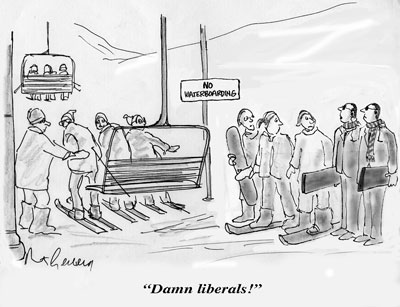
The persistent failure to hold anyone accountable at any level for years of state-sanctioned abuse speaks louder than their words. It has taken this issue from a legal question to a matter of personal taste. What we choose to define as torture is now just another policy disagreement, like extending the Bush tax cuts or picking a caterer. This is precisely the kind of sliding-scale ethical guesswork the rule of law should preclude.Lithwick articulates well the point that we fail to grasp: Waterboarding is not a policy option like tax cuts. She writes:
Indeed, as Andrew Cohen notes, when the men ordering the destruction of those tapes are celebrated as "heroes," who's to say otherwise? Check, please.All these mean then that we are all waterboarders:
All this was done in the name of moving us forward, turning down the temperature, painting over the rot that had overtaken the rule of law. Yet having denied any kind of reckoning for every actor up and down the chain of command, we are now farther along the road toward normalizing and accepting torture than we were back in November 2005, when President Bush could announce unequivocally (if falsely) that "The United States of America does not torture. And that's important for people around the world to understand." If people around the world didn't understand what we were doing then, they surely do now. And if Americans didn't accept what we were doing then, evidently they do now. Doing nothing about torture is, at this point, pretty much the same as voting for it. We are all water-boarders now.
The end of the world in 20 years: chocolate will become expensive
The world could run out of affordable chocolate within 20 years as farmers abandon their crops in the global cocoa basket of West Africa, industry experts claim.If that is not a sign of the coming end of the world!
"What the hell," you say? Why this crisis? It is actually a good thing.
But, how can this be good? Because it makes us wake up to the reality of cocoa production:
Farmers in the countries that produce the bulk of cocoa bought by the multinationals who control the market have found the crop a bitter harvest. The minimal rewards they have historically received do not provide incentives for the time-consuming work of replanting as their trees die off – a task that usually means moving to a new area of canopied forest and waiting three to five years for a new crop to mature."It's hard to maintain production at high levels in a particular plot of land every time, because of pest problems that eat away at the yields and the farms need to be rejuvenated," explains Thomas Dietsch, research director of ecosystem services at the Earthwatch Organisation. "Although research into new varieties and better management methods could solve those problems, the other challenge is that cocoa is competing for agricultural space with other commodities like palm oil – which is increasingly in demand for biofuels."Meanwhile, as the supply of the raw material diminishes, millions of new consumers in the developing world are becoming addicted to the sweet energy-fix at the end of the processing chain. "Chocolate consumption is increasing faster than cocoa production – and it's not sustainable," Tony Lass, chairman of the Cocoa Research Association, told the annual conference of Britain's Academy of Chocolate last month.Despite price rises on the trading floor, precious little reaches the smallholders who make up 95 per cent of growers, according to Mr. Lass, a former Cadburys trader and ethical sourcing advisor who has co-authored a book on the cocoa industry."These smallholders earn just 80 cents a day," he says. "So there is no incentive to replant trees when they die off, and to wait up to five years for a new crop, and no younger generation around to do the replanting. The children of these African cocoa farmers, whose life expectancy is only 56, are heading for the cities rather than undertake backbreaking work for such a small reward."

A contrast to this geography is the geography of consumption of cocoa.
As one might hypothesize, poor people don't eat a whole lot of chocolates nor do they drink chocolate milk by the gallons.
The following chart explains it all:

Is economics a science? Do we need to ask? :)
Economics aspires to be a science. But in this it does not succeed. Neither does finance. This despite the fact that there is an annual, optimistically named Nobel Prize in “Economic Sciences.”Thus begins Alex Pollock's essay, which, I hope, will trigger responses from academic economists so that people like me can have fun watching the fireworks :)
Financial crises keep happening—the list is long. Could they be avoided if economics and finance were science?
Ever since the onset of the Great Recession, the "scientific" nature of economics has been seriously doubted, and for all the good reasons, as even noted in this ill-informed blog. So, more the discussions on this, the better for our own understanding.
Pollock writes:
To forecast and, moreover, control the financial future correctly is literally impossible. This is because of the exceptionally complex and very rapid recursiveness of financial markets and the resultant Uncertainty. This “Uncertainty,” with a capital “U,” means, remembering the classic definition of economist Frank Knight, that you not only do not know the odds of events, but you cannot know the odds.In case you thought it was some left-wing publication where this essay appeared, NOT! Pollock is with the American Enterprise Institute.
Wednesday, November 10, 2010
Graph of the day: currency wars and competitiveness
Was it a month ago that I quoted Martin Wolf, who wrote in the Financial Times that:

Strong dollar? Ha!
To put it crudely, the US wants to inflate the rest of the world, while the latter is trying to deflate the US. The US must win, since it has infinite ammunition: there is no limit to the dollars the Federal Reserve can create. What needs to be discussed is the terms of the world’s surrender: the needed changes in nominal exchange rates and domestic policies around the world.In the graph below, the impacts even before the latest US Fed/Bernanke strategy which has pretty much the entire world up in arms
Strong dollar? Ha!
Tuesday, November 09, 2010
Stephen Colbert explains Rand Paul's Nothingness :)
| The Colbert Report | Mon - Thurs 11:30pm / 10:30c | |||
| The Word - Nothingness | ||||
| ||||
Dirty coal, clean future
That is the title of a calm and level-headed essay from James Fallows on how coal will dominate for quite a few more decades. But then when have his essays not been calm and level-headed, right? Fallows notes the horribly low energy efficiency of coal-fired processes even three centuries after James Watt's pioneering use of steam that is pretty much the symbol of the Industrial Revolution. But, coal is here and we better deal with it because CO2 keeps piling up above.
Why focus on coal on our way to cleaning up the air?
 Notice that one dot practically on the Oregon/Washington border? Apparently that could be closed down as early as 2020.
Why focus on coal on our way to cleaning up the air?
“I know this is a theological issue for some people,” Julio Friedmann of Lawrence Livermore said. “Solar and wind power are going to be important, but it is really hard to get them beyond 10 percent of total power supply.” He pointed out the huge engineering achievement it has taken to raise the efficiency of solar photovoltaic cells from about 25 percent to about 30 percent; whereas “to make them useful, you would need improvements of two- or threefold in cost,” say from about 18 cents per kilowatt-hour to 6 cents. He recited a skeptic’s line used about the Carter administration’s clean-energy programs—“You’re not going to run a steel plant with solar panels”—and then made a point that summarized the outlook of those who have decided they can best wage the climate fight by working on dirty, destructive coal.living in Oregon means we are lucky to enjoy hydroelectric power (it has a different set of environmental impacts) and we can even forget coal fired plants. It was a surprise to hear on the news the other day about plans to close down the only coal-fired power plant. Which left me wondering where it was. One student in my class knew about this--she grew up in a town that was practically across from this plant. The things I learn from students everyday, and they have no idea about the free education I am getting from them. One other student wondered where all those coal fired plants are in the US. Google gave me the following graphic:
“It is very hard to go around the world and think you can make any difference in carbon-loading the atmosphere without some plan for how people can continue to use coal,” Friedmann said. “It is by far the most prevalent and efficient way to generate electricity. People are going to use it. There is no story of climate progress without a story for coal. In particular, U.S.-China progress on coal.”
Subscribe to:
Posts (Atom)