Saturday, October 30, 2010

Americans do the right thing--after trying Republicans and everything else

Every once in a rare while Maureen Dowd writes something that is worth quoting; in her latest column, Dowd writes about President Obama:
In 2008, the message was him. The promise was him. And that’s why 2010 is a referendum on him. 
That is a neat way to summarize the dynamics of this election.  Which is also why it is bloody dangerous to have personality-driven politics and leaders.  Bill Clinton's re-election was not about Clinton the person at all--not with all that baggage he carried around.  But, during the campaign season, the stock that Obama sold was himself, and now as President he has a tougher problem making a repeat sale.

Meanwhile, Nicholas Kristof, who seems to have taken time off from the gruesome stories that otherwise he forces us to recognize, wants us to give Obama a break:
go ahead and hold Mr. Obama’s feet to the fire. He deserves to be held accountable. But let’s not allow economic malaise to cloud our judgment and magnify America’s problems in ways that become self-fulfilling.
I am not so sure about this argument. 

The problem is that the alternative, in terms of Republican leadership, is an even more pathetic joke.  If the GOP takes over the house, Kevin McCarthy will become number 3?  I remember him from my days in Bakersfield, and a few days ago I watched him on C-Span and the guy is as lacking as ever.  At least Bill Thomas, whose retirement paved the way for McCarthy, was a really sharp guy and, unfortunately, even more ruthless!

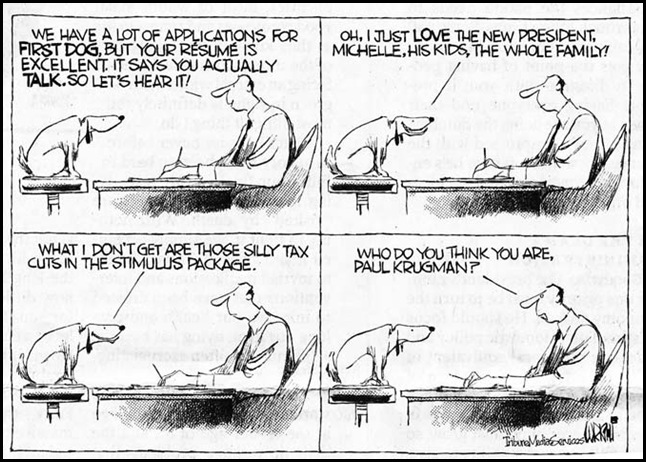
So, to some extent, I am with Paul Krugman who is worried about a Republican Congress:
This is going to be terrible. In fact, future historians will probably look back at the 2010 election as a catastrophe for America, one that condemned the nation to years of political chaos and economic weakness.
However, I wish, for the nth time, that Krugman would be less shrill and less hyperbolic, and engaged more like the economist he is; did he really have to write "Be afraid. Be very afraid" ...?


David Brooks lays out what Obama's problem is going to be if (when?) Republicans take over the House (and Senate?):
[If] Obama is to rebound, he is going to have to suppress his natural competitive instincts. If he gets caught up in the Beltway fight club, the Republicans will emerge as the party of limited government and he’ll emerge as the spokesman for big government — surely a losing proposition.
Thomas "master manipulator of metaphors" Friedman, too, has something sensible, for a change, when he writes on why this election matters, as he looks at it from India while talking with some of his favorites (does Friedman talk to the 400 million poor there, I wonder!):

It looks, said Srivastava, as if “what is happening in America is a loss of self-confidence. We don’t want America to lose self-confidence. Who else is there to take over America’s moral leadership? American’s leadership was never because you had more arms. It was because of ideas, imagination, and meritocracy.” If America turns away from its core values, he added, “there is nobody else to take that leadership. Do we want China as the world’s moral leader? No. We desperately want America to succeed.”
This isn’t just so American values triumph. With a rising China on one side and a crumbling Pakistan on the other, India’s newfound friendship with America has taken on strategic importance. “It is very worrying to live in a world that no longer has the balance of power we’ve had for 60 years,” said Shekhar Gupta, editor of The Indian Express newspaper. “That is why everyone is concerned about America.”
Well, we--in the US and in the entire world--will find out real soon.

My long term bets are always on the good ol' US of A.  As Winston Churchill said, “You can always count on Americans to do the right thing - after they've tried everything else.”  And with a Republican victory in the midterms, we would have exhausted everything, and we will start doing the right thing.
Music video for Halloween: MJ's Thriller, of course

The Mumbai McMansion: The Ambani Attila, er, Antilia

So, India's richest man builds the world's most expensive "home"
Mukesh Ambani is having a few friends round to celebrate moving into his new Mumbai pad. But as the home has 27 storeys, soars to 173 metres and is worth an estimated £630m, it will be a housewarming like no other.
The building – named Antilia, after a mythical island – will be home to Ambani, the richest man in India and the fourth richest in the world, plus his wife and their three children. It contains a health club with a gym and dance studio, at least one swimming pool, a ballroom, guestrooms, a variety of lounges and a 50-seater cinema.
Good for him--he and his brother, Anil, have not squandered away the wealth they inherited, but have gone on to multiply it many times over.

But, somewhere along the road, I hope the Ambanis will remember a golden rule from India: the "dharma" of a rich person is to create a lot of wealth, and to donate wealth to charity.  The old Indian wisdom recognized that creating wealth is not only ok, but is the duty for some.  But, what comes after that wealth .... something like the "noblesse oblige" in the Western contexts.  Here is one:

संपदो जलतरंगविलोल
   यौवनं त्रिचतुराणि दिनानि ।
शारदाभ्रपरिपेलवमायुः
   किं धनैः परहितानि कुरुध्वम् ॥
- सुभाषितसुधानिधि
Wealth is as temporary as a wave on still water. Youth is just a matter of few years. Our life it self is as uncertain as a cloud of Sharat month (where clouds could get formed and dispersed in a matter of minutes. No rain.) What is the use of all the wealth that you accumulate? Spend them in a way that is helpful to others.
A friend emailed me the link to this commentary, where the author notes:
What I would like to see Ambani do now is emulate Gates on another front: philanthropy.
Gates (and his wife), who have said their children will not inherit their wealth, have proceeded to give it away and also managed to successfully convince several other people like them to follow suit.
Given Ambani’s considerable wealth and influence, a similar move by him could kick-start the all-but-non-existent corporate philanthropy scene here.
BTW, Antilia? ... Seriously! 
I think "Attila" might be more appropriate :)
No wonder then there is this news item:

The house which has become the talk of the town — Mukesh Ambani's new high rise at Mumbai's posh Altamount Road, may soon sport a new name. Apparently, the quaint Antilia, according to insiders, doesn't have as much positive energy as the traditional occupants would like. However, nobody is quite sure yet as to what the new name of the 27-floor apartment would be, which is said to be the world's costliest address. The name is likely to be announced at a traditional function, followed by a high society gathering in the evening of November 28, at Ambani's new abode.

Don't vote: It Just Encourages the Bastards

"Politics is a vulgar fucking subject," O'Rourke writes by way of apology for his repeated swearing. "I have resorted to barnyard words because of the amount of bullshit, horseshit and chickenshit involved in politics,"
O'Rourke seems to be channeling his inner George Carlin :)

I heard him earlier this morning on NPR, and absolutely loved the way he described the politics of climate change; I find it at the Guardian, too:
Take his intentionally short chapter on the issue of climate change. It is one page and begins with the words: "There's not a goddamn thing you can do about it." By way of explanation he adds: "There are 1.3 billion people in China and they all want a Buick." He accuses western leftists of being self-deluding hypocrites when they raise taxes on people wealthier than themselves as a way of creating a more just society. It depends on your perspective, he argues, pointing out that even a poor westerner is unimaginably rich to a developing world slum-dweller."You're farting through silk as far as that person in Karachi who's looking for a job as a suicide bomber is concerned ... let he who is without anything anybody wants cast the first vote," he writes.
I have blogged about this many times (like here), and have pointed out the hypocrisy of a few million affluent Westerners telling billions of poorer people around the world that they and their consumption are the problem!

Of course, there are a number of issues where I would part company with O'Rourke.  But, there is a lot of common ground between this libertarian-Democrat and O'Rourke's libertarian-Republican view of the world.

And, BTW, that George Carlin spiel on not voting?  No harm on re-blogging that one; too damn funny and serious all in one

Quote of the day: on higher education

The vision of a college education that Hacker and Dreifus advance is as timeless as Cardinal Newman's classic 19th-century account, The Idea of a University. "College should be a cultural journey, an intellectual expedition," the authors write. A major like sport management or sign-language interpretation has no place in this vision: "It isn't education. It is training." What should colleges do? Make undergraduates "more interesting people," Hacker and Dreifus say.
So writes Professor David Kirp, of UC-Berkeley, while reviewing a couple of books on higher education, of which one is the recent book from Andrew Hacker and Claudia Dreifus, who list in their book Western Oregon University as one of the best places to get educated for the money spent.

Of course, as I have blogged earlier, and as difficult as it might be to imagine, the recognition from Hacker and Dreifus was not actually well received in the university.  Academe is a strange place where even compliments can become controversies :)

Anyway, I wonder if Hacker and Dreifus did all their homework then: the university where I teach, which they applaud, has a big sign language interpretation program, and a minor in sports management too.  If despite all that they are willing to applaud the university, then the state of most other American universities must be highly crappy, eh!

Quote of the day: on geography

Geography is the new hot discipline.  A new generation of geographers is integrating the myriad concerns of the world, whether economic or political, social or environmental.
That is Fred Pearce while reviewing a new book, The World in 2050.

Geography is a fantastic intellectual field of inquiry, where there is a natural recognition of the multiple factors that influence even a local issue.  And given the inter-linked, global, and complex set of issues that we often talk about--particularly when it comes to the big issues like climate change--geography, with its integrative approach, is naturally suited for those discussions.

Unfortunately, geography is like Rodney Dangerfield in that it doesn't get any respect.

In April 2011, I will be one of the panelists who will discuss this issue at the annual meeting of the Association of American Geographers.  What will our discussions be about?
Geography and the liberal arts and sciences are moving toward a mutually reinforcing, symbiotic relationship, largely for two reasons.  First, many of today's crucial problems are being recognized as the result of processes - political, economic, cultural, and ecological - unfolding at a global scale.   Second, geography has always been "the synthetic discipline," providing a context for integrative analysis of people, places, and environments.   Learning to think geographically is a process that engages concepts specific to the discipline of geography, but also one that complements a suite of cognitive abilities such as scientific inquiry, humanistic discourse, and critical thinking – all hallmarks of liberal education.

This panel session will explore ways of strengthening the role of geography in liberal education in the early 21st century.   Key questions for discussion will include:

1) To what degree does the undergraduate geography curriculum support the goals of liberal education?  Is the geography major as currently designed fulfilling the evolving needs of a liberal education?

2) How effectively are geography programs preparing majors with the knowledge, skills, and perspectives they need for successful careers in industry, business, government, or for continuing education?

3) What are the most-compelling intellectual and practical reasons for non-majors to take geography classes?

4) In what ways are geography programs succeeding in providing strong learning experiences and opportunities for students of all backgrounds?

5) Are geography programs failing to interface with institutional efforts to enhance liberal education, and if so, what can be done about it?
ht for the Pearce link

Oh, Pearce writes of the author of the book that is reviewed:
Smith is a major new writer on the new geography of the 21st century.  He is as fluent and insightful in discussing political power, cultural nuance, and ethical dilemmas as he is in analysing climate models and economic forecasts.  His study of the “new north” is valuable and timely.  Move over, Jared Diamond.

Friday, October 29, 2010

Elections and ... how about those wars?

It is an awful state of civics and democracy that the two wars, in Afghanistan and Iraq, which have horribly expensive both in material and human costs, have rarely been discussed this election campaign season.  There is something seriously wrong with this ... Instead of tough questions on the wars, and the many domestic topics, we are witness to all kinds of bullshit.
As much as I joke with my neighbor that political theater is the best entertainment that our taxes can get us, it is a shame that it is all entertainment and nothing else.
I am just so close to informing the election folks that I don't care for a ballot anymore
And then there are all kinds of discussions on a war with Iran. Are we f***king so messed up?

Mara Liasson's $2 million contract? :)

Way back, in February 2009, was my blog post that NPR should not renew the contracts with Juan Williams and Mara Liasson.  Well, she is the "other" NPR analyst over at Faux Noose, and I wonder if it is only a fistful of dollars that Roger "fat cat" Ailes is dangling in front of Liasson.

Thursday, October 28, 2010

Remembrance of things past: Ek duje ke liye

I didn't realize that this is now almost 30 years old, which is how long since I completed high school :)

Am not sure if I have those "mark sheets" with me, or if they have been lost in the shuffle somewhere ... All I remember is the aggregate score of 332 out of 400 (though that sounds way too low ... I scored only a 83 percent?  really?  maybe that is how scores were then? editor: did you consider the possibility that you were not all that smart, and maybe not even now?  Awshutup)

I am not sure whether I can sit through this movie now though--such an awful formula, leave alone the very strange outfits of that time period :)

Image of the day: on Juan Williams and NPR

I was one of the many who had opined that Juan "I fear Muslims" Williams ought to be fired from NPR as soon as I watched that video.  And, was glad that NPR did, though the "psychiatrist" remark ought to have been avoided.

Well, I came across this tweet today:
(on Twitter, I am "congoboy," which is how I sometimes called my dog, Congo, who died almost five years ago!!!)
I suppose Ceeb2 will be happy to know that my faculty and administrative colleagues decided that I am not qualified to be a "Professor" and I am only an Associate Professor :)

How Winston Churchill starved India. Literally :(

Soutik Biswas writes in reviewing Madhusree Mukherjee's Churchill's Secret War:
Some three million Indians died in the famine of 1943. The majority of the deaths were in Bengal. In a shocking new book, Churchill's Secret War, journalist Madhusree Mukherjee blames Mr Churchill's policies for being largely responsible for one of the worst famines in India's history.
Why is the war time prime minister, Churchill, to be blamed?  Well, the acute shortage of food
was caused by large-scale exports of food from India for use in the war theatres and consumption in Britain - India exported more than 70,000 tonnes of rice between January and July 1943, even as the famine set in. This would have kept nearly 400,000 people alive for a full year. Mr Churchill turned down fervent pleas to export food to India citing a shortage of ships - this when shiploads of Australian wheat, for example, would pass by India to be stored for future consumption in Europe. As imports dropped, prices shot up and hoarders made a killing. Mr Churchill also pushed a scorched earth policy - which went by the sinister name of Denial Policy - in coastal Bengal where the colonisers feared the Japanese would land. So authorities removed boats (the lifeline of the region) and the police destroyed and seized rice stocks.
And, what was Churchill's response when this was discussed at cabinet meetings?  The soon to be appointed Viceroy, Archibald Wavell, writes:
"Apparently it is more important to save the Greeks and liberated countries than the Indians and there is reluctance either to provide shipping or to reduce stocks in this country," writes Sir Wavell in his account of the meetings. Mr Amery is more direct. "Winston may be right in saying that the starvation of anyhow under-fed Bengalis is less serious than sturdy Greeks, but he makes no sufficient allowance for the sense of Empire responsibility in this country," he writes.
As Shakespeare wrote, "And Brutus is an honourable man" .... :(

Quote of the day: on men, masculinity, and feminism

Men are caught between an old-fashioned breadwinner ideal and an economic era that no longer delivers the family wage, and are left facing two choices: They can feel terrible about themselves, or they can help to change an outdated ideal. Feminists need to engage men on this issue.
 From this essay (ht) which itself is from Reshaping the work-family debate, by Joan C. Williams.

Wednesday, October 27, 2010

Was the war in Iraq worth all that?

From Der Spiegel:
America's war in Iraq lasted seven years, longer than its war against Adolf Hitler. The Iraq war has claimed the lives of 4,426 US soldiers and about 100,000 Iraqi civilians. Now DER SPIEGEL, the New York Times the Guardian and other media have been given access to almost 400,000 documents compiled by the website WikiLeaks: the war logs of soldiers in the US military. According to an initial analysis of these documents, the number of dead is even higher than previously believed.
What was the outcome of this war? Iraq is rid of a tyrant. Today Iraqis can vote for their leaders, and millions have already made use of this right.
But for this war the United States violated international law, vilified allies and mocked the United Nations. It squandered its authority as a military and moral superpower. It spent more than $1 trillion (€720 billion). It was triumphant at first, but then it gave up hope for a moment and allowed terrorists to push it to the brink of an historic defeat. Then it rallied once again -- not to emerge victorious but to avert defeat, a strategy that resulted in many, many casualties.
Was it worth it? Does the outcome justify this war?
The title of Spiegel's report answers this question: "A Dumb War"
Maybe things will turn out well. Everything is possible in this devastated country. The interpreter fidgets with his mobile phone and wipes his forehead. Then he shouts out the words he has been wanting to say all along: "You can leave again, but we have to stay behind."

Tuesday, October 26, 2010

Currency wars reach the Indian shores

A few days ago, I quoted Martin Wolf, who wrote in the Financial Times that:
To put it crudely, the US wants to inflate the rest of the world, while the latter is trying to deflate the US. The US must win, since it has infinite ammunition: there is no limit to the dollars the Federal Reserve can create. What needs to be discussed is the terms of the world’s surrender: the needed changes in nominal exchange rates and domestic policies around the world.
And ...?  Here is the NY Times:
The Indian rupee is soaring — up 9 percent against the dollar in the last 16 months. That has taken a toll on exports like textiles by making them more expensive on the world market. And the strong rupee poses longer-term threats of overheating the economy.
So, one would expect India to take appropriate action?  Not yet ...
instead of fighting currency appreciation, as Brazil and some other countries have done, India has been willing to let the rupee rise — for now, at least.
India is simply too hungry for the foreign capital that is drawn to the strong rupee and is driving it higher, because that influx of money is helping support this country’s approach to developing a modern consumer economy.
Makes sense,right?  A developing country will need capital for all kinds of investments, and if foreigners are eager to send their money across, hey, grab that:

The influx of capital has helped fuel a nearly 9 percent annual growth rate for India’s economy. It has also powered the Indian stock market to near record highs. A big beneficiary of the stock rally has been the government, which is selling shares in state-owned firms like Coal India, the world’s largest coal miner.
The government, which has a large budget deficit, plans to raise $9 billion in the current fiscal year from share sales and spend the money on jobs for the rural poor and other welfare programs. A stronger rupee also reduces India’s bill for commodities, like oil, that it needs to import.
Imagine if China too allows its currency to appreciate ...

Cartoons for today: war and WikiLeaks

The Daily Show and Colbert on Juan "I fear Muslims" Williams

Hilaaaaaaaaaaaaaaaaaaaaaarious :)
The Daily Show With Jon StewartMon - Thurs 11p / 10c
NPR Staffing Decision 2010
www.thedailyshow.com
Daily Show Full EpisodesPolitical HumorRally to Restore Sanity

The Colbert ReportMon - Thurs 11:30pm / 10:30c
Colbert Report: 10/25/10 in :60 Seconds
www.colbertnation.com
Colbert Report Full Episodes2010 ElectionMarch to Keep Fear Alive

Monday, October 25, 2010

Quote of the day: "moderates" in American politics

Whatever connotations it once had, the word moderate has now come to mean liberal or even left-wing in American politics. It has been a long time since moderate Republicans were regarded as important, centrist assets by their party. Nowadays, they are far more likely to be regarded as closet lefties and potential traitors. Moderate Democrats, meanwhile, no longer exist at all. In their place, we have "Conservative Democrats." Nobody pays attention to them, either
Anne Applebaum on "why this Jon Stewart rally is such a gloomy development."  Why you ask?
I'm sure his Million Moderate March, if it happens, will be amusing, and I wouldn't want to spoil the fun by calling it tragic. But if that's the best the center can do, then "blackly humorous" wouldn't be that far off.
Hey, politics is live theater, and only the crazy and dramatic characters appeal to the audience!  Let us see if the "drama" of the center becomes a hit

Will someone please shut Krugman up

Leave it to the British (and Slate, here in the US) for bold and punny headlines.  In this case, a bold headline at the Daily Telegraph that says it all!  Really, I have borrowed the title for this post from there ...

Even before I get to the content, I could not understand why there is no question mark at the end of the headline :)

About the content itself, it is a squabble over the Lib-Con government's recent decision in favor of massive budget reductions.  Cameron is doubling down on a gamble that such reductions during this feeble recovery will actually do Britain good.  Krugman blasts that in his column and, hence, the response from Daily Telegraph, which is typically right of the political/economic center.

I suppose we will know in five years whose policy decisions turn out to be the correct ones.

As far as I am concerned, I yet again wonder if Krugman is diluting his value by pontificating a tad too much.  Even if Krugman is always correct, it might become like the nerdy guy in the class who always puts his hand up and provides the correct answer while the rest of the class begin to hate him for being so smart :) 

So, from a PR perspective, if not for the sake of content, perhaps Professor Krugman ought to chill for a while?

I am a NPR listener

In the traditions of "I am Spartacus" :)

I will leave it James Fallows, who has an excellent post on the importance of defending NPR against the ruthless and unprincipled attacks from Faux Noose:
We don't have so many first-rate institutions -- in general, and especially in journalism -- that we can afford to let one this valuable be delegitimized. Its leadership made a mistake in its handling of Juan Williams, but people who care about the news environment should recognize how much it has done right and defend it against the current cynical attack....
Imagine for a moment what NPR's Robert Siegel or Neal Conan or Scott Simon or Melissa Block, among many other long-experienced interviewers, might have done with such an opportunity. This is an illustration of different standards. More simply, NPR could have said: You want to continue being a personality and commentator on Fox? Fine -- it's your choice. That's a different kind of operation from ours, and we wish you all the best there.

*** Here are two illustrations of how I have seen the sense of personal embarrassment about something inaccurate getting on the air.

One: During early stages of the Iraq war, I was on "Talk of the Nation" in the studio with Neil Conan. I carelessly said "soldiers" when I should have said "troops," because the operation in question involved Marines. ("Soldiers" = Army; "airmen" = Air Force; "seamen" = Navy; "Marines" = Marines. "Troops" = any and all.) A pained look came across Conan's face -- he didn't want his show to contain an error -- and, without saying anything directly, he steered the conversation over the next two minutes so that both he and I had several opportunities to talk about the "Marines" who were fighting.

Two: A few months ago, I recorded a discussion with Guy Raz of Weekend All Things Considered about increasing polarization and logjam in Congress. As an illustration, I said that Obama's stimulus plan had received "no Republican Congressional votes." What I meant was, "no votes from Republican Congressmen" -- ie, members of the House, which was accurate. But half an hour later, just before airtime, producers called back to re-record the segment at the last minute, so I could use proper language to clarify the House/Senate difference -- and note that in the Senate three Republicans had voted for the plan. They were that determined not to have an error on their show.
Click here to contribute to NPR

Cartoon of the day: Sarah Palin

Sunday, October 24, 2010

Read this and tell me if India is a poor country!

A Financial Times report:
New Delhi considers an $11bn deal to buy 126 multi-role combat fighter jets to rearm India’s out-of-date air force and boost defence capabilities against Pakistan and China.
Lockheed Martin and Boeing are among six foreign companies competing for the sale.
India is one of the world’s largest arms bazaars with a military budget of Rs1,420bn ($32bn). Mr Obama’s visit will be followed this year by those of Nicolas Sarkozy, France’s president, and Demetri Medvedev, Russia’s prime minister. Both would like to supply India.
 Hey, that is a lot of rupees to throw around, right?  So, rich country or poor country?

Warmaking is an industry with no recession, and knows no poor country, eh :(

Would you buy jeans from Brett Favre?

Every once in a while SNL does something really funny; here is one:

Just in case you missed out on the news that is the reason for this "advertisement," here is a recap
And here is the original ad that SNL parodied

I am a lucky professor ...

... to have known quite a few students with wonderfully warm and generous hearts.  Two of them have been profiled in today's Statesman Journal: Philip Gray and Leah Loe. Philip is currently serving in Afghanistan:
Gray had plenty of reasons to stay home.
He had just started his first business with his girlfriend of three years, and was set to graduate from Western Oregon University in the spring of 2010.
His mother was recovering from breast cancer, and he'd been doing his best to care for her through that ordeal.
In his spare time, he worked to restore his 1963 Chevy Nova Super Sport.
At age 27, his life was coming into focus. Still, doing his part in Afghanistan proved a compelling idea for Gray.
"I've been in the military since May 2001," he recalls. "And I've never deployed. I didn't want to finish my service without getting overseas."
Philip and Leah own a photography business, if you are looking for an event photographer

Quote of the day: on free market and free men

In reviewing Nicholas Phillipson's book, Adam Smith: An Enlightened Life, Adam Gopnik writes in the New Yorker (subscription required) that
[Adam Smith] believed not that markets make men free but that free men move toward markets.  The difference is small but decisive; it is most of what we mean by humanism.
This sentence is essentially now being tested through the so-called Chinese model of economic development, which countries like Rwanda are too glad to adopt.  In this model, it is clearly not a case of free men moving toward markets.
Yet another test of that sentence comes through the likes of hard core Republicans and the the Wall Street Journal ideologues who believe that freeing the market will lead to free men. 

In both these Chinese and WSJ approaches to market and men, the priority is clear: economic interactions.

But, Adam Smith the philosopher was focused on humans, which is why Gopnik writes of humanism. "Sympathy alone, Smith makes plain, isn't enough to make us good. ... For Smith, the market is imaginative sympathy on speed."  How does the market make us sympathetic?  "Mere love is not sufficient for it, till he applies in some way to your self love. A bargain does this in the easiest manner."  Where do you find this bargain among a sympathetic community?  The market.   

Gopnik writes about Smith's other book that all these free marketers ignore at our peril--The Theory of Moral Sentiments--and weaves in David Hume into this narrative and the mentoring role he played.  After reading this book review, I am all the more curious about David Hume--his life and intellectual contributions.  Will begin the hunt for a book on this; any recommendations?