Prior to the elections that brought Netanyahu back as the prime minister, I had hoped that Tzipi Livni would win. I didn't know much about Livni, but never cared for Netanyahu ... If Livini had become the PM, there is a good probability that incidents such as the metaphorical slap on Joe Biden's face, or the crazy Dubai killing, or the latest one--the commando assault on the Gaza aid flotilla--might not have happened ...
Like we didn't have enough problems already!!!
Turkey is ready to sever diplomatic ties with Israel. The US is in one hell of a tough spot now: it will find it difficult to condemn Israel's actions. If it is not categorical in critiquing Israel, then the US will lose that much more ground in the Islamic world. This will make the US' job in Iraq, Afghanistan, and Pakistan even more difficult. I would assume that by now Obama's big time speech in Cairo has been thrown into the trash ...
Monday, May 31, 2010


Chart of the day: IT in India

India's economic expansion averaged 9% for four years through March 31, 2008, before slowing to 6.7% in the last fiscal year amid the global slowdown.It does not surprise me, therefore, when I find out that pretty much every young twenty-something in the extended families back in India is working in IT. Even old folks who have never used computers casually refer to "IT" ... Interesting times ...
Sunday, May 30, 2010
Economic recovery depends on "gas now, brake later"?
The first time I came across the phrase was in this piece in the Economist:
A Google search for "gas now, brake later" points only to the Economist as a source for it. So, ahem, the Economist making things up but does not want to claim ownership and wants to pretend that it is something like a well-accepted descriptor of the current administration's economic policies? Hey, whatsup?
Anyway, where will this sticky gas pedal metaphor take the US?
Mr Obama’s fiscal policy has been described as “gas now, brake later”: wider deficits in the near term to keep the economy out of depression (which would risk even bigger deficits), followed by a switch to deficit reduction to cap the rise in the national debt. The switch, however, remains a future abstraction.So, who actually coined that phrase anyway? (I'll admit that it is too darn "cute" a metaphor. So, it can't be Thomas Friedman ... muahahaha)
A Google search for "gas now, brake later" points only to the Economist as a source for it. So, ahem, the Economist making things up but does not want to claim ownership and wants to pretend that it is something like a well-accepted descriptor of the current administration's economic policies? Hey, whatsup?
Anyway, where will this sticky gas pedal metaphor take the US?
Fortunately, America has time. Its favourable demographic trends mean its fiscal day of reckoning is further off than Europe’s and the dollar’s reserve-currency status provides manoeuvring room. Yet this may not be the blessing it seems. Getting politicians to take the deficit seriously may well be impossible unless the bond market forces them. For now Europe’s crisis has done exactly the opposite: as investors flee the euro, the dollar has soared and Treasury yields have plunged. There is not much incentive to take the foot off the gas-pedal and apply the brakes just yet.Great!

A few of the awesome people at NPR

Hey, thanks for the wonderful Sunday morning programs over the years :)
So, in addition to , Hansen, whose photo is here on the left, ...
here are a few other people... can you guess who they are? :) Answers at the very end ... after the jump BTW,do you ever wonder whatever happened to Bob Edwards?

Hint: She is on the air in the afternoon

B.
Hint: she reports from Culver City, CA

Hint: She reports from Afghanistan

Hint: On the air on Saturdays, and refers a lot to Chicago :)
Planes, trains, and automobiles: deaths in India :(
Within a matter of couple of days, transport disasters big enough to make international news :(
I can't even begin to imagine what the friends and families of the dead will be going through ....
First was this plane crash in Mangalore, in which 158 died
Next was a Maoist sabotage of a rail line that derailed a train and triggered the death of 145
And, this morning I find this news item:
At least 30 people have been killed and about 30 others injured in a bus crash in southern India, media reports say.The question is how much were these avoidable ...
I can't even begin to imagine what the friends and families of the dead will be going through ....
Friday, May 28, 2010
Graduation ... the end is here ... then what?
Given the grim economic conditions everywhere, I do not know whether to congratulate the students who are graduating, or to commiserate with them.
The American economy had barely come out of a recession when I completed my PhD. But, that recession in the early 1990s was nothing compared to this Great Recession. I did manage to find a job, and then lucked out by coming back to academia, which I truly enjoy as a calling, starting in California and then on to Oregon
But, unemployment as a result of this Great Recession continues to remain high, and analysts forecast that it could hover at between 8.5 and 9 percent nationwide even at the end of 2011!
Studies also point out that when careers begin at such unfavorable economic conditions, earnings tend to be low—at the starting point as well as throughout the career.
Job prospects for graduates are bleak. I am willing to bet that this is not what students had imagined will be the case, as they worked through the four to six years of college. One of my students, who is completing the undergraduate program in four years, masked her concerns in a rather humorous manner when she said that she cannot go back to living with her parents because of the attention that she will receive as the only child. A sense of humor certainly helps!
On the other side, when we look at the employment data, it does seem like we have inflated the academic credential requirements for jobs where that high level of investment in education might not be required at all. One of the often cited examples is the data that fifteen percent of the mail carriers are college graduates.
By encouraging, nudging, and even forcing youth to head to college, we find ourselves in a situation where there is no comparable taxpayer expenditure on higher education. In fact, with budget deficits over the next couple of biennia, further reductions in government support for higher education are guaranteed. This then will further compel state-assisted institutions to increase tuition and fees, which in turn will force students to borrow loans. At the end of it all, even now, a typical graduate exits with a diploma, about 20,000 dollars of debt, and no job.
Meanwhile, we taxpayers expect and require colleges to demonstrate, with appropriate measures of efficiencies and effectiveness, increases in utilization of their capacities, while learning itself gets pushed to the side. A factory system then serves as the model for education, when, ironically, the country has been rapidly shedding factories from its economic structure.
All these strengthen my worries that we are setting up a system that is bound to fail, or is already failing.
Volatire remarked that the Holy Roman Empire was neither holy, nor Roman, and nor an empire. Well, higher education is increasingly neither higher nor education. Perhaps we could use the context of graduation “commencements” and commence a sincere, serious, and systematic revolution in education here in Oregon
The Euro crisis, and what Congress plans to do ...
First, the Eurozone crisis .... try your best not to laugh; after all, this is one serious crisis:
(ht) So, if that amused you, welcome to my world. Perhaps you will then like the following one on what Congress is planning to do:
Congressmen Submit Emergency 3 AM Bill Demanding IHOP Stay Open All Night
(ht) So, if that amused you, welcome to my world. Perhaps you will then like the following one on what Congress is planning to do:
Congressmen Submit Emergency 3 AM Bill Demanding IHOP Stay Open All Night
Wednesday, May 26, 2010
A riddle for you :)
After a string of well-received topical posers, Motley asked the following:So, what is the answer to this riddle?
A pocket-hole that grew so large,
A giant couldn't eat it.
A cache of gold that never was,
But nonetheless depleted.
Hint: think economics, think country, think government, and the answer is ....
"the National Debt, of course."A pretty neat one; but then what else can one expect from America's most trusted news source! :)
Anyway, speaking of debt, the new coalition of the willing--the Tory/LibDem alliance--has begun that most difficult task of tackling the debt. The graphic below (ht) shows how difficult the challenge is ...
As You Like It
Yes, I have been thinking ... about life ... triggered by my dad saying that the dentist extracted three more teeth of his, and mom goes in next week for another tooth extraction ...
All the world's a stage,Of course, it is from Shakespeare's As You Like It (Act II, Scene 7)
And all the men and women merely players:
They have their exits and their entrances;
And one man in his time plays many parts,
His acts being seven ages. At first the infant,
Mewling and puking in the nurse's arms.
And then the whining school-boy, with his satchel
And shining morning face, creeping like snail
Unwillingly to school. And then the lover,
Sighing like furnace, with a woeful ballad
Made to his mistress' eyebrow. Then a soldier,
Full of strange oaths and bearded like the pard,
Jealous in honour, sudden and quick in quarrel,
Seeking the bubble reputation
Even in the cannon's mouth. And then the justice,
In fair round belly with good capon lined,
With eyes severe and beard of formal cut,
Full of wise saws and modern instances;
And so he plays his part. The sixth age shifts
Into the lean and slipper'd pantaloon,
With spectacles on nose and pouch on side,
His youthful hose, well saved, a world too wide
For his shrunk shank; and his big manly voice,
Turning again toward childish treble, pipes
And whistles in his sound. Last scene of all,
That ends this strange eventful history,
Is second childishness and mere oblivion,
Sans teeth, sans eyes, sans taste, sans everything.
More on restructuring higher education .... go multinational!
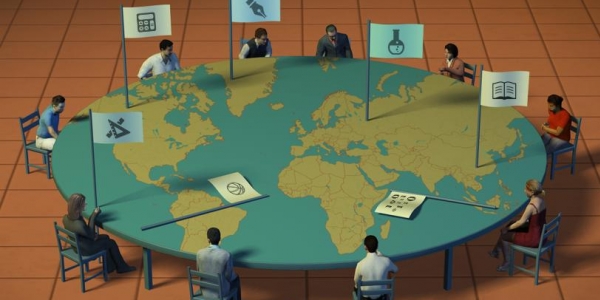
Professor Sheila Croucher likens academic departments to nation-states, and provides a fantastic argument on why that model will not work.
She wants us to go multinational--well, not by starting branch campuses in the Dubais and Bangalores of the world, but by doing away with this old, parochial, department nation-state model.
Croucher writes:
As Croucher points out, "discipline" does not equal "department" ... Croucher adds:
If only I could convince my esteemed colleagues!
She wants us to go multinational--well, not by starting branch campuses in the Dubais and Bangalores of the world, but by doing away with this old, parochial, department nation-state model.
Croucher writes:
As one who has been educated in, and has worked in, many disciplines (electrical engineering, urban planning, economics, environmental resource management, geography) I suppose I could be one of the easiest to be convinced :)
[Disciplinary] identities and departmental attachments are somehow irrational, or that their promoters and defenders have bad intentions. Traditional disciplines and departments have met, and may continue to meet, important needs and serve valuable purposes—for the individual faculty members within them, the chairs who lead them, the institutions that house them, and the students who are educated by them. Disciplines, like nations, constitute a community of kind—of shared interests, ideas, and intellectual commitments. Members of disciplinary communities share a language (some literally); they share a history, heroes, sacred texts, symbols, vocabulary. Having been powerfully socialized into those communities, most faculty members find a stable, fulfilling source of intellectual and perhaps social belonging in their disciplines, and are likely to see departmental status as the means of preserving their interests.
Yet, as has happened with nation-states in a global era, there are now educational and practical reasons to question the utility of existing models.
As Croucher points out, "discipline" does not equal "department" ... Croucher adds:
As universities ponder transcending the conventional model of academic nation-states, those with concerns about their attachments to disciplines need to be assured that these forms of belonging are valued and can be preserved. In fact, scholars of interdisciplinary learning, such as Veronica Boix-Mansilla, have emphasized the need for rigorous engagement with disciplinary knowledge to advance interdisciplinary learning. Integrative or interdisciplinary learning is not antidisciplinary. Similarly, those faculty members who fear that departmental status is the only possible path to safety and security need to be assured with open conversations as well as transparent and democratically conceived policies that that is not the case.Yes, Prof. Croucher!
If the international system (comprising a wide diversity of nations, states, ethnic groups, and identities) can recognize and give way to new, multiple, and fluid forms of attachment and governance, surely agreeing on some form of academic reconfiguration is feasible. First, however, people need reminding that "discipline" is not a synonym for "department," that disciplines themselves do, or should, regularly adapt to changing contexts and undergird rather than detract from integrative efforts, and that the freedoms and fairness important to us all can and most certainly should be preserved, whatever the emergent structures.
If only I could convince my esteemed colleagues!
Burqa, Hijab, Niqab, ... they are NOT the same ...
So, is there is a difference? Yes. Yes :)
 Hijab: it can be conceptualized as a head scarf.
A couple of years ago, we had a visitor from Bahrain as a house-guest for ten days or so. She always wore a hijab. And, it turned out that it was her choice to wear a hijab--even her mother does not wear one.
But, this was in Bahrain, which is one of the less restrictive Persian Gulf societies.
 Now, let us suppose we expand the covering to most of the body--except the face. In other words, anybody can see the entire face of the woman, despite that all-covering garment. Well, that is the chador.
As a kid growing up in India, I think I have seen many women in chadors. But then in India, I recall that everything was given a common word of purdah. Purdah itself, according to Wikipedia, has Persian/Urdu origins. But, the purdah that we generically referred to in India is more like the Niqab or burqa.

With the niqab, well, one can at least see the eyes and eyebrows. This is also what a German reporter wore for a day to get an idea of how others might respond to a woman wearing a niqab.
With the burqa, there is a small veil/slit for the eyes. This is one serious covering up.
(Source for the images used here.)
As a kid, I did not see very many women in India in a burqa. Even now, when I visit, maybe I see a lot more of the chador and niqab, but not many burqa-clad women.
Here is one of my favorite Hindi songs where you ... well, watch it :) Click here for an English translation of the lyrics
A couple of years ago, we had a visitor from Bahrain as a house-guest for ten days or so. She always wore a hijab. And, it turned out that it was her choice to wear a hijab--even her mother does not wear one.
But, this was in Bahrain, which is one of the less restrictive Persian Gulf societies.
As a kid growing up in India, I think I have seen many women in chadors. But then in India, I recall that everything was given a common word of purdah. Purdah itself, according to Wikipedia, has Persian/Urdu origins. But, the purdah that we generically referred to in India is more like the Niqab or burqa.
With the niqab, well, one can at least see the eyes and eyebrows. This is also what a German reporter wore for a day to get an idea of how others might respond to a woman wearing a niqab.
With the burqa, there is a small veil/slit for the eyes. This is one serious covering up.
(Source for the images used here.)
As a kid, I did not see very many women in India in a burqa. Even now, when I visit, maybe I see a lot more of the chador and niqab, but not many burqa-clad women.
Here is one of my favorite Hindi songs where you ... well, watch it :) Click here for an English translation of the lyrics
Tuesday, May 25, 2010
Bring on the learning revolution!
Sir Ken Robinson says it is time to bring on the learning revolution, and quotes the following from Lincoln's message to the Congress in December 1862:
The dogmas of the quiet past, are inadequate to the stormy present. The occasion is piled high with difficulty, and we must rise -- with the occasion. As our case is new, so we must think anew, and act anew.As I have noted many times in this blog, higher education in its current format ought to be re-structured in more ways than one. But, the status-quo preserving education system ... well, ... if the change does not come from within, I bet it will be forced on the system from the outside ... sooner than one might think.
Quote of the day: on academia
[Being] an intellectual entails analyzing and understanding issues from multiple angles. I hope that in advising their undergraduates, academics will encourage their students to share that view.

But, that is not the reality that I experience and witness--neither about being an intellectual, nor about advising students. Unfortunately :(

Monday, May 24, 2010
War. War. War, forever :(
The state of the union, as Glenn Greenwald describes, is awfully depressing ... Sometimes I do think that a permanent state of war is merely the other side of the professional military coin. If it were a citizen military, well, we will have a military only if there is a "real" war emergency. It is like how when citizen legislatures are replaced by year-round ones, we have now ended up with a system where incumbents stay on forever .... Oh well.
Here is an excerpt from Greenwald:
Here is an excerpt from Greenwald:
war is basically the permanent American condition: war is who we are and what we do as a nation. We're essentially a war fighting state. We have been at "war" the entire last decade (as well as largley non-stop for the decades which preceded it), and continue now to be at "war" with no end in sight. That's clearly true of our specific wars (in Afghanistan). And, worse, the way in which The War, more broadly, has been defined (i.e., against Islamic extremism/those who wish to harm Americans) makes it highly likely that it will never end in our lifetime. The decree that we are "at war" has been repeated over and over for a full decade, drumbed into our heads from all directions without pause, sanctified as one of those Bipartisan Orthodoxies that nobody can dispute upon pain of having one's Seriousness credentials immediately and irrevocably revoked. With war this normalized, is it really surprising that nobody debates it any longer? It'd be like debating the color of the sky.
That's why I always find the War Excuse for anything the Government does so baffling and nonsensical. Any objections one voices to what the Executive Branch does -- indefinite detentions, presidential assassinations of citizens, extreme secrecy, etc. -- will be met with the justification that such actions are permissible "during wartime," as though "wartime" is some special, temporary, fleeting state of affairs which necessitates vesting powers in the government which, during "normal" times, would be impermissible.
But the contrast between "war and "normal times" is totally illusory. For the United States, war is normalcy. The "war" we're fighting has been defined and designed to be virtually endless. Political leaders from both parties have been explicit about that. Here's how Obama put it last May in his "civil liberties" speech:
Now this generation faces a great test in the specter of terrorism. And unlike the Civil War or World War II, we can't count on a surrender ceremony to bring this journey to an end. Right now, in distant training camps and in crowded cities, there are people plotting to take American lives. That will be the case a year from now, five years from now, and -- in all probability -- 10 years from now.All the way back in September, 2001, with the World Trade Center still smoldering, George Bush said basically the same thing: "Now, this war will not be like the war against Iraq a decade ago, with a decisive liberation of territory and a swift conclusion. . . . Americans should not expect one battle, but a lengthy campaign unlike any other we have ever seen." Thus: to justify new and unaccountable powers based on the fact that we are "at war" is, in essence, to change the American political system permanently, because the "war," and the accompanying powers that it justifies, are not going anywhere for many, many years to come.
With both political parties affirming over and over that we are going to be at "war" for years, indeed decades, it's unsurprising that so few people are interested in debating "war."
Way worse than the Exxon-Valdez spill

A young heron sits dying amidst oil splattering underneath mangrove on an island impacted by oil from the Deepwater Horizon oil spill in Barataria Bay, along the the coast of Louisiana on Sunday, May 23, 2010. (AP Photo/Gerald Herbert)
One speech, different takes: Obama @ West Point
A variation of the theme that beauty is in the eye of the beholder!
First, here is James Fallows, who leads it off with "I Like Ike" and names Eisenhower as the intellectual father of Obama's address:
First, here is James Fallows, who leads it off with "I Like Ike" and names Eisenhower as the intellectual father of Obama's address:
The more significant point, to me, is how consistent Obama's argument was with one of the statements of U.S. interest and strategy that holds up best over time: Dwight Eisenhower's extraordinary "farewell address" to the nation nearly 50 years ago.Next up, Will Inboden at FP who says this is not the candidate Obama of 2008:
President Obama's West Point speech on Saturday provides a great example of the structural continuities in American foreign policy. As president and commander-in-chief, Obama now embraces and owns policies that he previously eschewed. For example, after running his campaign denouncing the Iraq War and doubting the surge, he is now essentially declaring Iraq a victory ("this is what success looks like: an Iraq that provides no safe-haven to terrorists; a democratic Iraq that is sovereign, stable, and self-reliant.") After spending much of his first year in office downplaying if not ignoring democracy and human rights promotion, he is now making democracy and human rights promotion one of the four pillars of his national security strategy. After previously rhetorically distancing himself from American exceptionalism, he now says that a "fundamental part of our strategy is America's support for those universal rights that formed the creed of our founding."Let us go for a third--to Peter Beinart, who calls it a clunker:
This weekend, for the second time in six months, President Obama flew to West Point to deliver a big foreign policy speech. And for the second time in six months, he delivered a clunker.And then Beinart adds this:
Like Truman and the elder Bush, Obama is trying to limit America’s wartime goals, to define victory down rather than either going for broke or giving up. It may be a defensible strategy, but it’s not an inspiring one. And it’s not a strategy for which the American public is prepared to lose many lives. Perhaps the president should avoid West Point graduations for a while.I tell you, life might be easier if I didn't read such competing arguments. Ignorance has its advantages, I suppose. But then, this is how we make mashed potatoes :)
More Mick Jagger: Ahem, you lie, "Sir" :)
Sir Mick has been in the news a lot recently because of the music from the "year in exile" ... no, he did not lie about the music, or the year in France ... well, this is what Sir Mick said:
He does sound quite existentialist here, eh:
 Rock on, Sir Mick!
"We were young, good-looking and stupid," he told the audience. "Now we're just stupid."Mick Jagger and Keith Richards being "good-looking" then? That is the lie .... muahahaha
He does sound quite existentialist here, eh:
"Everyone's life comes to an end. We'll all die, we all have the same fate, but I think you should just keep going while you can, doing what you like."
Sunday, May 23, 2010
Redemption, religion, and Rrrrrrrrrrr!!!!!
Ayaan Hirsi Ali's story is one that I find discussing in many different contexts with my students--it can be a discussion of migration, Somalia, Islam, female genital mutilation, radical Islamism, ....
In this Q/A, the final question/response is:
I can't but wonder why quite a few people so preoccupied with the hereafter can't be "human" in the here and now :( Oh well ...
In this Q/A, the final question/response is:
Are you in touch with your mother?Hmmm ....
I talk to her on the phone. She says, Please go back to being a Muslim because that’s the only way that you’re going to have any kind of redemption in the hereafter.
I can't but wonder why quite a few people so preoccupied with the hereafter can't be "human" in the here and now :( Oh well ...
Beverly Sills sings with the Muppets
Yes, live from the Muppetopolitan Opera, with Kermit serving as the emcee :)
So, it is past 1030 on Sunday night, and I deserved a break from grading. The Classic Arts channel on cable had a clip of Beverly Sills singing Habanera. I thought I would track down more from Sills on Youtube, and then came across this fantastically funny and clever (as always) Muppets piece. Awesome!!!
And, BTW, here is Habanera according to the Muppets: be warned that this is way too hysterically funny :)
So, it is past 1030 on Sunday night, and I deserved a break from grading. The Classic Arts channel on cable had a clip of Beverly Sills singing Habanera. I thought I would track down more from Sills on Youtube, and then came across this fantastically funny and clever (as always) Muppets piece. Awesome!!!
And, BTW, here is Habanera according to the Muppets: be warned that this is way too hysterically funny :)
Bamboleo: video of the day
Takes me back to my graduate school days ... The Gypsy Kings were on all kinds of music channels--pop, jazz, Spanish, ... Fast forward a few years and one day I get a call from my daughter, and I can barely hear her at all. She then yelled "listen to this" and I could hear the Gypsy Kings--turned out that she was at their concert and remembered to call when they played "Bamboleo" ... :)
Mick Jagger talks economics
Sir Mick Jagger was an undergraduate student at the prestigious London School of Economics before, well, you know the music story. So, it does not surprise me at all to read his observations on the dollars and cents of recording and the internet (ht):
Things have obviously changed a great deal since those sessions. What's your feeling on technology and music?
Technology and music have been together since the beginning of recording.
I'm talking about the internet.
But that's just one facet of the technology of music. Music has been aligned with technology for a long time. The model of records and record selling is a very complex subject and quite boring, to be honest.
But your view is valid because you have a huge catalogue, which is worth a lot of money, and you've been in the business a long time, so you have perspective.
Well, it's all changed in the last couple of years. We've gone through a period where everyone downloaded everything for nothing and we've gone into a grey period it's much easier to pay for things - assuming you've got any money.
Are you quite relaxed about it?
I am quite relaxed about it. But, you know, it is a massive change and it does alter the fact that people don't make as much money out of records.
But I have a take on that - people only made money out of records for a very, very small time. When The Rolling Stones started out, we didn't make any money out of records because record companies wouldn't pay you! They didn't pay anyone!
Then, there was a small period from 1970 to 1997, where people did get paid, and they got paid very handsomely and everyone made money. But now that period has gone.
So if you look at the history of recorded music from 1900 to now, there was a 25 year period where artists did very well, but the rest of the time they didn't.Throughout history, musicians and artists generally did not earn lots of money--same story with teachers, too. For a brief while, as Sir Mick points out, yes, there was real money for musicians--it was almost the same time period that was also the best of times for teaching. Now, once again teaching is rapidly losing the little bit of economic prosperity that it enjoyed for a couple of generations. Well, aren't such changes the kind of stuff that history is made of? May we live in interesting times, indeed!
Friday, May 21, 2010
Meanwhile, liberty--lack of--elsewhere :(
The photos say a lot more than I could--in India, and in Thailand :(


Quote of the day, and more about the UK democratic experiment
We will be strong in the defence of freedom. The Government believes the British state has become too authoritarian, and that over the past decade it has abused fundamental human rights and historic civil libertiesThat is the preamble to the "civil liberties" section of the platform that the Tory/Liberal Democrat coalition government. (ht)
Simply awesome. After the triangulating Tony Blair and the rather dull Gordon Brown, and their bizarre fetish to faithfully follow the Bush/Cheney approach to infringing on civil liberties, wow, what a refreshing set of sentences. It simply gets better; here is a sampling:
- We will introduce a Freedom Bill.
- We will scrap the ID card scheme, the National Identity register and the ContactPoint database, and halt the next generation of biometric passports.
- We will outlaw the finger-printing of children at school without parental permission.
- We will extend the scope of the Freedom of Information Act to provide greater transparency.
A judge will investigate claims that British intelligence agencies were complicit in the torture of terror suspects, William Hague, the foreign secretary, said tonight. ...Glenn Greenwald, too, points out this contrast:
Hague's statement redeems a pledge that both he and his then Liberal Democrat opposite number, Ed Davey, made in opposition. Hague told the BBC: "We have said again in the coalition agreement that we want a judge-led inquiry. So will there be an inquiry of some form? Yes, both parties in the coalition said they wanted that. Now what we're working on is what form that should take."
The coalition agreement published today by the government does not explicitly call for a judicial inquiry; it simply states: "We will never condone the use of torture."
[Just] contrast all of this to what is taking place in the United States under Democratic Party rule. We get -- from the current Government -- presidential assassination programs, detention with no charges, senseless demands for further reductions of core rights when arrested, ongoing secret prisons filled with abuse, military commissions, warrantless surveillance of emails, and presidential secrecy claims to block courts from reviewing claims of government crimes. The Democratic-led Congress takes still new steps to block the closing of Guantanamo. Democratic leaders push for biometric, national ID cards. The most minimal surveillance safeguards are ignored. Even the miniscule limits on eavesdropping powers are transgressed. And from just this week: "Millions of Americans arrested for but not convicted of crimes will likely have their DNA forcibly extracted and added to a national database, according to a bill approved by the U.S. House of Representatives on Tuesday" (h/t Dan Gillmor). Can anyone even imagine for one second Barack Obama standing up and saying: "My administration believes that the American state has become too authoritarian"?It will be neat if a news person can get Dick Cheney's reaction to the coalition government's platform. BTW, where is that
Thursday, May 20, 2010
Stat of the day
The two national teachers’ unions — the American Federation of Teachers and the larger National Education Association — together have more than 4.6 million members. That is roughly a quarter of all the union members in the country.This is in a lengthy piece by Steven Brill on education reforms and The Teachers’ Unions’ Last Stand. ht
Of course, Brill is following up on his earlier piece on the battle over NY's worst teachers, which he discussed in the New Yorker essay on the Rubber Room. Of all places, it was in Tanzania that I discussed the Rubber Room essay--at a serendipitous Christmas Supper at the home of an American expat couple. Despite all of us being liberals, we were all unanimous in our shock/unpleasantness over:
The Rubber Rooms house only a fraction of the 1.8 per cent who have been rated unsatisfactory. The rest still teach. There are fifty Rubber Roomers—a twentieth of one per cent of all New York City teachers*—awaiting removal proceedings because of alleged incompetence, as opposed to those who have been accused of misconduct.
“If you just focus on the people in the Rubber Rooms, you miss the real point, which is that, by making it so hard to get even the obvious freaks and crazies that are there off the payroll, you insure that the teachers who are simply incompetent or mediocre are never incented to improve and are never removable,” Anthony Lombardi says. In a system with eighty-nine thousand teachers, the untouchable six hundred Rubber Roomers and eleven hundred teachers on the reserve list are only emblematic of the larger challenge of evaluating, retraining, and, if necessary, weeding out the poor performers among the other 87,300.
Robots and war: new military technology forever?
As of May 3, American unmanned systems had carried out 131 known airstrikes into Pakistan, well over triple the number we did with manned bombers in the opening round of the Kosovo War just a decade ago. By the old standards, this would be viewed as a war.P.W. Singer raises a number of uncomfortable issues regarding the growing use of robots in warfare. Well, not only in warfare, but also, for instance:
But why do we not view it as such? Is it because it is being run by the CIA, not by the U.S. military?
Does the Second Amendment cover my right to bear (robotic) arms? It sounds like a joke, but where does the line go, and why? A bar owner in Atlanta already started the push to test this, building "Bum Bot," a robot armed with an infrared camera, spotlight, loudspeaker, and aluminum water cannon that he used to scare away homeless people and drug dealers from a parking lot near his business.Singer's essay is one of the three featured at Slate.
The article is being published in conjunction with "Warring Futures: How Biotech and Robotics Are Transforming Today's Military—and How That Will Change the Rest of Us," a May 24 conference in Washington, D.C., sponsored by Slate, the New America Foundation, and Arizona State University. You can sign up to attend the event here. Read an article by Fred Kaplan about how the nature of war limits the use of technology and by Brad Allenby about why it's futile to resist new military technology.
Wednesday, May 19, 2010
The American Dream ... is slipping away?
To a large extent, the issues that Newton raises are a reflection of the rapidly changing economic structure, here in the United States
However, as economic opportunities opened up initially to tens of millions in South Korea , Taiwan , and Singapore , and later on to hundreds of millions in China , India
It is no coincidence that the heyday of the American middle class correlated with a vast majority of humans on Earth living in horrible economic conditions. It is not that the American society systematically kept the millions in Asia poor—it simply was the effects of the closed and tightly controlled economic structure and policies in most of the less developed countries that had gained independence from their colonial masters after the end of World War II.
The world is now far less poorer because of phenomenal improvements elsewhere, which have also been triggered by countries opening up their societies to the outside world. But, this also means that the American middle class is now under severe economic stress. This is one of the side effects of hundreds of millions of Asians, and hopefully Africans too in the near future, rising above poverty.
As a recent article in the Economist magazine notes, the result here in the US
Finally, about the teaching profession itself, on which Newton
But, in the history of humans, teaching has never been as lucrative a profession as it currently is. While the teaching profession has always been highly respected practically anywhere on the planet, those positive sentiments did not always translate to comfortable lifestyles for teachers. The economic fortunes of teachers—“gurus”—in the old India
Perhaps Newton
At the end of it all, as concerned citizens, we have a responsibility to worry about the increasingly uncertain economic futures that lie ahead for the younger generations who also dream about leading successful American middle class lives. We ought to worry that our elected leaders do not seem to care that unemployment continues to be high. But, unionization in the private sector is not sufficient to ensure a continuation of the idea of the American Dream.
Tuesday, May 18, 2010
"Failure is not an option." well, it is.
We have reshaped the education system—largely through federal legislation—to an approach of "right answers, right answers, right answers." But life's not like that. We're putting a tremendous amount of value on being able to pick the right one out of four little bubbles. But this turns out not to be a very valuable skill. You can't take this skill out into the workplace and get paid for it.That is Diane Ravitch speaking of her Damascene conversion of sorts on public education and No Child Left Behind
My research assistant did a blog for the Washington Post about this mantra of "Failure Is Not an Option." Her point was, you can't learn anything unless you fail. Failure has to be an option. What does success mean if there's no failure? It just means that you've dropped the bar so low that everyone can walk over it.
 . I am reminded of Robert McNamara admitting much later in life about how wrong he was on the Vietnam War.
Finally, ...
If you could hear someone else interviewed about wrongness, who would it be?
That's a hard one. Donald Rumsfeld said he was wrong, but I don't even want to hear from him. [Former Treasury Secretary, former Goldman Sachs Co-Chair, and former Citigroup Chair] Bob Rubin would be interesting, but he'll never admit he was wrong. Right now what's coming to mind are people who have never admitted that they're wrong about anything.
Like who?
Like basically everybody I've been associated with for the last 20 years.
Monday, May 17, 2010
Chart of the day: the failing war on drugs
that even with increased crop eradication and constant “record seizures” of the drug by land and at sea are not accomplishing the stated goals of the policies and therefore calls into serious question whether they are worth the expenditures in question. Indeed, it is quite clear that the ability of coca famers to produce enough coca leaf to overtake whatever successes that are accomplished in crop eradication and cocaine seizures is quite clear. Such overproduction is simply the cost of doing business. This is a lesson, by the way, that we need to keep in mind in Afghanistan, where the policy direction it towards crop eradication of opium poppies. I predict now that even if thousands upon thousands of hectares or opium poppies are eradicated, that the poppy farmers will be able to out produce the eradicators.Of course, libertarians like the folks at Reason have all along pointing out to the wasteful and costly attempt to keep the drugs out--and, of course, the infringement on the rights of American citizens ... The war on drugs which is no longer confined to Colombia, and is now just short of a civil war in Mexico is, according to Jorge Castaneda all screwed up: "The Mexican drug war is costly, unwinnable, and predicated on dangerous myths." Going after the supply, without acting on policies that might address the demand in the US merely escalates violence, and Secretary Clinton echoed this as well when she said:
"Clearly what we've been doing has not worked," Clinton told reporters on her plane at the start of her two-day trip, saying that U.S. policies on curbing drug use, narcotics shipments and the flow of guns have been ineffective.So, when are we going to end this war, that even pre-dates the ongoing wars in Afghanistan and Iraq?
"Our insatiable demand for illegal drugs fuels the drug trade," she added. "Our inability to prevent weapons from being illegally smuggled across the border to arm these criminals causes the deaths of police, of soldiers and civilians."
Plan B: Skip College
I have been harping on the idea that college degrees are hyped way more than they are worth, and is an ongoing topic in this blog.
Of course, expressing such an opinion while within academia means that I practically never hear anybody seconding my arguments. (editor: does anybody even talk to you in the first place, for you to "hear" anything?!)
But, given the severe economic conditions in society, I would argue that this issue will not fade away, but will actually gather strength. As this NY Times report indicates ... an excerpt:
Of course, expressing such an opinion while within academia means that I practically never hear anybody seconding my arguments. (editor: does anybody even talk to you in the first place, for you to "hear" anything?!)
But, given the severe economic conditions in society, I would argue that this issue will not fade away, but will actually gather strength. As this NY Times report indicates ... an excerpt:
College degrees are simply not necessary for many jobs. Of the 30 jobs projected to grow at the fastest rate over the next decade in the United States, only seven typically require a bachelor’s degree, according to the Bureau of Labor Statistics.It is not at all the case that I am against higher education--I love it. But, I want counselors, faculty, administrators, .... to provide high school students with some kind of a full disclosure, a la:
Among the top 10 growing job categories, two require college degrees: accounting (a bachelor’s) and postsecondary teachers (a doctorate). But this growth is expected to be dwarfed by the need for registered nurses, home health aides, customer service representatives and store clerks. None of those jobs require a bachelor’s degree.
Professor Vedder likes to ask why 15 percent of mail carriers have bachelor’s degrees, according to a 1999 federal study.
Professor Rosenbaum said, high school counselors and teachers are not doing enough to alert students unlikely to earn a college degree to the perilous road ahead.The lack of full disclosure means that it is nothing but a .... ponzi scheme :(
Sunday, May 16, 2010
Noam Chomsky barred by Israelis
The Guardian reports:
Noam Chomsky, whose withering critiques of political establishments have earned him the wrath of regimes of all persuasions around the world, was todayforbidden by Israeli immigration officers from entering the Palestinian West Bank.The Onion has a different take:
Chomsky said he was disappointed and surprised to have been turned back from the Allenby bridge across the Jordan river, which is understood to be the first time he has been refused entry by the Israelis. He had been due to give a series of lectures on domestic and foreign policy at Birzeit University and the Institute for Palestine Studies in Ramallah, in the West Bank.
"I just want to lie in a hammock and have a nice relaxing morning," said the outspoken anarcho-syndicalist academic, who first came to public attention with his breakthrough 1957 book Syntactic Structures. "The systems of control designed to manufacture consent among a largely ignorant public will still be there for me to worry about tomorrow. Today, I'm just going to kick back and enjoy some much-needed Noam Time."But, apparently Chomsky could not quite relax as he had planned:
"No fighting against institutional racism, no exposing the legacies of colonialist ideologies still persistent today, no standing up to the widespread dissemination of misinformation and state-sanctioned propaganda," Chomsky added. "Just a nice, cool breeze through an open window on a warm spring day."
Sources reported that the 81-year-old Chomsky, a vociferous, longtime critic of U.S. foreign policy and the political economy of the mass media, was planning to use Monday to tidy up around the house a bit, take a leisurely walk in the park, and possibly attend an afternoon showing of Date Night at the local megaplex.
Sources said Chomsky took what was supposed to be a refreshing drive in the countryside, only to find himself obsessing over the role petroleum plays in the economic and military policies that collude with multinational corporate powers.ps: Just in case you didn't get it ... ahem, the Onion is a satirical publication and the Guardian is not :)
After stopping at a roadside McDonald's, Chomsky was unable to enjoy the Big Mac he purchased, due to the popular restaurant chain's participation in selling "a bill of goods" to the American people, who consume the unhealthy fast food and thereby bolster the capitalist system rather than buying from local farmers in order to equalize the distribution of wealth and eat more nutritiously.
The politics of the libertarian mob
Democrats were day-trading, Republicans were divorcing. We were all individualists now.A wonderful line from Mark Lilla's essay in the NYRB, which has a neat title: "The Tea Party Jacobins." Lilla is a professor at Columbia, after quite some time at Chicago. More than anything else, Lilla is a faculty who is comfortable in both academic and journalistic domains--a trait I admire and look up to.
What is Lilla writing about there?
A new strain of populism is metastasizing before our eyes, nourished by the same libertarian impulses that have unsettled American society for half a century now. Anarchistic like the Sixties, selfish like the Eighties, contradicting neither, it is estranged, aimless, and as juvenile as our new century. It appeals to petulant individuals convinced that they can do everything themselves if they are only left alone, and that others are conspiring to keep them from doing just that. This is the one threat that will bring Americans into the streets.Instead of the old Jacobins, who were leftist radicals, Lilla says we have the new Jacobins. How different are these from the old?
Welcome to the politics of the libertarian mob.
When the new Jacobins turn on their televisions they do not tune in to the PBS News Hour or C-Span to hear economists and congressmen debate the effectiveness of financial regulations or health care reform. They look for shows that laud their common sense, then recite to them the libertarian credo that Fox emblazons on its home page nearly every day: YOU DECIDE.Lilla has a point when he notes that the new Jacobins prefer:
the company of anti-intellectuals who know how to exploit nonintellectuals, as Sarah Palin does so masterfully.16 The dumbing-down they have long lamented in our schools they are now bringing to our politics, and they will drag everyone and everything along with them. As David Frum, one of the remaining lucid conservatives, has written to his wayward comrades, “When you argue stupid, you campaign stupid. When you campaign stupid, you win stupid. And when you win stupid, you govern stupid.”So, where is this heading towards? Lilla thinks that the Tea Party itself might dissolve soon, as much as a float is taken down after the Homecoming party! But:
Now an angry group of Americans wants to be freer still—free from government agencies that protect their health, wealth, and well-being; free from problems and policies too difficult to understand; free from parties and coalitions; free from experts who think they know better than they do; free from politicians who don’t talk or look like they do (and Barack Obama certainly doesn’t). They want to say what they have to say without fear of contradiction, and then hear someone on television tell them they’re right. They don’t want the rule of the people, though that’s what they say. They want to be people without rules—and, who knows, they may succeed. This is America, where wishes come true. And where no one remembers the adage “Beware what you wish for.”
I wish Lilla had phrased something else in place of "libertarian mob" because true libertarians like the intelligent folks at Cato or Reason are not quite thrilled with the Tea Party folks' anti-intellectual ranting. And, to a Libertarian Democrat like me, well, this nutcase mob is not anything like our idea of why we like the libertarian streak in our politics .... But, that is my only quibble :)
Saturday, May 15, 2010
"The hurling habit dies hard" :)
Or, as one commenter has described it,
BBC has blocked access to that clip, which includes footage after the victorious male meets the female. The following clip stops with the male and female shaking hands, er, legs :)
Wham, Bam, thank you Ma'am!
BBC has blocked access to that clip, which includes footage after the victorious male meets the female. The following clip stops with the male and female shaking hands, er, legs :)
Afghanistan: remember that war over there?
A student I have known for a couple of years now is headed to Afghanistan; he got his deployment orders a few weeks ago, and is in the training phase now. I wish him well.
But, I have no idea why we keep sending troops there. Instead of writing about it, well, the editorial cartoons convey the point

But, I have no idea why we keep sending troops there. Instead of writing about it, well, the editorial cartoons convey the point
Graduation: celebrate or commiserate?
I tell them that from the summer after the sophomore years, they need to do internships/part time work in career-related fields.
If they seem to be ready for the message, then I tell them that the way we do higher education now is a scam, a ponzi scheme, and that they need to make sure they don't get fooled by all the fancy talk about how college degrees are the sure tickets to economic prosperity.
And then I wonder why I am not popular!
Friday, May 14, 2010
Ok, here is one reason why I support Elena Kagan
Because I want Pat Buchanan to get mighty pissed off.
Media Matters reports this from Pat Buchanan's May 14 syndicated column (emphasis added in the original Media Matter's post):
Media Matters reports this from Pat Buchanan's May 14 syndicated column (emphasis added in the original Media Matter's post):
Indeed, of the last seven justices nominated by Democrats JFK, LBJ, Bill Clinton and Barack Obama, one was black, Marshall; one was Puerto Rican, Sonia Sotomayor. The other five were Jews: Arthur Goldberg, Abe Fortas, Ruth Bader Ginsberg, Stephen Breyer and Elena Kagan.Buchanan ought to be happy and relieved that he lives in the US of A where we protect the freedom of people to say such loony and offensive things ... What is wrong with these people?
If Kagan is confirmed, Jews, who represent less than 2 percent of the U.S. population, will have 33 percent of the Supreme Court seats.
Is this the Democrats' idea of diversity?
But while leaders in the black community may be upset, the folks who look more like the real targets of liberal bias are white Protestants and Catholics, who still constitute well over half of the U.S. population.
Not in living memory has a Democratic president nominated an Irish, Italian or Polish Catholic, though these ethnic communities once gave the party its greatest victories in the cities and states of the North.
What happened to the party of the Daleys, Rizzos and Rostenkowskis?
And not in nearly half a century has a Democratic president nominated a white Protestant or white Catholic man or woman.
[...]
If Kagan is confirmed, the Court will consist of three Jews and six Catholics (who represent not quite a fourth of the country), but not a single Protestant, though Protestants remain half the nation and our founding faith.
Image of the day: Maxwell's equations

I know what you are thinking: where can I buy this shirt? I don't know :)
update: a helpful reader (sadly, anonymous) has left a comment on where this t-shirt can be purchased. Hey, thanks, whoever you are ....
The coming deflation?
While hyperinflation is to be worried about, a little bit of inflation does not worry most of us--in fact, most central banks work towards maintaining that healthy rate of inflation.
Deflation, on the other hand, is a serious monster. Krugman adds more to why we need to worry ...
Table? crawl under it. stay there. until 2020?
Deflation, on the other hand, is a serious monster. Krugman adds more to why we need to worry ...
Ever since the economic crisis began there have been two schools of thought about inflation prospects. One school basically has a Phillips curve, aggregate demand view: because major economies are operating far below full employment, we should expect disinflation, and possibly deflation. The other is basically monetarist with a touch of Austrianism: look at all the money central banks are printing and governments are borrowing, it says, inflation — maybe even hyperinflation — is just around the corner.
Guess who’s been right so far?
“Spain joins therefore Slovenia, Portugal and Ireland in the number of countries where core prices are falling compared to the previous year,” said Luigi Speranza, an economist at BNP Paribas.What about the US? Well, various measures of core inflation — like the Dallas Fed trimmed-mean deflator, the Cleveland Fed median CPI, and indexes excluding food and energy have all fallen from 2.5-3 percent inflation at the start of the crisis to around 1 or lower. If the trend continues — which it will unless the recovery is stronger than I fear — deflation is in our future, maybe next year.
Am not going to Arizona. For now.
I am not going to Arizona anytime soon, unless their immigration law is repealed or declared unconstitutional and void.
It is not any hyperbole, which unfortunately fills the airwaves and drowns out the genuine concerns. In my case, my decision not to visit Arizona is simply because I remember all too well the awful feelings of sudden awareness of my brown-skinned ethnic appearance and accent after the horrific events of 9/11.
I lived in Bakersfield, California, when the towers of the World Trade Center in New York tumbled down to dust. Later that day, when it was early morning half way around the world in India, I talked to my parents and assured them that I was safe and that they needn’t worry about me.
After a momentary pause, my father slowly said something like “maybe you should consider shaving your beard off, at least for a few weeks.” His concern was that a passionate mob might think that I am one of “them”, which could then have disastrous results.
I laughed it off. I did not want to scare him by admitting that the thought had crossed my mind as well, and that I had already planned to restrict my movements outside the home only to the bare essentials. There is, after all, millennia of human experiences distilled into the statement, “better safe, than sorry.”
My worry was justified to some extent by the news that a Sikh had been shot and killed because his beard and turban made him look suspiciously similar to the images of the bearded and turbaned Osama bin Laden and his followers. Incidentally, this tragic incident happened in Arizona—in Mesa!
It was a strange time, for the country and for me. After years of living in the US without having to think twice about my skin color and my beard, I now had to systematically think through the potential downsides of being brown-skinned, bearded, and with an accent.
I did not become clean-shaven, and nor was there even one single incident where I was even remotely threatened. Even at the security screening at airports, I went through without any special treatment—just like anybody else. And, yes, the scientific training reminded me about the data that showed that there was no large-scale and systematic targeting of people like me.
But, it was a while before my perception of the reality would return to the pre-9/11 days when I did not have to be self-conscious about my ethnic appearance. I suppose I am like most humans in that we need to be convinced within ourselves that our fears are unfounded.
Which is why I am not in favor of visiting Arizona. How much ever their elected officials and public safety officers claim that brown-skin will not become a blip in their enforcement radars, they have planted a worry in my head about a probability that I could be asked to prove my citizenship if I am in Arizona.
Earlier this year, I met a Hungarian environmental attorney, who was in Eugene for ten weeks as a visiting fellow with Environmental Law Alliance Worldwide (ELAW.) I chuckled when she made sure that she had her passport before we stepped outside for coffee. “Even in Hungary I always carry my passport” she said.
I thought it was horribly bizarre that a Hungarian citizen had to walk around in Budapest with citizenship papers in case the police asked for it. “But, this is America” was my response. I explained that like most people, I never carry my passport with me when I am in the US. To top it off, I joked that we would sue the police if we were asked to prove our legal right to be here.
Well, it is not a joke anymore, I suppose.
I worry that the possibility exists—even if a low probability—that I could end up in a jail in Arizona because I don’t carry my passport while within the borders of these United States of America.
Well, I would rather bypass the Grand Canyon State.
Tuesday, May 11, 2010
Who is winning the war on terror?
It was ridiculous when the TSA folks scanning the carry on luggage repeatedly scanned a pair of shoes of a passenger who was ahead of me. All because that fancy pair had some kind of a strip in the sole's construction that was not visible to the naked eye, but was clear as hell in the scanner. So, the line kept getting longer while two other agents came over to look at the image.
Oh well ....
Monday, May 10, 2010
It is Kagan, not Diane Wood, for the Supremes :(
I would have voted for Diane Wood to replace the retiring Stevens.
Kagan?
Even Bill Clinton, who forever tried to appease everybody, nominated Ginsburg to the court--despite all her overt association with ACLU that, unfortunately, the "liberty loving" right tends to despise. (Yes, I am proud to be a card-carrying member of the ACLU!)
As one would expect, Glenn Greenwald is, well, not happy with the Kagan nomination; this opening paragraph sets the tone for the rest of his commentary (this guy is way too sharp!):
Kagan?
Even Bill Clinton, who forever tried to appease everybody, nominated Ginsburg to the court--despite all her overt association with ACLU that, unfortunately, the "liberty loving" right tends to despise. (Yes, I am proud to be a card-carrying member of the ACLU!)
As one would expect, Glenn Greenwald is, well, not happy with the Kagan nomination; this opening paragraph sets the tone for the rest of his commentary (this guy is way too sharp!):
Nothing is a better fit for this White House than a blank slate, institution-loyal, seemingly principle-free careerist who spent the last 15 months as the Obama administration's lawyer vigorously defending every one of his assertions of extremely broad executive authority. The Obama administration is filled to the brim with exactly such individuals -- as is reflected by its actions and policies -- and this is just one more to add to the pile. The fact that she'll be replacing someone like John Paul Stevens and likely sitting on the Supreme Court for the next three decades or so makes it much more consequential than most, but it is not a departure from the standard Obama approach.Dahlia Lithwick, at Slate, explains why Kagan makes everybody nervous:
With no judicial record to pore over, and some of the wonkiest law-review articles ever penned to her credit, Kagan has mastered the fine art of nearly perfect ideological inscrutability. Even Jeffrey Toobin, her law school study partner, has virtually no idea what she really believes.How could such a track record be possible for somebody who will end up interpreting the Constitution for the rest of us? I have no idea, and it is bizarre. Lithwick writes:
It's not at all clear from her record whether Kagan will someday prove to be the Jurist for the Little Guy or the Judge Who Bridged the Partisan Divide. There is ample evidence in her professional and academic record that she has ably managed to do both at different times, depending on the professional position she held and whose views she was representing. We will hear a good many testimonials in the coming weeks that Kagan has the heart of a progressive lion and the political skills of a diplomat. What remains to be seen is whether she will put the former to service in the interest of the latter—or vice versa.
Subscribe to:
Posts (Atom)