Report here
Influential food writers, advocates, and celebrity restaurant owners are repeating the mantra that "sustainable food" in the future must be organic, local, and slow. But guess what: Rural Africa already has such a system, and it doesn't work. Few smallholder farmers in Africa use any synthetic chemicals, so their food is de facto organic. High transportation costs force them to purchase and sell almost all of their food locally. And food preparation is painfully slow. The result is nothing to celebrate: average income levels of only $1 a day and a one-in-three chance of being malnourished.One might think that such views will not be found in countries like India where not only do poor and undernourished live number in the millions, but also where millions of others have been lifted out of abject poverty and undernourishment.
If we are going to get serious about solving global hunger, we need to de-romanticize our view of preindustrial food and farming. And that means learning to appreciate the modern, science-intensive, and highly capitalized agricultural system we've developed in the West. Without it, our food would be more expensive and less safe. In other words, a lot like the hunger-plagued rest of the world.
Celebrity author and eco-activist Vandana Shiva claims the Green Revolution has brought nothing to India except "indebted and discontented farmers." A 2002 meeting in Rome of 500 prominent international NGOs, including Friends of the Earth and Greenpeace, even blamed the Green Revolution for the rise in world hunger. Let's set the record straight.
The development and introduction of high-yielding wheat and rice seeds into poor countries, led by American scientist Norman Borlaug and others in the 1960s and 70s, paid huge dividends. In Asia these new seeds lifted tens of millions of small farmers out of desperate poverty and finally ended the threat of periodic famine. India, for instance, doubled its wheat production between 1964 and 1970 and was able to terminate all dependence on international food aid by 1975. As for indebted and discontented farmers, India's rural poverty rate fell from 60 percent to just 27 percent today. Dismissing these great achievements as a "myth" (the official view of Food First, a California-based organization that campaigns globally against agricultural modernization) is just silly.
Merkel has rejected a debate about ejecting Greece from the euro zone. "It is about a quick reaction in favor of the euro's stability as a whole. Everything else is a distraction."
In Monday's newspapers, German commentators are divided over whether the country's taxpayers should be forking out for the debts of other European nations and whether it may be time to contemplate kicking Greece out of the euro zone.
the overall cost (state and private funding) was estimated to reach 8.954 billion euro, not including the cost of projects that were completed or the construction of which were accelerated due to the Games, but which had been planned for construction regardless of the Games. Those projects included the Attiki Road highway, Athens' new Eleftherios Venizelos international airport, the tram, and the suburban railway. Of that 8.954 billion euro total, an estimated 7.202 billion was footed by the State, with the remaining 1.752 billion euro coming from the Athens 2004 Organizing Committee (ATHOC) and financed by the committee's revenues from ticket sales, television broadcast rights, Olympic-logo product sales, and sponsorships.If we count all those investments "regardless" of the Games, well, let us round it up to 10 billion euros. That was six years ago. So, factor in inflation as well. All it means is this: if Greece hadn't wasted away that precious euros, it would not be facing this disastrous scenario of not enough cash to pay the piper, eh!
Greece seems to be spiraling over the edge into default; I just don’t know how it steps back from that edge now. Might it also leave the euro? That would be a total mess, inviting the mother of all bank runsThese developments could even make the Goldman Sachs folks respectable and responsible :) Talk about timing!
In the summer of 2005, Foreign Policy magazine asked its contributors to name one taken-for-granted thing that they thought was overrated or would not last. After a brief interval of reflection, I chose the euro.A better prediction that Fukuyama's "the end of history" ...
How tragic it is that the euro system has already, in effect, become a two-tier one and that the bottom tier is occupied by the very countries—Greece, Portugal, Spain, and Ireland—that benefited most from their accession to the European Union. The shady way in which Greece behaved in concealing its debts, and the drunken-sailor manner in which other smaller states managed their budgets, has, of course, offended the Germans. It is openly said in Germany now that it would be better to bring back the deutsche mark than to be bailing out quasi-indigent and thriftless banana republics.Well, this is the same stuff that Krugman refers to the "cohesion crisis"
The most drastic solution - abandoning the euro as a prelude to devaluation - would not change the requirement to cut the twin deficits since short-term export competitiveness is not the key issue and opportunities to boost exports (including tourism) are quite limited, especially as the European economy remains weak. Those who see euro exit as attractive should also recall the instability generated by historic episodes of devaluation.Hmmm .... we will be in this for a long time ... hold on to your wallet, home, kids, ....
Arizona will become an American-style police state. Racial profiling will be the law. Whites will be all right, just as they were in the Jim Crow South. God help everyone else. The nativist right seems to be calling the tune in Arizona politics today. Senator John McCain, facing a primary challenge from an anti-immigrant talk-radio host, abandoned long-held moderate positions on immigration policy and supported the new law. The governor, Jan Brewer, also being challenged from the right this year, did the same thing and signed the bill. The Arizona state legislature has tried to lead the nation backwards on racial issues before. In the nineteen-eighties, Arizona refused to recognize the birthday of Dr. Martin Luther King, Jr., as an official holiday. This week the legislature’s lower chamber passed a bill that will require President Obama to produce his birth certificate if he wants to be on the ballot in Arizona in 2012. According to the Associated Press, “Supporters say the bill would help settle a controversy over whether Obama was born in the United States.”If only Congress had acted on immigration issues all these years. Obama said it best: it is a result of “our failure to act responsibly at the federal level.”
Homeland Security Secretary Janet Napolitano is taking aim at the new controversial law passed in her home state of Arizona dealing with illegal immigration, telling ABC News it is "not a good law in any number of reasons."
"That one is a misguided law. It's not a good law, good enforcement law," said Napolitano, who served as governor of Arizona before being joining President Obama's administration last year. "But beyond that, what it illustrates is that other states now will feel compelled to do things."


Summers's claims about what caused the banking crisis were, likewise, aggressively misleading to plain deceitful. "Regulators didn't have the specific mandate for the consumer." Wrong. The Federal Reserve and other agencies had plenty of legal authority to protect consumers. They chose not to use it. Their dereliction actually occurred on Summers's watch, when he himself was Treasury secretary under Bill Clinton.Ok, that is from the left. Next up, from the libertarian perspective, here is Reason:
"Regulators didn't have authority in a comprehensive way to monitor the derivatives market." This is a flaming lie. The principal regulatory agency--the Commodity Futures Regulatory Commission--was actually preparing to impose stricter oversight on derivatives in the late 1990s when Larry Summers stopped it. Summers and Republican allies intervened in 2000 with legislation that castrated that agency and prohibited it from acting further. Derivatives exploded thereafter.
When Summers was finally asked about his own responsibility for encouraging the dangerous financial instruments, he responded with a mouthful of double talk. "You know, the situation's changed hugely.... So people were actually focused on a very different set of issues." Summers even tried to make it sound like he personally had wanted to tighten the oversight, but was blocked by "Congressional opposition."
Liar, liar, pants on fire.
More serious than Summers' well established habit of citing a fake consensus of experts to support his claims is that these comments embarrass an administration that is trying to promote the fiction that it is seriously interested in ending bailouts for gigantic banks. It might make intuitive sense that regulators would rather deal with a few big, identical institutions than with many diverse ones, but that's not the story the Democrats are using to sell their financial reform plan. So between Thursday and yesterday, somebody must have found a woodshed big enough to take Summers out to. Here's what he had to say on one of the Sunday talk shows:You can understand why I like these: After all, I identify myself as a libertarian Democrat :)
"We must end too big to fail," he said on Face the Nation. "There is no one associated with the White House who believes "too big to fail" is acceptable, or that it's acceptable for financial institutions to rely on a bailout."Glad that's squared away.
"Students are the inventory," Mr. Crumbley says. "The real stakeholders in higher education are employers, society, the people who hire our graduates. But what we do is ask the inventory if a professor is good or bad. At General Motors," he says, "you don't ask the cars which factory workers are good at their jobs. You check the cars for defects, you ask the drivers, and that's how you know how the workers are doing."To some extent, this metaphor is rather crude. But, there is a great deal of merit in the argument that Professor Crumbley offers.
Across 14 on-air years, there’s no icon “South Park” hasn’t trampled, no vein of shock-comedy (sexual, scatalogical, blasphemous) it hasn’t mined. In a less jaded era, its creators would have been the rightful heirs of Oscar Wilde or Lenny Bruce — taking frequent risks to fillet the culture’s sacred cows.
In ours, though, even Parker’s and Stone’s wildest outrages often just blur into the scenery. In a country where the latest hit movie, “Kick-Ass,” features an 11-year-old girl spitting obscenities and gutting bad guys while dressed in pedophile-bait outfits, there isn’t much room for real transgression. Our culture has few taboos that can’t be violated, and our establishment has largely given up on setting standards in the first place.
Except where Islam is concerned. There, the standards are established under threat of violence, and accepted out of a mix of self-preservation and self-loathing.
Tight connections between Washington and Wall Street are nothing new, of course, especially when it comes to Goldman. Hank Paulson ran the bank before becoming George W. Bush’s Treasury secretary. Robert Rubin followed the same trajectory under Bill Clinton, then returned to Wall Street to head Citigroup’s executive committee. Dick Gephardt, the former Democratic House leader, lobbies for Goldman. Some 250 former members of Congress are now lobbying on behalf of the financial industry. President Barack Obama himself received nearly $15m from Wall Street during his 2008 campaign, of which almost $1m came from Goldman employees and their families.And then, Frank Rich in the NY Times:
Politicians cannot continue to have it both ways. The close nexus between Washington and Wall Street is eroding trust in government.
The truth is that both parties are too often in hock to the financial sector, and both parties bear responsibility for the meltdown. In response to a question from Jake Tapper of ABC News last weekend, Bill Clinton was right to say that he and two of his Treasury secretaries, Rubin and Lawrence Summers, “were wrong” to leave derivatives unregulated.

Anne, an assumed name, a 31-year old French woman who has been fined for wearing a niqab while driving, speaks during a news conference in Nantes, western France, April 23, 2010. Anne told French media that police handed her a 22-euro ($29.6) fine, saying her veil posed a "safety risk" to her driving.
Fresh off the news that General Motors had paid back its taxpayer-backed loans five years ahead of schedule, Obama said the decision to help the companies as proven to be less costly than the alternative.The CEO of GM wrote an op-ed in the WSJ, and the title of that was: The GM Bailout: Paid Back in Full
when Mr. Whitacre says GM has paid back the bailout money in full, he means not the entire $49.5 billion--the loan and the equity. In fact, he avoids all mention of that figure in his column. He means only the $6.7 billion loan amount.The rest is not cash but
the company has applied to the Department of Energy for $10 billion in low (5%) interest loan to retool its plants to meet the government's tougher new CAFÉ (Corporate Average Fuel Economy) standards. However, giving GM more taxpayer money on top of the existing bailout would have been a political disaster for the Obama administration and a PR debacle for the company. Paying back the small bailout loan makes the new--and bigger--DOE loan much more feasible.Hmmm .... hire a couple of accountants and executives who can juggle numbers .... wait a minute; wasn't that Enron's approach as well? Ahem ....
In short, GM is using government money to pay back government money to get more government money. And at a 2% lower interest rate at that. This is a nifty scheme to refinance GM's government debt--not pay it back!
GM boasts that, because it is doing so well, it is paying the $6.7 billion five years ahead of schedule since it was not due until 2015. So will there be an accelerated payback of the rest of the $49.6 billion investment? No. That goal has been pushed back, as it turns out.

| The Colbert Report | Mon - Thurs 11:30pm / 10:30c | |||
| The Word - Straight to Video | ||||
| ||||
| The Daily Show With Jon Stewart | Mon - Thurs 11p / 10c | |||
| South Park Death Threats | ||||
| ||||
She has not refrained, due to careerism and personal ambition, from issuing principled rulings (even in dissent) that she knew could be used against her (such as the series of abortion rulings which are now being used to depict her -- falsely -- as some sort of pro-abortion extremist). That she graduated college and law school from the University of Texas (before clerking for Justice Harry Blackmun) will bring some much needed diversity to the Court; by all accounts, this background (along with her raising three children while piling up these accomplishments) causes her to bring a different perspective to the circumstances of individual litigants as compared to the typical Yale/Harvard federal judge or academician. As a result, her judicial record evinces a steadfast commitment to ensuring (rather than closing off) justice system access for ordinary Americans when the law permits it. I document these attributes below.And, Greenwald also observes this, which is an important point to note:
* * * * *
But the starting point for seeing why Wood is such a superior alternative -- what first convinced me -- is the University of Chicago Law Review article she wrote in early 2003, entitled The Rule of Law in Times of Stress. This courageous analysis was designed to warn the nation about the profound threats posed to the rule of law and the Constitution by excesses in the War on Terrorism, but also more broadly to set forth her general view of the proper role of the Supreme Court when rights are being assaulted and individuals from marginalized groups are being mistreated. By itself, this article says more than I ever could about why she is really the ideal replacement for Justice Stevens, using every standard which progressives have always claimed to embrace regarding their views of the Court.
Whatever else is true, progressives should demand a replacement for Justice Stevens whose values, approach to the Constitution, and judicial philosophy they can know, as well as someone who has embodied the function the Supreme Court is intended to serve in our political system: namely, one which checks and limits the other branches and safeguards core Constitutional liberties, especially when the political climate makes it most likely that those rights will be assaulted.Yes. No more stealth candidates. Never, ever. That should be our directive to the people we elect to represent us. For instance, as Greenwald points out, we know exactly what Wood thinks about the rule of law even during times of stress: she has written about it, and she asserts the supremacy of the rule of law. Wood writes: In a democracy, those responsible for national security ... must do more than say "trust us, we know best"
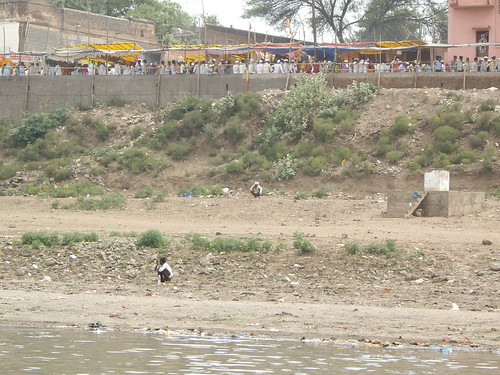
More people in India, the world’s second most crowded country, have access to a mobile telephone than to a toilet, according to a set of recommendations released today by United Nations University (UNU) on how to cut the number of people with inadequate sanitation. ...
India has some 545 million cell phones, enough to serve about 45 per cent of the population, but only about 366 million people or 31 per cent of the population had access to improved sanitation in 2008.


"I am a political liberal, but once I recognized the relative inertness and stability of the shared background knowledge students need to master reading and writing, I was forced to become an education conservative. The tacit, intergenerational knowledge required to understand the language of newspapers, lectures, the Internet, and books in the library is inherently traditional and slow to change. Logic compelled the conclusion that achieving the democratic goal of high universal literacy would require schools to practice a large measure of educational traditionalism."(via Mark Bauerlein) from E.D. Hirsch's The Making of Americans


Eight years ago, four Pashtun women told me of their assailants, three fighters from Dostum's militia, Junbish-e-Milli-e-Islami who took turn raping them all night. Technically, only one of them, Nazu, was a woman; her daughters were 10, 12, and 14. The youngest, Bibi Amina, was playing with the fringe of the giant red scarf that covered her head and smiling. It seemed to me that she had not understood what had been done to her.One of the many incidents of rape as a weapon .... this is after the fall of the Taliban government!!!
Last month, the Afghan government confirmed that it had signed into force the National Stability and Reconciliation Law -- and what a tragic misnomer that is. The law effectively amnesties all warlords and fighters responsible for large-scale human rights abuses in the preceding decades. "Their view," says Farid Mutaqi, a human rights worker in Mazar-e-Sharif, "is that justice should be the victim of peace."
You know what this means, daughters of Balkh: This means your rapes will never be punished. Perhaps, in some future iteration of war that has been rolling back and forth through these green wheat fields almost incessantly for millennia, they will be avenged -- through some other rapes, of some other women.
Whether here within the university, at think tanks, in the government, in the press, or even working with us in the labor movement, working people need the help of engaged policy intellectuals if we are together going to build an economy that works for all.From Richard Trumka's (President of AFL-CIO) speech on “Why Working People Are Angry and Why Politicians Should Listen” delivered at Harvard's Kennedy School of Government
Think about the great promise of America and the great legacy we have inherited. Our wealth as a nation and our energy as a people can deliver, in the words of my predecessor Samuel Gompers, “more schoolhouses and less jails; more books and less arsenals; more learning and less vice; more leisure and less greed; more justice and less revenge; in fact, more of the opportunities to cultivate our better natures.” ...
Working people are angry—and we are right to be angry at the betrayal of our economic future. Help us turn that anger into the energy to win a better country and a better world.

| The Daily Show With Jon Stewart | Mon - Thurs 11p / 10c | |||
| Recap - Week of 4/12/10 | ||||
| ||||

The coriander plant is native to the eastern Mediterranean, and European cooks used both seeds and leaves well into medieval times.What?
I’ve found cilantro pestos to be lotion-free and surprisingly mild. They actually have deeper roots in the Mediterranean than the basil version, and can be delicious on pasta and breads and meats. If you’re looking to work on your cilantro patterns, pesto might be the place to start.Sounds great to me. Next time I make pasta, cilantro will take the place of basil :)
If any three people are most responsible for the failure of financial regulation, they are Greenspan, Larry Summers, and my former colleague, Bob Rubin. In 1999 they advised Congress to repeal the Glass-Steagall Act, which since 1933 had separated commercial from investment banking. By 1999, Wall Street was salivating over such a repeal because it wanted to create financial supermarkets that could use commercial deposits to place bets in the financial casino. That would yield the Street trillions.Meanwhile, there is a talk that Summers is leaving the administration ...
At the same time, Greenspan, Summers, and Rubin also quashed the efforts of the Commodity Futures Trading Corporation to regulate derivatives, when its director began to worry that derivative trading already was getting out of control.
Yet Greenspan continues to take no responsibility for what occurred. In the interview he just completed he avoiding saying anything about the failure of the Fed under his watch to adequately oversee the banks, and the absence of sufficient financial regulation to begin with.
I dislike singling out individuals for blame or praise in a political system as complex as that of the United States but I worry the nation is not on the right economic road, and that these individuals — one of whom advises the President directly and the others who continue to exert substantial influence among policy makers — still don’t get it.
the long-term decline of the U.S. economy has been greatly exaggerated. America is coming back stronger, better, and faster than nearly anyone expected—and faster than most of its international rivals. The Dow Jones industrial average, hovering near 11,000, is up 70 percent in the past 13 months, and auto sales in the first quarter were up 16 percent from 2009. The economy added 162,000 jobs in March, including 17,000 in manufacturing. The dollar has gained strength, and the U.S. is back to its familiar position of lapping Europe and Japan in growth. Among large economies, only China, India, and Brazil are growing more rapidly than the U.S.—and they're doing so off a much smaller base. If the U.S. economy grows at a 3.6 percent rate this year, as Macroeconomic Advisers projects, it'll create $513 billion in new economic activity—equal to the GDP of Indonesia.Since he wrote this, the DJIA finished the day at 11,006
Some economic cheerleaders say rising stock prices are making consumers feel wealthier and therefore readier to spend. But most Americans' biggest asset is their homes. The "wealth effect" is felt mainly by the richest 10%, whose net worth is largely stocks and bonds. The top 10% accounted for about half of total national income in 2007. But they were only about 40% of total spending. A vigorous jobs recovery can't be based on 40% of what was spent before the economy collapsed.Reich worries about the job losses, and the economy's inability to create new ones, fast:
Since the start of the Great Recession in December 2007, the economy has shed 8.4 million jobs and failed to create another 2.7 million required by an ever-larger pool of potential workers. That leaves us more than 11 million jobs behind. (The number is worse if you include everyone working part-time who'd rather it be full-time, those working full-time at fewer hours, and people who are overqualified for the jobs they're in.) This means even if we enjoy a vigorous recovery that produces, say, 300,000 net new jobs a month, we could be looking at five to eight years before catching up to where we were before the recession began.Gross, any response to this one?
All well and good, the skeptics note, but we've got a long way to go. To recoup the 8.2 million jobs lost since December 2007, it'll take four years of growth at 170,000 jobs per month. And by definition, it's hard to identify the next transformative economic force—the next steam engine or interstate-highway system. White House economic adviser Larry Summers tells a story about the economic summit in Little Rock after the 1992 election. In the thousands of pages of briefing papers and policy briefs, one word didn't appear: Internet.I will stop here, before I drive myself crazy :) Can you imagine how much more incomprehensible this will all become if I added in here a truly economic conservative's analysis as well?

My piece was read by a huge number of people, who possibly then discussed it with others. There is a vast public out there; I'm determined to thicken my skin and remain a part of it.I concur.
Oranges writes:
HEADLINE NEWS: Taxes make government services available to all!mjacks06:
What a wonderful concept. It's almost like the Garden of Eden but not exactly. Close though!
Aahh, to know that government will take care of me and that I'm not responsible for anything . Nope. I inherited all that is evil dating all the way back to the day Eve ate that apple.
'Sriram Khé of Eugene is an associate professor of geography at Western Oregon University.'
Geography? They couldn't get an economics professor to write an article on taxes? Odd..
Physical education is what you learn from having your face in someone's armpit right before lunch:)

I have just finished reading a 116-page report by a committee appointed by the Delhi high court on the "condition of workers" engaged in construction work on Commonwealth Games sites in the Indian capital. The October Games, on which the government is spending more than $2bn, is the biggest international sporting event India has ever hosted. The report is shocking. It confirms Delhi's worst kept secret - how the shiny new stadia and other infrastructure hide the exploitative and unsafe conditions that 150,000 workers have to work under.So, in a vibrant, chaotic and unruly democracy that India is, one would expect such conditions to be huge political issues, right? Ain't so, writes Biswas:
But what I find particularly galling is the silence of political parties on the state of workers. The local Hindu nationalist BJP has made an issue about the proposed serving of beef to guests at the Games. The Congress-led Delhi government is going to town with a planned "good manners" campaign, imploring the city's people to behave properly during the Games. The parties of the Left are silent. All this even as the government cleared nearly 700 million rupees in extra funds for the Games, taking its bloated budget to more than $2bn.Even CNBC has reported on this!:
The main stadium is months overdue and remains a tangle of cranes, and residents are furious over new taxes to pay for the Games.Oh well .... I recall the days of the Asian Games in New Delhi, back in 1982 when I was an undergraduate student. I boycotted watching any of the events on television because I was convinced that it was a colossal waste of resources in a poor country.
Meanwhile, dozens of construction workers have died and hundreds of thousands are laboring in unsafe conditions in the rush to prepare the city for the Games, a court-appointed investigation said.... "For poor people there are no benefits from all this," said Ramesh Dubey, a sidewalk vendor angry over a proposed hike in cooking gas taxes. "This whole show is by rich people and will only benefit rich people."
I can't imagine President Obama nominating a male and, thereby, having only two women justices there.Convinced?
Judge Wood is from the University of Chicago--Obama's ol' stomping grounds
Her degrees are from the University of Texas, which breaks the Harvard-Yale stranglehold on the court.
Wood is a Protestant--Stevens is the only Protestant in the current court. (Six are Catholic, and two are Jewish)
Wood clerked for Justice Blackmun, who wrote the majority opinion in Roe v. Wade
[Richard] Dawkins and Christopher Hitchens, the atheist author, have asked human rights lawyers to produce a case for charging Pope Benedict XVI over his alleged cover-up of sexual abuse in the Catholic church.What is the case here with Pope Benedict?
The pair believe they can exploit the same legal principle used to arrest Augusto Pinochet, the late Chilean dictator, when he visited Britain in 1998.
The lawyers believe they can ask the Crown Prosecution Service to initiate criminal proceedings against the Pope, launch their own civil action against him or refer his case to the International Criminal Court.Wikipedia on Pinochet's arrest in Britain, and his trial(s)
Dawkins, author of The God Delusion, said: “This is a man whose first instinct when his priests are caught with their pants down is to cover up the scandal and damn the young victims to silence.”
Hitchens, author of God Is Not Great, said: “This man is not above or outside the law. The institutionalised concealment of child rape is a crime under any law and demands not private ceremonies of repentance or church-funded payoffs, but justice and punishment.
The Alfred P Murrah building in Oklahoma City was bombed at 9.01 in the morning, as a normal working day on the Great Plains was getting under way – not by Islamic fundamentalists plotting in Afghan caves, but by a paramilitary unit of Americans who called themselves "patriots", led by a former serviceman and 1991 Gulf war veteran, Timothy McVeigh. McVeigh was executed in 2001, and his principal accomplice, Terry Nichols, is serving life.Here is the horrible coincidence: it is on April 19th that the Tea Party folks will be holding their protests all across the country. So, let us see: people upset with taxes--which are due on the 15th--more so during this Great Rececssion; people upset with the recent healthcare reform; people worried that the government is coming after their guns; Faux News whipping up hysteria at the drop of a hat; Jihad Janes; .... and national protests are on the 19th? Seems like a horrible lining up of the planets.
Spending more on education and private security are cost-effective ways of cutting crimeOf course, we want details:
Why is private security apparently so cost-effective? One reason, says Mr Cook, is simply that guards are paid less than police officers. Another is they are dedicated to a single district and are directly responsible for making it safe. Guards can specialise. They know which shifty characters to look out for and which policing works best in their area. Unlike policemen, they are not called away to supervise a parade or protect a dignitary.How about the role of education?
Are there ways to prevent people from becoming criminals in the first place? In principle, a lengthier education ought to reduce crime by raising people’s future earning power from legitimate work, making a criminal career less attractive. School also keeps would-be criminals in touch with the right sort of peers and social attitudes. There is plenty of evidence that a lack of education goes hand in hand with criminal behaviour. Studies of America’s jail population in the 1990s showed that most inmates had not finished high school. But few studies have established that less education is actually a cause of crime.Which is why I joke around that it is better to house people in institutions of higher education than in penal institutions :) And if we didn't have faculty jobs, some of us would be in yet another type of institution--the mental institutions .... ha ha
State per capita spending on the Oregon University System has declined 44 percent in the past 15 years while spending for prisons has climbed by 50 percent ...
After my marriage at the age of 23, I was suddenly no longer alone but had a wife and a five-year-old stepdaughter, Tanya Kapka. This sudden change in my responsibilities made me realize that I had to get on with my career. I produced a passable thesis in the next year and obtained a Ph.D. in physics in 1976 just a month before our son Raman was born. But by that time I had already decided I was going to switch to biology.Let me see ... he has a PhD in physics by the age of 24, is married with two children and decides to switch to biology and then goes to grad school on that .... and does that, and more ...
On my return to Cambridge in early January, things slowly began returning to normal after the euphoria of the autumn. I began to realize that the Nobel Prize could be seen not just as an affirmation of my past work but also as an encouragement to continue to work on interesting problems. Certainly, it seems to have fired up people in my laboratory, and I look forward to the struggles ahead as we try to answer some of the hard questions in our field and beyond. Looking back on my life so far, I feel a deep sense of gratitude for having been able to lead such a rich life both intellectually and personally.Read the entire essay here
I'm sure you've heard about reverse engineering and industrial espionage -- they are the bread and butter of a competitive tech industry! -- but I had no idea there were firms, such as Chipworks, that specialize in the process. They've just released glorious, revealing details of the Apple iPad's hardware, and a complete breakdown of the new, top-secret A4 processor. For the less-technically-minded, iFixit has a walkthrough for the reverse engineering, too.
The pictures and details are juicy -- you can even order a bunch of die photos! -- but ultimately, there isn't anything exciting under the hood. The iPad is merely a large iPod Touch, with almost identical hardware in places. Chipworks calls the iPad 'a giant battery with a tiny [circuit] board attached to it' -- and looking at the picture above, you can see why!
So, no real news here I'm afraid, unless you're trying to mollify a Mac fanatic. What you're paying for is a large touch-screen and a giant battery -- you are not buying a piece of 'magic', but simply a large iPod Touch. The devil, as always, is in the software. It would not be the first time that Apple has shoehorned some fantastic software into a shiny, but otherwise lackluster hardware package.
In my opinion, the coolest part of this story is that Chipworks tears apart of bleeding-edge technology to produce full, reproducible schematics of a device's circuitry. Nothing is sacred!

This is part of a longer-term trend. Here are the admission rates from about 10 years before this graph begins:
Harvard: 12 %
Princeton: 14 %
Yale: 20 %
MIT: 27 %
Stanford: 19 %
It’s been a tough time lately for those of us who take social studies seriously.Examples?
The governor of Virginia has decided to bring slavery into his overview of the history of the Confederacy. Good news, or is this setting the bar a wee bit too low?If you remotely thought that the Guam tipping over comment is an exaggeration, well, it is not. Watch this absolutely surreal pontification by Johnson and, if you are like me, you will wonder how the admiral kept a straight face!
...
History took a hit in Texas, where the state Board of Education tried to demote Thomas Jefferson, presumably because of his enthusiasm for separation of church and state. This week, John McCain rewrote his own political biography, telling Newsweek: “I never considered myself a maverick.” And on the geography front, Representative Hank Johnson of Georgia took time during a recent Congressional hearing to express his concern that stationing additional Marines on Guam would make the island “so overly populated that it will tip over and capsize.”
| The Colbert Report | Mon - Thurs 11:30pm / 10:30c | |||
| Al Sharpton | ||||
| ||||
| The Daily Show With Jon Stewart | Mon - Thurs 11p / 10c | |||
| Jock Rap | ||||
| ||||
The modern American typically relates warmly to the use of English to the extent that it summons the oral — “You betcha,” “Yes we can!” -- while passing from indifference to discomfort to the extent that its use leans towards the stringent artifice of written language. As such, Sarah Palin can talk, basically, like a child and be lionized by a robust number of perfectly intelligent people as an avatar of American culture. And linguistically, let’s face it: she is.Complete essay here. ht
a novel solution last fall. She outsourced assignment grading to a company whose employees are mostly in Asia.Was daily life always this fascinating with new developments all the time? I am glad I live now.
Virtual-TA, a service of a company called EduMetry Inc., took over. The goal of the service is to relieve professors and teaching assistants of a traditional and sometimes tiresome task—and even, the company says, to do it better than TA's can.
The graders working for EduMetry, based in a Virginia suburb of Washington, are concentrated in India, Singapore, and Malaysia, along with some in the United States and elsewhere. They do their work online and communicate with professors via e-mail. The company advertises that its graders hold advanced degrees and can quickly turn around assignments with sophisticated commentary, because they are not juggling their own course work, too.
The assessors use technology that allows them to embed comments in each document; professors can review the results (and edit them if they choose) before passing assignments back to students. In addition, professors receive a summary of comments from each assignment, designed to show common "trouble spots" among students' answers, among other things. The assessors have no contact with students, and the assignments they grade are stripped of identifying information. Ms. Sherman says most papers are returned in three or four days, which can be key when it comes to how students learn.
No Classroom Insight
Critics of outsourced grading, however, say the lack of a personal relationship is a problem.
"An outside grader has no insight into how classroom discussion may have played into what a student wrote in their paper," says Marilyn Valentino, chair of the board of the Conference on College Composition and Communication and a veteran professor of English at Lorain County Community College. "Are they able to say, 'Oh, I understand where that came from' or 'I understand why they thought that, because Mary said that in class'?"