Saturday, January 09, 2010

"The White Messiah" in Hollywood movies

Who knew that David Brooks is a good movie reviewer too! :)
I have not seen Avatar, nor do I have any plans to.  I remember reading the lengthy feature about the movie and the director in the New Yorker, and that was enough for me.  Anyway, Brooks has a great column in which he writes that Avatar:
rests on the stereotype that white people are rationalist and technocratic while colonial victims are spiritual and athletic. It rests on the assumption that nonwhites need the White Messiah to lead their crusades. It rests on the assumption that illiteracy is the path to grace. It also creates a sort of two-edged cultural imperialism. Natives can either have their history shaped by cruel imperialists or benevolent ones, but either way, they are going to be supporting actors in our journey to self-admiration.
It’s just escapism, obviously, but benevolent romanticism can be just as condescending as the malevolent kind — even when you surround it with pop-up ferns and floating mountains.
 Yep.  It makes for romantic escapism, as much as "Dances with Wolves" or "The Last Samurai" were .... Oh, wait, I did go to see those movies!  I suppose I am older and wiser now. At least, I think so :D

The US, al Qaeda .... need a new Obama doctrine

So, it turns out that there a lot more people, not just Greenwald, who want us to think differently about this whole war on terror.  Here is Stephen Walt:
what's troubling is the extent to which the Obama administration appears to be continuing many of the same activities that have inspired anti-American extremism and undermined the governments that do seem to like us, without much consideration about the balance of costs and benefits that this may involve.
And then Walt adds:
My point is simply to reiterate that any serious effort to deal with our terrorism problem has to be multi-faceted, and has to include explicit consideration of the things we do that may encourage violent, anti-American movements. Only a complete head-in-the-sand approach to the issue would deny the connection between various aspects of U.S. foreign and military policy (military interventions, targeted assassinations, unconditional support for Israel, cozy relations with Arab dictatorships, etc.) and the fact that groups like al Qaeda keep finding people like al-Balawi to recruit to their cause. 
By itself, that mere fact does not mean that U.S. foreign policy is wrong. As I said a few days ago, one could make a case that our policy is mostly right, and that these problems are just the price we have to pay for them. But instead of having a serious debate on this question, we mostly ignore the possibility that our own actions might be making the problem worse, or we accuse anyone who does raise it of trying to "blame America first." 

Friday, January 08, 2010

The conservative case for gay marriage

We are at war! We are at war! :( .... well, war is NOT the answer

So we've spent the last decade screaming to the world that WE ARE AT WAR!, that we're a War Nation, that we're led by a War President.  That we are "at war" -- not just in Iraq and Afghanistan, but generally against Islamic extremists -- is an absolute bipartisan orthodoxy that must be affirmed by all Serious people.  And we are currently waging some form of actual war in no fewer than five predominantly Muslim countries (Afghanistan, Pakistan, Iraq, Yemen and Somalia); are threatening Iran with "crippling" sanctions and -- from our more deranged quarters -- war
Glenn Greenwald, as always, is sharp in his commentary, with a laser-like focus, and has a powerful way with words. He then writes:
It's truly astounding to watch us -- for a full decade -- send fighter jets and drones and bombs and invading forces and teams of torturers and kidnappers to that part of the world, or, as we were doing long before 9/11, to overthrow their governments, prop up their dictators, occupy what they perceive as holy land with our foreign troops, and arm Israel to the teeth, and then act surprised and confused when some of them want to attack us.  In general, the U.S. only attacks countries with no capabilities to attack us back in the "homeland" -- at least not with conventional forces.  As a result, we have come to believe that any forms of violence we perpetrate on them over there is justifiable and natural, but the Laws of Humanity are instantly breached in the most egregious ways whenever they bring violence back to the U.S., aimed at Americans.  It's just impossible to listen to discussions grounded in this warped mentality without being astounded at how irrational it is.  What do Americans think is going to happen if we continue to engage in this conduct, in this always-widening "war"?
It is absolutely disheartening that for us here in the US, the first decade of the 21st century was all about war.  And it does not look like it will end soon either.  We are becoming a phenomenally huge version of Israel, which views its need for security and war as existential.  But, it is not--our daily lives are not subject to security threats that Israel faces every single day.  Israel fought wars with countries--yes, in plural--that were/are its neighbors.  Oh well .... I do not mean to imply that everything that Israel does is justifiable.  Not at all.  But, at least there is a reason for that madness.  Other than toppling the Taliban regime, and apprehending bin Laden and Zawahiri, well, we had no reason to do anything else.

Greenwald ends his updates with this:
Just contemplate how many Balawis [the suicide bomber who killed seven CIA officers] there are in the world:  Muslims who begin with sympathy towards the U.S. and hostility towards Al Qaeda who are completely transformed into the opposite as a result of the constant civilian death we and Israel bring (regardless of intent) to that part of the world.

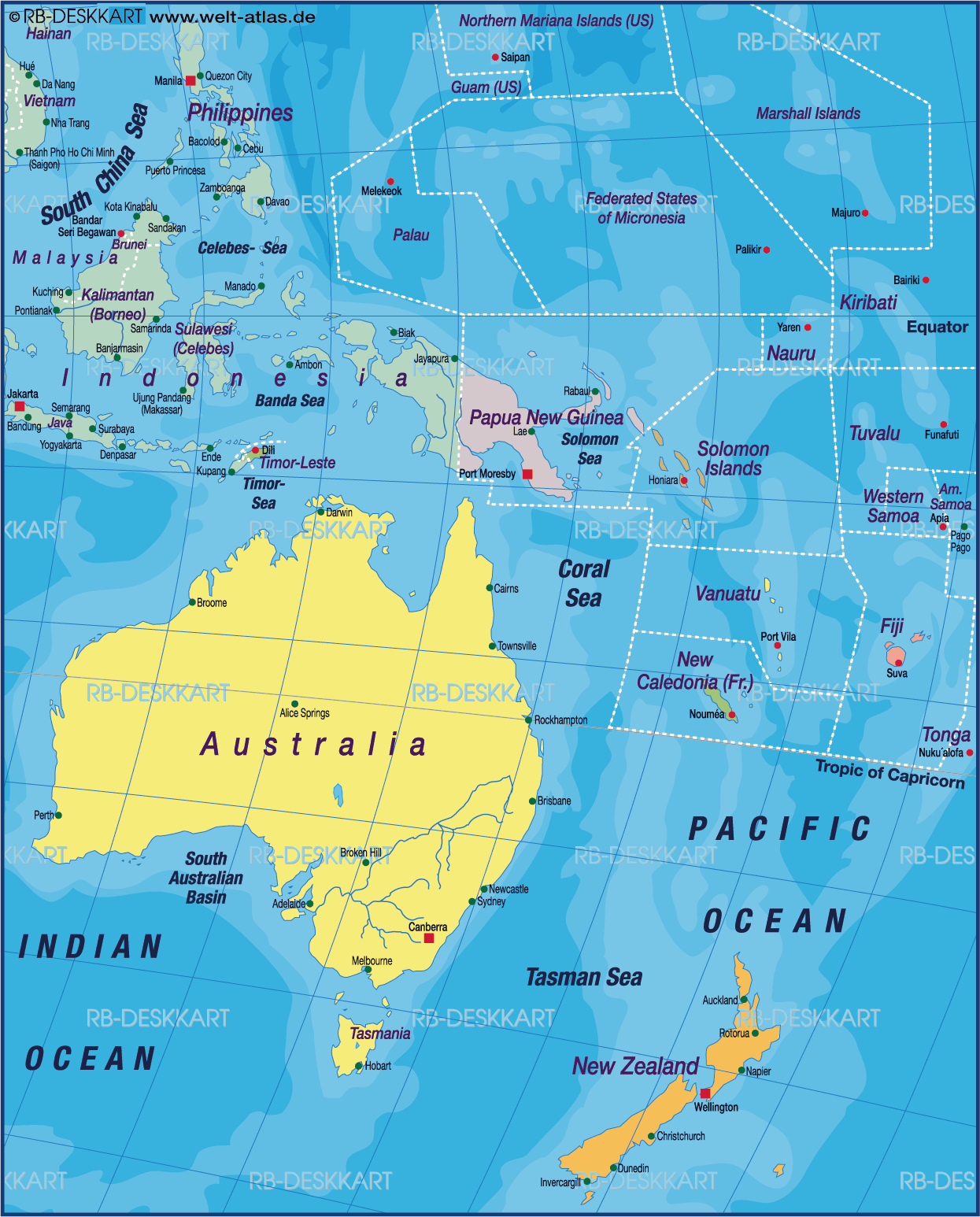
How Americans learn world geography :(

The Daily Show With Jon StewartMon - Thurs 11p / 10c
Terror 2.0 by Yemen - Sad Libs
www.thedailyshow.com
Daily Show
Full Episodes
Political HumorHealth Care Crisis

Thursday, January 07, 2010

Congo's stimulus plan: An AK-47 for everyone!

The folks are the Onion are simply way too well informed, wise, brilliant, and hysterically funny, to come up with stuff like this all the time.
It is a tragedy that the war and killings go on in the Congo, while we seem to be far more interested in Star Wars and Avatars .... oh well, I suppose we will continue to ignore Africa a lot more ...


Congo Approves Economic Stimulus Package Of AK-47 For Every Citizen

C-Span: "we report, you don't care" :-)

The Colbert ReportMon - Thurs 11:30pm / 10:30c
Drag Me to Health - Ezra Klein & Linda Douglass
www.colbertnation.com
Colbert Report Full EpisodesPolitical HumorEconomy

Tuesday, January 05, 2010

How do you solve a problem like .... China?


How do you solve a problem like .... India?

Barbara Crossette over at Foreign Policy has an interesting argument:
On crucial matters of global concern, from climate change to multilateral trade, India all too often just says no. India, first and foremost, believes that the world's rules don't apply to it.
Yes, indeed.  I agree with her bottom line. 

India gets a free pass most of the time because of its democracy.  But, otherwise, it is often a cantankerous global participant.  The examples Crossette gives are right on--from nuclear weapons, to international trade agreements, to, of course, climate change.  Yes, India does have some valid reasons--the country's stance is not as irrational as North Korea's can be.  But, while India is great at mouthing impressive rhetoric, well, those rules are for the rest of the world :-)

It is simply a fascinating country to observe from the outside.  Academics have a continuous supply of issues to write about, and I suppose we ought to be thankful for that!  Earlier today in a conversation with a colleague, we observed that people rush around in India making money from every possible capitalist venture, while simultaneously talking about Bapuji (Gandhi), and various gurujis.  It is one crazy place.  But, you know what, that persona is also why India gets all the free passes it does, which is how then the country walks around with a "what? me?" look that then generates even more sympathy for the country. 
"There's a certain style of Indian diplomacy that alienates debating partners, allies, and opponents."
Well said :-)

The underwear bomber: the rest of the story!


Ford and Toyota sell .... Chrysler and GM?

Turns out that Government Motors General Motors, is still struggling .... while Ford, which did not get any bailout money, is doing fine, says the WSJ:

Ford Motor Co. posted a 33% rise in December U.S. light-vehicle sales, ending a stellar year for the auto maker compared with its rivals. Ford recorded its first full-year market-share gain since 1995.
Meanwhile, Chrysler Group LLC posted a 3.7% decline compared with a year earlier and said its full-year sales were the worst the auto maker had seen in 47 years.
The largest U.S. auto maker—General Motors Co.—posted a 5.7% decline, but said its process to sell down Pontiac and Saturn inventory was ahead of schedule and reported a 2.2% increase for the four brands GM will keep after its streamlining.
Toyota Motor Corp. of Japan said its U.S. sales rose 32% to 187,860 vehicles last month.
The results underscore how the auto makers have responded to the recession that began officially in December 2007 and led to the bankruptcy filings of Chrysler and GM.
More cash for clunkers?

Tiger Woods, Brit Hume, and Bill O'Reilly: Heights of WTF!

I hope Christopher Hitchens will write something about this; I can't think of anybody more qualified and talented than him ....

Monday, January 04, 2010

Stay away from grad programs in the humanities ... and social sciences too

As always, Thomas Benton (William Pannapacker) has wise words to offer in his Chronicle column:
I can only identify a few circumstances under which one might reasonably consider going to graduate school in the humanities:
  • You are independently wealthy, and you have no need to earn a living for yourself or provide for anyone else.
  • You come from that small class of well-connected people in academe who will be able to find a place for you somewhere.
  • You can rely on a partner to provide all of the income and benefits needed by your household.
  • You are earning a credential for a position that you already hold — such as a high-school teacher — and your employer is paying for it.
Those are the only people who can safely undertake doctoral education in the humanities. Everyone else who does so is taking an enormous personal risk, the full consequences of which they cannot assess because they do not understand how the academic-labor system works and will not listen to people who try to tell them.

Here are some more posts from the past related to graduate school--yes, very discouraging, I know :(

For Tanzania, foreign aid part of global connections

Appeared in print: Monday, Jan 4, 2010

DAR ES SALAAM, Tanznia — In 1498 a new connection was made between India and Africa when the Portuguese explorer Vasco da Gama rounded Africa’s Cape of Good Hope, paused for a while in Mozambique and finally reached the land of pepper, which was the original “black gold.” When he landed in Kozhikode in India’s state of Kerala, da Gama one-upped Christopher Columbus, who had mistakenly claimed to have reached India.

The spices that drew the European explorers quickly transformed into political and military conquests. Thus, when da Gama undertook a second expedition in 1502, it was with cannons aboard a large fleet. What followed, as they say, was history. Five centuries later, “globalization,” which has its origins in those European maritime explorations, has become a household world.

The economic and cultural interconnections between peoples and countries present themselves every day. In my trip to Tanzania, these connections were evident right from the start at Dar es Salaam airport, where I was picked up by a couple from India, who came to Tanzania four years ago because of professional banking opportunities. I suppose people of Indian origin are everywhere on this planet!

They joked that the celebrations outside the airport were in my honor, and quickly followed up with the explanation that I had landed on Tanzania’s independence day. It is certainly an extraordinary achievement for Tanzania to have experienced 48 years of self-rule, without the ethnic strife that unfortunately characterizes many of its neighboring countries — Rwanda and the Congo, in particular.

Tanzania’s connections to the global economy are all around, especially with Japanese cars on the roads, and people driving and walking around with Swedish- and Korean-made cell phones. It was quite mind-boggling to read the news item that “Kuwait-based Zain Group has awarded Nokia Siemens Networks a five-year outsourcing contract to manage and upgrade its mobile networks in Kenya, Tanzania and Uganda.” What fascinating complexities: A Kuwait-based corporation responsible for the mobile phone operations in Tanzania, awarding the contract for day-to-day management to a company whose global headquarters are in Finland!

As if such a web of global economic interconnections were not enough, it turns out that the CEO of Nokia Siemens is, you guessed it, from India!

But this is also where Tanzania’s disconnect is obvious — the absence of Tanzania-made products. As students in my introductory course find out through their assignments, we consumers in the United States rarely come across products manufactured in Tanzania or any of the other African countries.

The Tanzanian government, not unlike other countries whose policies were heavily influenced by socialist ideals, is maneuvering in many ways to reverse the old policies and integrate the country into the global economy, and has done so with moderate success. Until the Great Recession hit, Tanzania had one of the best economic growth rates in all of sub-Saharan Africa.

However, Tanzania is also plugged into the economic world in a very different way — through foreign aid. According to the Development Partners Group, which comprises 16 bilateral aid groups and five international bodies including the United Nations, “Tanzania is one of the largest recipient countries of foreign aid in sub-Sahara Africa. Approximately 35 percent of government spending is dependent on foreign aid.” Last year, official development assistance from the U.S. government alone was more than $360 million — roughly $1 million in U.S. aid per day.

A lot of the aid is theoretically aimed at reducing poverty and economic development, which is also what I hope to understand during this trip. I will be spending an overwhelming majority of my time in the southern highlands. As the commercial capital of Tanzania, Dar es Salaam projects an image that is not quite reflective of the country where more than a third of the country subsists at below poverty levels as defined by the Tanzanian government. Neither are the shiny new multistoried buildings in the city’s center representative of the about 80 percent of the population that lives in rural areas.

But it is a long, long way to the highlands from the Mozambique shores where Vasco da Gama landed more than 500 years ago. If I will be able to get chicken tikka masala out in the villages in those highlands, I will need no further evidence of globalization!