Monday, November 30, 2009

It was not a sari that the White House gate-crasher wore

I heard a couple of reporters describe that the female of the duo was attired in a sari.
Well, technically that is not a sari. She is wearing what is referred to as a "lengha" or a "ghagra choli."
(Editor: do you really know what you are talking about? Hey, when has that ever stopped me?)
As this detailed explanation of the lengha points out, it seems to capture the fashion spotlight quite a bit.
More photos/models here.
So, what is the big deal, you ask? The answers are in this book; actually in the title!
D-Day in the Afghan War
President Obama nears his decision time, and Fred Kaplan's column explains well why this is a tough decision to make:
when it comes to this war, I am the one thing that a columnist probably shouldn't be—ambivalent. I've studied all the pros and cons. There are valid arguments to justify each side of the issue, and there are still more valid arguments to slap each side down. And if the basic decision were left up to me, I'm not sure what I would do.His parting paragraph is awesome:
My guess is that President Obama held so many meetings with his national-security advisers on this topic—nine, plus a 10th on Sunday night to get their orders and talking points straight—because he wanted to break through his own ambivalences; because he needed to come up with a reason (not just a rationalization) for doing whatever it is that he's decided to do, some assurance that it really does make sense, that it has a chance of working, so he can defend it to Congress, the nation, and the world with conviction. Let's hope he found something. A columnist can be ambivalent; a president can't be.Meanwhile, Pakistan has a few decisions to make as well--on its own, and in response to whatever Obama reveals tomorrow. Christopher Hitchens sums it up really well:
When the throat-slitters and school-burners and woman-stoners come to the villagers of Pakistan and Afghanistan at dead of night, they have one great psychological advantage. "One day, the Americans and the Europeans will go," they say. "But we will always be here." There's some truth in this: Most of the talk in this country is now of an "exit strategy," and for all the good they are doing, most of the other NATO contingents might as well have shipped out already. But if the United States was to upgrade and cement an economic, military, and political alliance with the emerging giant in New Delhi, we could guarantee without any boasting that our presence in the area was enduring and unbudgeable. It would also be based more on mutual friendship and common values and less on the humiliating practice of bribery and cajolery. And the Pakistani elite would have to decide which was its true enemy: the Taliban/al-Qaida alliance or the Indo-American one.What a mess. But, the last thing we needed at this critical juncture was an inane demand from the UK that Pakistan do more to apprehend bin Laden. What was Brown smoking?
Afghanistan: not very Jungian
From the international edition of Germany's Der Spiegel:
A deadly airstrike on two tankers in Afghanistan in September has proved to be a political timebomb in Berlin.
On Thursday Germany's top soldier and a deputy defense minister were forced to resign after revelations that the German army command and the Defense Ministry had been sent reports showing that there had been civilian casualties after the German-ordered airstrike. This was contrary to the initial claim by the government that only Taliban fighters had been killed in the attack. On Friday it was former Defense Minister Franz Josef Jung's turn to fall on his sword. The clamor for his resignation in the light of his disastrous handling of the aftermath of the airstrike had grown too loud.
Sunday, November 29, 2009
"Finish the job"--out of Iraq and Afghanistan NOW!
I have no idea what our (US) mission is for the US and NATO forces in Afghanistan. The number of US military personnel dead is one too many. The number of Afghans, and Iraqis, who have died, been injured, and displaced is one too many.
Meanwhile, here at home:
Iraq veteran Jessie Bratcher shot the man he was told had raped his girlfriend. An Oregon jury found he had been legally insane at the time because of post-traumatic stress disorder.The sociologist, William Brown, quoted in that story is my colleague--he is known to friends and colleagues as "Bud." A Vietnam veteran himself, Bud has invested a great deal of time and his own money in post traumatic stress disorder (PTSD) cases in particular. He provides a compelling analogy to help us laypeople understand. There is a difference between civilian and military lives and work. For all purposes, the civilian and military "operating systems" and software are very different and, sometimes, incompatible. Unfortunately, while the military is very good at installing new software when civilians enlist, it does a horrible job of removing the killing software before returning the soldiers to civilian lives.
To make things worse, the VA does not give PTSD the attention and respect it deserves.
I can only imagine that pretty much the entire Afghan society is in a permanent state of PTSD. Given that Afghanistan was practically in a state of civil war even before the Soviet tanks rumbled into Kabul that fateful Christmas night in 1979, we are now looking at two generations of Afghans who have known nothing but wars and chaos in their countries. That is the "normal" for them? What a crazy world we live in!
End the bloody wars now. Please.
Saturday, November 28, 2009
A tale of two countries and their catastrophes
Writes Pankaj Mishra:
India may have been passive after the Mumbai attacks. But India has not launched wars against either abstract nouns or actual countries that it has no hope of winning or even disengaging from. Another major terrorist assault on our large and chaotic cities is very probable, but it is unlikely to have the sort of effect that 9/11 had on America.
This is largely because many Indians still live with a sense of permanent crisis, of a world out of joint, where violence can be contained but never fully prevented, and where human action quickly reveals its tragic limits. The fatalism I sense in my village may be the consolation of the weak, of those powerless to shape the world to their ends. But it also provides a built-in check against the arrogance of power — and the hubris that has made America’s response to 9/11 so disastrously counterproductive.
The Middle Eastern financial earthquake from Dubai
A few days ago, I told my colleague that we are only an event away from a double-dip-recession .... the much feared w-shaped recession and recovery.
 I thought that the second dip would result from an event in the Middle East--Iran, or the Israel-Palestine issue, or Iraq.
But, could Dubai's sovereign default reverse any recovery and slide us down a second recessionary dip?
What sayeth Krugman?
But, could Dubai's sovereign default reverse any recovery and slide us down a second recessionary dip?
What sayeth Krugman?
First, there’s the view that this is the beginning of many sovereign defaults, and that we’re now seeing the end of the ability of governments to use deficit spending to fight the slump. That’s the view being suggested, if I understand correctly, by the Roubini people and in a softer version by Gillian Tett.Horrible times. If only our collective madness hadn't found it worthwhile to invest a gazillion dollars in crazy developments
Alternatively, you can see this as basically just another commercial real estate bust. Either you view Dubai World as nothing special, despite sovereign ownership, as Willem Buiter does; or you think of the emirate as a whole as, in effect, a highly leveraged CRE investor facing the same problems as many others in the same situation.
Finally, you can see Dubai as sui generis. And really, there has been nothing else quite like it.
At the moment, I’m leaning to a combination of two and three. For what it’s worth (not much), US bond prices are up right now, suggesting that the Dubai thing hasn’t raised expectations of default.
Anyway, we continue to live in interesting times.
Friday, November 27, 2009
Not from Monty Python, but from Senator James Inhofe
From the NY Times Magazine: (in bold are the questions, and his responses follow)
You think the detainees at Guantánamo eat better than you do?
I’m talking about before they got in there, what they ate back in Yemen or wherever they came from. One of the big problems is they become obese when they get here because they’ve never eaten that good before. Can you tell me one reason to close Gitmo?
Because it’s on foreign soil, where prisoners don’t have the same legal rights as prisoners tried here, and we want to apply the same laws to everybody.
You want to apply the same laws to terrorists that are captured as you do to criminals in America?
Yes.
Wow.
Because we have to take the high road as Americans.
I see. That’s an interesting concept.
Thursday, November 26, 2009
Mobile phone ops in Tanzania: a story of globalization by itself
Kuwait-based Zain Group has awarded Nokia Siemens Networks (NSN) a five-year outsourcing contract to manage and upgrade its mobile networks in Kenya, Tanzania and Uganda.So, a corporation based in Kuwait is responsible for the mobile phone operations in Tanzania--and Kenya, and Uganda. And this corporation awards the contract for the day-to-day management to Nokia Siemens, the global headquarters for which are in, Finland I assume!
The eternally curious guy that I am, I thought I would explore who actually runs Nokia Siemens.
Laugh not: the CEO is Rajeev Suri. Of course, not only an Indian name, the guy is from India :-) And the second in command there? Ashish Chowdhary. Turns out Suri is three years younger than me, and Chowdhary is one year older than me. It is because of such reasons that my parents for a long time could not understand why I ditched electrical engineering when quite a few from my cohort--the larger sense--were raking in money like crazy, even at a middle management level.
It is one crazy world, man, one crazy world!
Delhi, globalization, and ..... the Ramayana? and Freud?
‘You know about the Oedipus complex? Freud said this was the universal condition of young men: they unconsciously want to kill their fathers and sleep with their mothers. That’s the source of revolutionary energy – you kill your father symbolically by rejecting all his values and finding new ones. But I don’t think this applies to Indian men. I would analyse Indian men in terms of what I call the Rama complex. In the epic poem Ramayana, Rama gives up the throne that is rightfully his and submits himself to enormous suffering in order to conform to the will of his father. Indian men don’t wish to kill their fathers, they wish to become them; they wish to empty themselves out of everything that has not come from their fathers.’That was from an essay in Granta.
I thought it was about time I re-visited Granta; I do that every once in a while. I don't understand why I do that though. Because, rarely do I find essays or fiction that resonate with me. The poems there are, well, like the essays--way too pretentious.
Well, I know why I visit Granta--occasionally I come across a piece like the one on Pondicherry. And because I still carry a torch for the kind of issues that are normally addressed only by the lefty-left and the greenies.
Anyway, back to this quote and the essay itself ... I wonder if any of the "Indian" readers have anything to say about the quote, and the entire essay too .... anybody? :-)

Wednesday, November 25, 2009
East African Community--signs of hope
I think back in India we still have a couple of stamps in our collection that refer to the Kenya-Uganda-Tanzania alliance that later collapsed. Now, the alliance is regrouping, with Rwanda and Burundi also in the mix. Good for them, I say. You--the reader--ought to be happy too. (editor: what makes you think that this blog actually has readers? Well, the site traffic data?)

The note accompanying the photo at the source reads:
Leaders of the Eastern African Community sign the common market treaty
Of course, this will not be a common market when I am there in Tanzania in, oh my freaking life, two weeks!!!
It was interesting to read in that news item the following quote:
How much ever I am familiar with the idea that there are people of Indian origin scattered all over the planet, it continues to amaze me that it is such a global group. When I was young--a long time ago--a new kid (Belliappa) who joined our school had spent a couple of years in Kenya because his dad was working there. That might have been the first time I came face-to-face with what was otherwise merely news reports. I wonder what that guy is up to now ....
From Neyveli to America to Tanzania ..... I would not have imagined such a life journey .... awesome!
Leaders of the Eastern African Community sign the common market treaty
Of course, this will not be a common market when I am there in Tanzania in, oh my freaking life, two weeks!!!
It was interesting to read in that news item the following quote:
"From 36 million people in the Kenyan market we are moving to 126 million. The impact is going to be great," said Vimal Shah, the chief of a giant Kenyan beverages and food manufacturer.Vimal Shah!
"We cannot remain an island anymore. The key now is to become competitive."
How much ever I am familiar with the idea that there are people of Indian origin scattered all over the planet, it continues to amaze me that it is such a global group. When I was young--a long time ago--a new kid (Belliappa) who joined our school had spent a couple of years in Kenya because his dad was working there. That might have been the first time I came face-to-face with what was otherwise merely news reports. I wonder what that guy is up to now ....
From Neyveli to America to Tanzania ..... I would not have imagined such a life journey .... awesome!
Remembrance of things past--Thanksgiving
The following was published in the Register Guard, back in 2007:
Above all, I am eternally thankful for having had the opportunity to immigrate to, and become a citizen of, this wonderful country, and then to move to the paradise that the Willamette Valley
Given my accent and distinctly ethnic appearance, it is not any surprise when students ask me whether I celebrate Thanksgiving. To me, the answer is a no-brainer: of course, yes.
If unable to shake off the teacher within me, I might then use the students’ question as a learning opportunity and ask them whether Native Americans and African Americans will be thrilled about Thanksgiving, and whether their responses could be different from how the movies depict the day. “Would you be thankful if you had been brought over as a slave, or if your people were practically wiped off the face of the earth?” is my typical probing question.
As I see their eyes glaze over, perhaps even regretting broaching this topic with me, I lighten it up with my old joke that the best thing about inviting me to Thanksgiving supper is that I am simultaneously both an Indian and an American.
As is the case with me, there is a good chance that to most of us Thanksgiving has expanded beyond the notion of remembering the meal that the early settlers had with Native Americans. Now, Thanksgiving is a day for families to get together, with a common theme of feeling grateful for the good things over the year.
In such an understanding, I would think that “giving thanks” is a universal notion, irrespective of histories, cultures, and traditions. I cannot imagine people in any culture not being thankful for surviving yet another day, or for enjoying life with people they cherish.
I am sure my parents tried drilling into me such a concept of life when I was young and, like most kids, I probably ignored their comments and rolled my eyeballs way up. In any case, every other day it seemed like we had a religious event to thank any one of the thousands of Hindu gods and to pray for the continuation of the good things.
My grandmother, though, was always a tad hesitant to loudly recognize the good things out of a fear that this might trigger the onset of unfortunate events. “Don’t laugh too much,” she warned, “because you will end up crying.” Having experienced too many unfortunate events, including the death of her husband when she was only eighteen and when her son—my father—was barely a month old infant, my grandmother had enough reasons to be cautiously optimistic.
While a day for giving thanks does not seem to have become quite global, Valentine’s Day, on the other hand, is one of the few that has caught on almost all over the world. We might think this is a great idea—“make love, not war”—but, apparently even saying “I love you” can cause controversies. In India
Yes, it is an irony that India, which is known to many in the west only for a much misunderstood Kama Sutra, has quite a few who think celebrating love is not Indian. In a letter to a moderate mainstream newspaper last February, one reader suggested that “to avoid further controversy, the government should restrict, if not control, the celebrations.” I suppose the Hindu god of love, Kama , ought to be thanked for making sure that sanity prevailed. Of course, love triumphs, and people in urban India
Perhaps the reason for why a day of giving thanks is not as universal as it ought to be lies in lighthearted remarks of a friend, an immigrant herself—she tried to convince me that Thanksgiving is the day that husbands buy gifts for their wives. Could it be that a day to give thanks has not caught on, as much as Valentine’s Day has, because there is no gift-giving associated with it? If that is indeed the case, then I have yet another reason to be thankful for.
Tuesday, November 24, 2009
Billion-plus in the dark, while we energy hogs whine
Get this:
But, these are the kind of issues that will bubble up at Copenhagen and other conferences. My metaphorical hat is off to people who bring such issues to our attention:
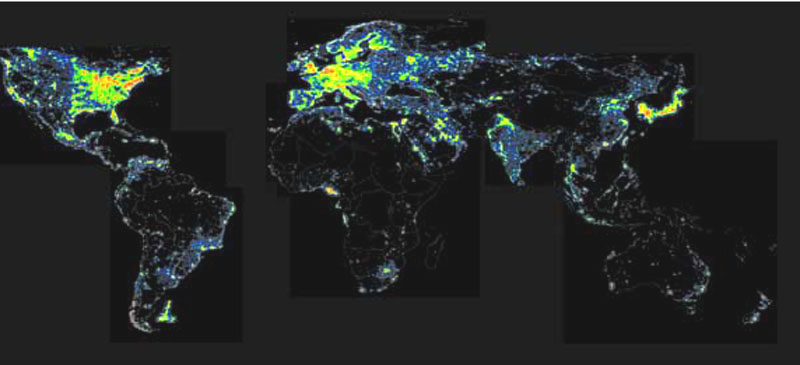
This map of the world shows the artificial light used in the night--a measure of electricity usage.
An estimated 79 percent of the people in the Third World -- the 50 poorest nations -- have no access to electricity, despite decades of international development work. The total number of individuals without electric power is put at about 1.5 billion, or a quarter of the world's population, concentrated mostly in Africa and southern Asia.In case you missed that last sentence, let me repeat that quote:
The 1.5 billion figure represents an improvement over previous years, but not because of any concerted effort to expand power connections. Rather, it is a consequence of rapid urbanization with populations moving to electricity and not the other way around, said Fatih Birol, IEA's chief economist.
"This is very bad and is something that the energy community and others should be ashamed of," Birol said. The amount of electricity consumed in one day in all sub-Saharan Africa, minus South Africa, is about equal to that consumed in New York City, an indicator of the huge gap in electricity usage in the world.
The amount of electricity consumed in one day in all sub-Saharan Africa, minus South Africa, is about equal to that consumed in New York CityWe don't talk enough about this HUGE imbalance. I suppose it is because we will feel guilty as a result; denial helps, eh!
But, these are the kind of issues that will bubble up at Copenhagen and other conferences. My metaphorical hat is off to people who bring such issues to our attention:
about 2.5 billion people globally subsist on wood or charcoal. With so much attention on the energy consumption habits of larger economies in the climate talks, the report's authors say they worry that the plight of those without any modern power is being willfully ignored. A quarter of the world is disconnected from debates over clean energy "because their reality is much more basic than that," said UNDP's director of development planning, Olav Kjørven.
India news all the time? Slow down, please ....
Way too much about India .... First, here is a groaner (at least according to my students!): Looks like Obama has advanced the Thanksgiving dinner, but wait, he has invited the wrong Indian to a state dinner at the White House ... ha ha ha
What do you expect here; this is not a comedy show!
So, Manmohan Singh is visiting the US and is dining with the Prez. I don't know if this was the only date open in Obama's calendar, or whether this was a calculation to get Singh's input as well into the Afghanistan decisionmaking. If these two were reasons, great.
If not, it is really lousy timing. Why?
For one, the release of the report after what seemed like a gazillion years of investigation into the destruction of the Babri Masjid by Hindu fanatics. Even Time has a rather lengthy report on it:
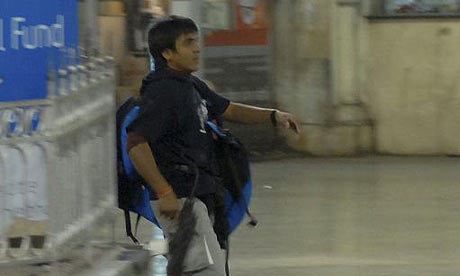
I am not sure when Singh returns to India, because November 26th is a day that I think he ought to be in the country. The photo on the left is eerie, even after all these months.
When I went to India a few months ago, during the couple of days I was in Bombay (yes, I way prefer this to Mumbai!) I swung by two of the sites of that horrible terrorist acts--the Taj hotel, and the railway station
What do you expect here; this is not a comedy show!
So, Manmohan Singh is visiting the US and is dining with the Prez. I don't know if this was the only date open in Obama's calendar, or whether this was a calculation to get Singh's input as well into the Afghanistan decisionmaking. If these two were reasons, great.
If not, it is really lousy timing. Why?
For one, the release of the report after what seemed like a gazillion years of investigation into the destruction of the Babri Masjid by Hindu fanatics. Even Time has a rather lengthy report on it:
Even as Prime Minister Manmohan Singh arrived in Washington Monday to represent an India emerging as a cosmopolitan economic powerhouse, his parliament sent an ugly reminder that the world's largest democracy has a dark side: Both chambers of India's parliament have had to be adjourned repeatedly over the past two days amid a furor over leaked findings of a judicial inquiry into the destruction of the Babri mosque in Ayodhya in 1992. The mosque was destroyed by Hindu extremists in order to rebuild a Hindu temple that had stood on the same site hundreds of years earlier, and it triggered a wave of Hindu-Muslim violence that left more than 2,000 people dead.
Hmm.... and the prime minister is out of the country.
Ok, understandable if Obama's calendar or the Afghan situation warranted it.
When I went to India a few months ago, during the couple of days I was in Bombay (yes, I way prefer this to Mumbai!) I swung by two of the sites of that horrible terrorist acts--the Taj hotel, and the railway station
Making (non)sense of healthcare reform
When a pretentious and half-baked nincompoop like me in the academic backwaters of a state that is often mispronounced has opinions on healthcare reform, then surely the Dean of Harvard's Medical School has opinions on this, right? And when it comes down to it, I bet this Dean's explanations on what the reform entails will have more credibility than mine; wouldn't you think so too?
Which is why I am worried about some of the points that this Dean raises:
Anonymous Philanthropist Donates 200 Human Kidneys To Hospital
Which is why I am worried about some of the points that this Dean raises:
In discussions with dozens of health-care leaders and economists, I find near unanimity of opinion that, whatever its shape, the final legislation that will emerge from Congress will markedly accelerate national health-care spending rather than restrain it. Likewise, nearly all agree that the legislation would do little or nothing to improve quality or change health-care's dysfunctional delivery system. The system we have now promotes fragmented care and makes it more difficult than it should be to assess outcomes and patient satisfaction. The true costs of health care are disguised, competition based on price and quality are almost impossible, and patients lose their ability to be the ultimate judges of value.All too confusing this healthcare reform is. So, as always, I turned to the only real source of news and wisdom: The Onion:
Worse, currently proposed federal legislation would undermine any potential for real innovation in insurance and the provision of care. It would do so by overregulating the health-care system in the service of special interests such as insurance companies, hospitals, professional organizations and pharmaceutical companies, rather than the patients who should be our primary concern.
In effect, while the legislation would enhance access to insurance, the trade-off would be an accelerated crisis of health-care costs and perpetuation of the current dysfunctional system—now with many more participants. This will make an eventual solution even more difficult.
Anonymous Philanthropist Donates 200 Human Kidneys To Hospital
Monday, November 23, 2009
Photo of the day .... India ... again? :-)

With innovative and unique plans and calling strategies. The first time I heard a driver tell me "give me a missed call, sir" it took me a few nanoseconds of conscious processing of that statement to figure out what he meant. It made sense once I got used to that logic :-)
Or calling plans where one can only receive calls, but cannot make any. Comes in handy for the much poorer folks who are keen on finding work--if only somebody would let them know where the job is. Bingo--cellphone with receive only calling plans.
Despite the evil Murdoch taking over the WSJ, the paper continues to do some decent reporting. Today's paper had a neat feature on cell phone usage in India, which is where this photo is from. I
Sunday, November 22, 2009
Meanwhile at Government Motors, er, at GM ...
You know what attracted me to this op-ed in the NY Times? The leader "Portland, Ore." To think that a NY Times op-ed on GM would be authored from somebody here in Oregon .... I was trapped :-)
It was a bad, bad idea for the government to run this automobilesinkhole company. Anyway, we are where we are. This op-ed argues that:
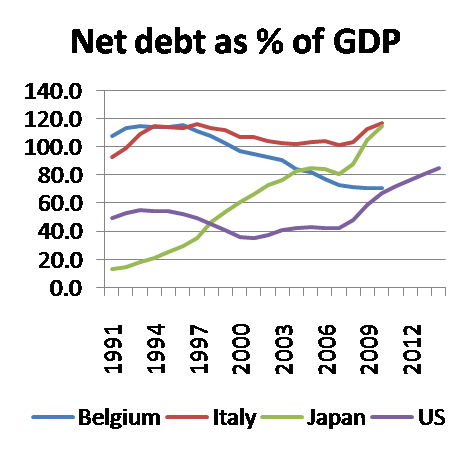
Speaking of debt, Paul Krugman chips in with we have no reason to worry; after all, Belgium, which will soon preside over the EU, is mired in a lot of debt, and provides this chart.
Ahem, while what was good for GM 60 years ago might have been good for the US then, what is good for Belgium being good for the US now? Seriously, what happened to Krugman?
And, another page in the NY Times wants us to be afraid, really really afraid, of the debt situation:
It was a bad, bad idea for the government to run this automobile
Maintaining a majority stake in a struggling G.M. as the 2012 election approaches will only increase the liability. If G.M. has to use taxpayer money to bail out Opel and Daewoo, its Korean division (which lost billions on currency speculation, no less), the issue of bailout money being sent abroad will undoubtedly be a campaign issue.I wonder if the logic is why worry about tens of billions of dollars in debt, when we are piled high in gazillions of dollars of debt.
G.M.’s global interests are far too diverse for it to serve its taxpayer owners faithfully, and it can’t afford to subjugate its business prerogatives to the political needs of its major shareholder in the White House. So, unless Americans develop a sudden obsession with G.M.’s $40,000 Volt electric car just in time for an I.P.O., taxpayers will be stuck with tens of billions of dollars in losses.
Speaking of debt, Paul Krugman chips in with we have no reason to worry; after all, Belgium, which will soon preside over the EU, is mired in a lot of debt, and provides this chart.
Ahem, while what was good for GM 60 years ago might have been good for the US then, what is good for Belgium being good for the US now? Seriously, what happened to Krugman?
And, another page in the NY Times wants us to be afraid, really really afraid, of the debt situation:
With the national debt now topping $12 trillion, the White House estimates that the government’s tab for servicing the debt will exceed $700 billion a year in 2019, up from $202 billion this year, even if annual budget deficits shrink drastically. Other forecasters say the figure could be much higher.So, who you gonna believe? :-)
In concrete terms, an additional $500 billion a year in interest expense would total more than the combined federal budgets this year for education, energy, homeland security and the wars in Iraq and Afghanistan.
The autonomous jihad in America
The ending sentence in this opinion piece is an attention getter that should have been the opening sentence:
And, you know what? It is not any war-obsessive right-wing American publication either.
This column is from The Hindu. I copied and pasted the title of the column, for the title of this post. It is clear that the author wants to make a case that Pakistan is the area that is most connected to terrorist acts anywhere:
Once distant enemies now pose a real threat to the U.S. at home.Now, before you jump to conclusions, no, the opinion piece is not in the context of the incident at Fort Hood. In fact, the essay makes no mention of Texas, or Fort Hood, or Hasan. Which is why the piece is all the more interesting. I have no idea about the data in the column, but the publication is a reliable one.
And, you know what? It is not any war-obsessive right-wing American publication either.
This column is from The Hindu. I copied and pasted the title of the column, for the title of this post. It is clear that the author wants to make a case that Pakistan is the area that is most connected to terrorist acts anywhere:
Even as it moves to address the causes of the rising tide of jihadist violence at home — among them resentment over foreign policy, racism, religious bigotry, and Islamist institutions that exploit them — the U.S. will have to work to dismantle the infrastructure of terrorist groups in Pakistan.But, in trying to make this point, the essay does not make it easy for the reader; not quite an example of wonderful writing. Check it out though.
Waiting to exhale on Afghanistan ... egalitarian faux-democracy?
I have made my position clear. Now, I am with billions of others on the planet waiting for Obama to tell us what his decision is.
If he still planning on a surge, hey may want to think more about it. Why? Pakistan is not keen on a surge, particularly if the US does not share its plans. (ht)
Update: later I was reminded of this comment on candidate Obama by Robert Samuelson--back in June 2008 that he might be the best graduate student ever:
If he still planning on a surge, hey may want to think more about it. Why? Pakistan is not keen on a surge, particularly if the US does not share its plans. (ht)
Pakistan expressed fear Friday that a large increase in foreign troops in Afghanistan could push militants across the border into its territory and called on the U.S. to factor in that concern as part of its new war strategy.....And, that same AP story ends with this BTW kind of an observation, which is a nasty reminder of how we got to where we are:
...The Pakistani concerns, raised by the prime minister during a meeting with visiting CIA director Leon Panetta, could pose another headache for President Barack Obama as he weighs military proposals to send 10,000 to 40,000 additional U.S. troops to Afghanistan next year.
Pakistan helped nurture a generation of Islamic militants after the Soviet Union invaded Afghanistan in 1979. Following the Soviet withdrawal a decade later, Pakistan helped the Taliban seize control. Many of these militants fled to Pakistan after the U.S.-led invasion of Afghanistan in late 2001.Meanwhile, Obama taking his longest time trying to come up with a solution that pleases all is beginning to get noticed, finally. The ever caustic Dowd, who is good at playing with words (I don't care for her columns at all; but, to borrow from Rumsfeld--did I really quote this war criminal?--we have to go to engage in discussions with the columnists we have!)
If we could see a Reduced Shakespeare summary of Obama’s presidency so far, it would read:Lee Siegel describes the un-decider's approach as:
Dither, dither, speech. Foreign trip, bow, reassure. Seminar, summit. Shoot a jump shot with the guys, throw out the first pitch in mom jeans. Compromise, concede, close the deal. Dither, dither, water down, news conference.
It’s time for the president to reinvent this formula and convey a more three-dimensional person.
egalitarian faux-democracy, in which the illusion of responding to every side in a debate undercuts the democratic process of actually arriving at a decision.How exactly does this work? Siegel explains:
This illusion of national participation in his decision-making process, with the promise of a happy ending that excludes no one, has been Obama’s method almost from Day One. Call it the American Idol style of governing—except that no possibility ever gets voted out of the competition.Not looking good, man. Not looking good at all.
No one must feel marginalized by a tyrannical majority. Obama allows the responses of the public, and the political establishment, and the media to break down every issue into a million parts, so that the multi-faceted clamor outside his head ends up looking a lot like the multi-faceted way he considers the world from inside his head. And by the time a decision comes—and yet it seems that Obama has not come to a single consequential decision since his inauguration—some people will feel unsatisfied, but no one will feel defeated.
Update: later I was reminded of this comment on candidate Obama by Robert Samuelson--back in June 2008 that he might be the best graduate student ever:
I cannot detect powerful convictions in Obama. He seems merely expedient in peddling his convenient conflicts. He strikes me as a super-successful graduate student: the brightest, quickest, most articulate guy in the seminar. In his career, he has advanced mainly by talking and writing -- not doing -- and may harbor a delusion common to the well-educated: that he can argue and explain his way around any problem.
Saturday, November 21, 2009
The only sensible part of Friedman's crappy column
I wonder if Thomas Friedman outsourced his column :-) It was a whole lotta blah, blah and blah. What was the only sensible part? His statement (not an argument, because of all the blahs) for "So what do we do?":
My classes are wonderful examples of this. (Not about dozing!) When I present students with the petroleum issues--who the exporters are, and how anti-democratic most are--they immediately see how our oil consumption then ends up supporting those nutcases. If more citizens understood this concept, well, not only will we be better off, the entire planet will be better off. And oil is only one such issue ....
Power to the people, indeed.
The standard answer is that we need better leaders. The real answer is that we need better citizens. We need citizens who will convey to their leaders that they are ready to sacrifice, even pay, yes, higher taxes, and will not punish politicians who ask them to do the hard things. Otherwise, folks, we’re in trouble.I agree with him here. If only people will forget that no president or governor can be the game-changer and that, in fact, the constitution divvies up the powers so well that the power really lies only with the people. But, if we doze off, well, then that is what we deserve.
My classes are wonderful examples of this. (Not about dozing!) When I present students with the petroleum issues--who the exporters are, and how anti-democratic most are--they immediately see how our oil consumption then ends up supporting those nutcases. If more citizens understood this concept, well, not only will we be better off, the entire planet will be better off. And oil is only one such issue ....
Power to the people, indeed.
Photo of the day .... India?
It might surprise non-Indians (well, maybe a few Indians too!) that this photo is of people in India

The note at the source:
A colleague grew up in Nagaland when her parents were stationed there. No, this colleague is not an "Indian"--is an American now all the way from Wales! She has been to parts of India that I have only read about. Years ago, when there were immense internal problems in neighboring Mizoram as well, the husband of my late cousin-sister was posted there--he was a (medical) Major in the Indian army. I suppose things have calmed down a lot over the years. An old school friend spent a year in Sikkim, not far away from all these places.
So many places to visit. So little time. And no money. Well, I will go there. One of these days. Before Cherrapunji completely dries out :-(
The note at the source:
Tribal girls perform a traditional dance during the Garo Wangala festival at Dimapur in Nagaland.Looks so colorful, compared to the dull and boring lives here!
A colleague grew up in Nagaland when her parents were stationed there. No, this colleague is not an "Indian"--is an American now all the way from Wales! She has been to parts of India that I have only read about. Years ago, when there were immense internal problems in neighboring Mizoram as well, the husband of my late cousin-sister was posted there--he was a (medical) Major in the Indian army. I suppose things have calmed down a lot over the years. An old school friend spent a year in Sikkim, not far away from all these places.
So many places to visit. So little time. And no money. Well, I will go there. One of these days. Before Cherrapunji completely dries out :-(
I thought my life was complicated .... :-)
Until I read this ....
The best line there is this one though:
A wonderful short essay. Read it hereThis will be my first Thanksgiving as a vegetarian—excuse me—as a black vegetarian from the Southern United States. As in Texas. As in raised on meat as much as milk. My dad barbecued every weekend. Sunday dinners revolved around collards and green beans with turkey chunks in every forkful, salads and baked potatoes were always sprinkled with bacon. Thanksgiving always included fried turkeys.
This year, I’ll be bringing the Tofurky.
The best line there is this one though:
Vegetarianism is the dietary equivalent of Republicanism in the black community
Friday, November 20, 2009
Oregon's fiscal crisis
Are the revenue raising Measures 66 and 67 doomed to fail because they are scheduled to be voted on in January?
I relocated to Oregon in fall 2002, and soon I was on the metaphorical public policy treadmill in order to figure out what was at stake in the special election the following January. Measure 28 was on the ballot and it was an attempt to temporarily raise income tax rates.
On January 28, 2003, Measure 28 was defeated by almost a ten percentage margin, and budget cuts resulted, including at the university where I work.
I relocated to Oregon in fall 2002, and soon I was on the metaphorical public policy treadmill in order to figure out what was at stake in the special election the following January. Measure 28 was on the ballot and it was an attempt to temporarily raise income tax rates.
On January 28, 2003, Measure 28 was defeated by almost a ten percentage margin, and budget cuts resulted, including at the university where I work.
Before the year ended, there was another measure on the ballot, and again at about the same time of the year. In February 3, 2004, it was with a convincing 18-percentage margin that Oregonians voted down Measure 30, which was aimed at increasing revenues through income and corporate taxes.
I wonder about the timing for such votes to increase taxes. Are such revenue-raising attempts self-defeating because the ballots arrive at about the same time that we also receive bills for all the purchases we made over the lengthy holiday season from Thanksgiving until the new year?
If the “no” votes are more a reflection of voters juggling with their personal finances, and less about a political philosophy of taxes, well, Oregonians seem to be significantly less secure now compared to back in 2003 or 2004—we are currently amidst a deep and broad level of economic contraction and unemployment.
Will we then look past our respective financial insecurities to understand that Measures 66 and 67 will not raise tax rates for most Oregonians? Measure 66, for instance, will mean higher taxes for roughly about three percent of personal income tax filers, which means that it will not affect the remaining 97 percent.
I suspect that as in 2003 and 2004, the word “tax” could easily grab the attention of a significant number of voters who might almost reflexively reject the idea.
Should the measures fail, the impacts could be worse than the aftershocks of the rejection of Measures 28 and 30. In the current recessionary environment, government spending has been able to prevent a more serious depression. A reduction of public spending could further worsen the state’s economic situation, through direct cuts and their eventual multiplier effects. In a recent report, the National Governors Association observed that “the biggest impact on states is the one to two years after the recession is over.” It is, therefore, important to uphold the taxes approved by the legislature.
However, we also ought to recognize that Measures 66 and 67 are temporary solutions, at best. We need to look no further than down south at California Oregon
In the meanwhile, here is to hoping that Oregonians will reverse past trends this coming January.
Thursday, November 19, 2009

Wednesday, November 18, 2009
Chart of the day: prisons v. universities
Isn't the "negative" bar almost the mirror image of the "positive" bar on the right? Does this sufficiently explain the priorities in Oregon, and in the US too? Which "institution" would you rather support? Read the complete report here


From India, .... and then ....
I suppose I am not unlike many from my generation in India who, as impressionable youth, firmly believed in Marxism--how ever incorrect our understanding might have been of that "ism" .... and then we slowly drifted out of it as we read Orwell or Solzhenitsyn, before signing off on capitalism, and yet with a nagging worry that this "ism" has a lot of flaws as well, and forever wondering whether a right "ism" will somehow miraculously show up and make this world a fantastic place .... the fall of the Berlin Wall, and then Tony Blair and Bill Clinton talking up a "third way", .... and now we are down to one--the liberal democratic capitalism. History is over, spake Fukuyama.
This is International Education Week and my classes have aspects of globalization as the topics. I remind students about this week. They forget. I nag them. They forget. It goes on :-)
In such a context, it was neat to read Jagdish Bhagwati's comments. It was all the more fascinating how he uses "we" when talking about Americans. I sometimes wonder whether my students take it on face value when I also employ "we" Americans, or whether the accented "we" makes them think otherwise .... One of the fantastic things about America is how "we" becomes quite easy--very easy to become one of the 300 million ..... So, here is Bhagwati talking about "us" Americans, and "we" ought to favor free trade:
Yet, many of "us" immigrant do not completely ditch the old country either--particularly with the technological innovations that is seemingly only one step away from teleporting a masala dosai fresh from Madras all the way across here!!!. I think we are in the best possible situation--we get to enjoy everything.
Sen, of course, wonderfuly defined "us" in the old country as the "argumentative Indian" .... I don't think we ditch that either, much to the displeasure of many of "our" friends and colleagues here :-)
When I was in graduate school, one of my trips across town in the university's free shuttle to UCLA was to listen to a talk by another economist from India--Pranab Bardhan. A question during the Q/A then was why he was not keen on becoming a formal adviser to the Indian government, which was the direction Manmohan Singh was going at that time. Bardhan replied that his job was to be a critic, which I thought was a wonderful position to be in :-) The journeys in life brings me one degree of separation away from Bardhan--apparently a colleague and Bardhan know each other from their younger days in Calcutta.
And "we" are all here in America.
This is International Education Week and my classes have aspects of globalization as the topics. I remind students about this week. They forget. I nag them. They forget. It goes on :-)
In such a context, it was neat to read Jagdish Bhagwati's comments. It was all the more fascinating how he uses "we" when talking about Americans. I sometimes wonder whether my students take it on face value when I also employ "we" Americans, or whether the accented "we" makes them think otherwise .... One of the fantastic things about America is how "we" becomes quite easy--very easy to become one of the 300 million ..... So, here is Bhagwati talking about "us" Americans, and "we" ought to favor free trade:
America’s great comparative advantage lies in innovation. For someone like me who has come from India it is very obvious that this country is full of innovators. When I was a student I read about Britain’s Industrial Revolution. And it was powered by all kinds of people, inventing the spinning jenny and so on. They were like little Americans, you know, thinking of new ways of doing things and making a buck. Almost every other American I know is thinking about something, some way to do something. We are a highly inventive people, and technology therefore is our driving force. It’s not savings and investments which are driving our productivity. It’s technology and innovation and immigrants like me—not me in particular—lots of people who come here and by the second generation go through the mill and become Colin Powell or Orlando Patterson at Harvard.I am impressed with the supreme confidence with which he states "nobody can compete with us in the long run ...." Perhaps one needs to be an immigrant to truly relish the flavor of this sentiment :-)
Nobody can compete with us in the long run, in my view, because these are not advantages which people in traditional societies can reproduce. So we’re always going to be doing high value. We’ll lose the high value we generate to others quickly because now technology diffuses very fast. But then we’ll have new ideas, new technologies.
Yet, many of "us" immigrant do not completely ditch the old country either--particularly with the technological innovations that is seemingly only one step away from teleporting a masala dosai fresh from Madras all the way across here!!!. I think we are in the best possible situation--we get to enjoy everything.
Sen, of course, wonderfuly defined "us" in the old country as the "argumentative Indian" .... I don't think we ditch that either, much to the displeasure of many of "our" friends and colleagues here :-)
When I was in graduate school, one of my trips across town in the university's free shuttle to UCLA was to listen to a talk by another economist from India--Pranab Bardhan. A question during the Q/A then was why he was not keen on becoming a formal adviser to the Indian government, which was the direction Manmohan Singh was going at that time. Bardhan replied that his job was to be a critic, which I thought was a wonderful position to be in :-) The journeys in life brings me one degree of separation away from Bardhan--apparently a colleague and Bardhan know each other from their younger days in Calcutta.
And "we" are all here in America.

Obama's options in Afghanistan
According to a highly reliable source, the following are the options that President Obama is considering regarding Afghanistan:
- Not only learn the lessons of Vietnam, but apply them as well
- Visit; act fascinated by their rugs
- Remove every American soldier; see if fighting continues
- Legalize gambling, as that's worked well domestically
- Thunderdome-style battle to the death between Gen. Stanley A. McChrystal and Afghanistan Taliban leader Mullah Omar
- Call the Taliban pretending to be the Prophet Muhammad and tell them to stop ambushing American soldiers
- Announce you're raising troop levels by 15,000, then pull everybody out, then come back with a half million soldiers, in the process convincing al-Qaeda that you're loco and not to be messed with
- Arm and finance a group of religious fighters
- Back the murderous drug-dealing warlord with the most government officials in his pocket
I feel great! For now :-)
Feeling a tad low, I decided to pep myself up by reading some of the appreciatory stuff I have received over the years in response to my opinion pieces.
First, an email, and I have withheld the sender's name:
First, an email, and I have withheld the sender's name:
March 21, 2005And this one was a letter in the newspaper on May 7, 2008:
Sir
Thank you for your excellent guest opinion and for your work with students. We fear for our country's future as it is more and more difficult to discern reality from make believe. You are a bright light
Khé’s columns are thoughtfulThank you, folks.
I appreciate The Register-Guard’s inclusion of Professor Sriram Khé’s thoughtful and thought-provoking columns.
His perspective as a highly intelligent, well-educated immigrant to our country is one we can all benefit from.
The subjects he has chosen are invariably timely and significant.
I envy the students in the honors program at Western Oregon University who have access to his thinking and wisdom even more frequently than we readers do. They are fortunate indeed to pursue their education under his direction.
Prudy Zorotovich
Elkton
Tuesday, November 17, 2009
The imbalance between production and consumption: a tale of US and China
Robert Reich has a neat observation:
But, what is China's endgame in this approach? Let us say that in 2039 China is one rich country. Will it still be the Commie-facade economy? I simply do not understand what is next in China's speeding bus. The more I think about this, the more I think of my nutty bottom line, and the next game-changing event of history. And neither one is a good scenario to look forward to.
Both societies are threatened by the disconnect between production and consumption. In China, the threat is civil unrest. In the U.S., it's a prolonged jobs and earnings recession that, when combined with widening inequality, could create political backlash.Reich makes a great point that China's export-driven, Yuan-pegged-to-the-dollar, approach that is so much focused on production is a social policy. Of course, this is not anything new; Friedman, in his metaphor-driven style, compared this to the movie Speed where a minimum speed has to be maintained or else the bus blows up.
But, what is China's endgame in this approach? Let us say that in 2039 China is one rich country. Will it still be the Commie-facade economy? I simply do not understand what is next in China's speeding bus. The more I think about this, the more I think of my nutty bottom line, and the next game-changing event of history. And neither one is a good scenario to look forward to.
Be afraid: Geraldo is the voice of reason :-)
Watch this clip, or fast forward to the final minute :-)
| The Daily Show With Jon Stewart | Mon - Thurs 11p / 10c | |||
| Law & Order: KSM | ||||
| ||||
Email of the day!
You have a lottery winning of 400,000 British Pounds from the British American Tobacco Plc,contact,Dr Andrew Stephen for your price on +44 702 401 2739 and tobaccolottery009@administrativos.comThat is some good chunk of change. Maybe I can sell the Brooklyn Bridge for a cool mil, eh! :-)
Monday, November 16, 2009
From ABC News, and not from the Onion
Hit&Run notes an ABC news item:
Here's a stimulus success story: In Arizona's 9th Congressional District, 30 jobs have been saved or created with just $761,420 in federal stimulus spending. At least that's what the website set up by the Obama Administration to track the $787 billion stimulus says.ABC's reporter Jonathan Karl drily notes that Recovery.gov was created to foster greater accountability and transparency in stimulus spending.
There's one problem, though: There is no 9th Congressional District in Arizona; the state has only eight Congressional Districts.
There's no 86th Congressional District in Arizona either, but the government's recovery.gov Web site says $34 million in stimulus money has been spent there.
In fact, Recovery.gov lists hundreds of millions spent and hundreds of jobs created in Congressional districts that don't exist.

Sunday, November 15, 2009
Bush's deal for re-creating shoe-throwing!
Remember that Iraqi reporter who threw his shoes at President Bush?
Well, listen to this update:
Well, listen to this update:
Saturday, November 14, 2009
Mr Obama goes to visit his creditors
Ouch! Those headline writers in the UK and elsewhere can be brutal .... The title of this post is the editorial in Financial Times.
This editorial is one of the many that point out that we--the world--is in for trouble if the US dollar continues to be the world's currency, if the US continues with its what-me-worry approach, and if China continues to peg its currency to the dollar.
This editorial is one of the many that point out that we--the world--is in for trouble if the US dollar continues to be the world's currency, if the US continues with its what-me-worry approach, and if China continues to peg its currency to the dollar.
generalised concern about currencies; an as yet incomplete reversal of the strengthening of the dollar during the crisis; and a determination by the Chinese authorities to avoid appreciation against the dollar since the serious crisis began.What is more intriguing to me is something Dan Drezner wrote about some time ago, where he noted:
It's the rest of the world -- articularly Europe and the Pacific Rim -- that are getting royally screwed by China's policy. These countries are seeing their currencies appreciating against both the dollar and the renminbi, which means their products are less competitive in the U.S. market compared to domestic production and Chinese exports.The more time goes by, the more I am convinced that my rather nutty conclusion--it seemed like that then--might not be as nutty after all:
Sometimes I wonder whether China's interest in the US dollar, and keeping its yuan tied to the dollar, is to essentially bankrupt the rest of the world and the US so that it can ultimately prevail as the global power.
Friday, November 13, 2009
Remembrance of things past--the White House


I have not been to DC since 9/11; will be there next year for the AAG annual meeting. I bet the city will look very different from how I remember it from 15 years ago.
Why the hell did bin Laden have to screw up things for practically the overwhelming majority on this planet :-(
Oh well, "there is no there there" ..... I wish it were otherwise ....
Why are we in Afghanistan? seriously ....
The text under the photo that is to the left here:
Soldiers from the U.S. Army First Battalion, 26th Infantry take defensive positions at firebase Restrepo after receiving fire from Taliban positions in the Korengal Valley of Afghanistan's Kunar Province on May 11, 2009. Spc. Zachary Boyd of Fort Worth, Texas, far left was wearing "I love NY" boxer shorts after rushing from his sleeping quarters to join his fellow platoon members.
Hey Lou Dobbs, I will not miss you--I never watched your program :-)
A long time ago--when Bernard Shaw was the news anchor at CNN--I remember watching that news channel a lot. For two main reasons: one, the internets was only a series of tubes (!) at that time, and the friendly web hadn't come into place. So, there was no way a junkie like me could get updated otherwise. Second, CNN was mostly only a news channel.
Then things changed--thanks to Faux News.
Soon, CNN also became a sensation-seeking shoutfest channel, with half the screen devoted to rolling ticker updates.
While I was smart enough to program my TV to skip the Faux News channel, I would pause every once in a while at CNN. But, Lou Dobbs? Nah!
As always, The Onion has the best news update on Dobbs' departure. The entire report is hysterical--the way it weaves in stereotypes after stereotypes that Dobbs' might have used in his rants, er, program. An excerpt:
Then things changed--thanks to Faux News.
Soon, CNN also became a sensation-seeking shoutfest channel, with half the screen devoted to rolling ticker updates.
While I was smart enough to program my TV to skip the Faux News channel, I would pause every once in a while at CNN. But, Lou Dobbs? Nah!
As always, The Onion has the best news update on Dobbs' departure. The entire report is hysterical--the way it weaves in stereotypes after stereotypes that Dobbs' might have used in his rants, er, program. An excerpt:
Acting on anonymous tips from within the Hispanic-American community, U.S. Customs and Border Protection officials on Wednesday deported Luis Miguel Salvador Aguila Dominguez, who for the last 48 years had been living illegally in the United States under the name Lou Dobbs. ...
In addition to holding multiple jobs without ever obtaining a guest-worker permit or H-1B visa, "Dobbs" is reported to have collected welfare every month for nearly five decades. He appeared in good health when apprehended, having used Medicaid to obtain numerous health care services over the years, but immigration officials fear he still may have exposed the American population to the many infectious diseases illegal immigrants tend to carry, including both malaria and leprosy.
USA! USA! USA!!! .....

according to new Gallup polling data gathered over the last three years, 16% of adults—or some 700m people—in over 130 countries say they would like to start a new life abroad. The most popular destinations specified are wealthy Western countries, though Saudi Arabia and the United Arab Emirates are also attractive. If everyone got their wish, America's population would swell by 165m while Canada, Britain and France would each gain 45m new migrants.
Thursday, November 12, 2009
Outsourcing from Bangalore .... to rural India
With more than a billion people, India is more a continent than a country. So, we can and should expect wage differentials within its own borders, which means that outsourcing can happen even from costlier urban areas to inexpensive rural areas.
At the same time, as I have blogged often, here, a college degree is way too hyped, and is quite an unnecessary credential for many of these jobs.
So, combine these two and this NY Times report is no surprise at all! Excerpt:
At the same time, as I have blogged often, here, a college degree is way too hyped, and is quite an unnecessary credential for many of these jobs.
So, combine these two and this NY Times report is no surprise at all! Excerpt:
Now some businesses have begun looking to rural India for an untapped pool of eager and motivated office workers. Rural Shores has hired about 100 young people, most of them high school graduates who have completed some college, all of them from rural areas around this small town. The company has three centers now, but it aims to open 500 centers across India in the next five years.A whole new world, every few days :-)
Most of the center’s employees are the first members of their families to have office jobs. They speak halting English at best, but have enough skill with the language to do basic data entry, read forms and even write simple e-mail messages.
With much lower rent and wages than in similar centers in cities, the company says it can do the same jobs as many outsourcing companies for half the price. A Bangalore office worker with skills similar to those of workers here commands about 7,000 rupees a month, or $150, Mr. Srinivasan said. In small towns and villages, a minimum-wage salary of about $60 a month is considered excellent.
Here in Bagepalli, the Rural Shores office hums through two shifts a day. One set of workers answers customer service e-mail messages for an Indian loyalty card company. Another processes claims for an insurance company. In one room, workers capture data from scanned timecards filled out by truck drivers in the United States. They record nights spent in Abilene, Tex., deliveries in Kansas City and breakdowns in Salt Lake City, all of which the workers decipher and enter into a database.
Wednesday, November 11, 2009
The Best F**king News Team Ever reports on the Berlin Wall
The ending, with Jon Oliver, is simply fantastic :-)
| The Daily Show With Jon Stewart | Mon - Thurs 11p / 10c | |||
| Legends of the Wall | ||||
| ||||
Healthcare reform: subterfuge, and the triumph of hope over experience
The House narrowly passes a healthcare reform bill. Next stop the Senate.
But .....
First, from this NY Times piece that reports on Maine's healthcacre efforts:
But .....
First, from this NY Times piece that reports on Maine's healthcacre efforts:
Maine is the Charlie Brown of health care. The state’s legislators have tried for decades to fix its system, but their efforts have always fallen short: health insurance premiums are still among the least affordable in the nation, health care spending per person is among the highest and hospital emergency rooms are among the most crowded. Indeed, many overhauls to the system have done little more than squeeze a balloon — solving one problem while worsening another.
But like the Peanuts character, the state keeps trying. Indeed, Senator Olympia J. Snowe, Maine’s senior United States senator and so far one of only two Republicans in Congress to vote for an overhaul, spent two years in the late 1970s as chairwoman of the State Legislature’s joint Health and Human Services Committee pushing small reform efforts. “That’s where I garnered an enormous deference to the issue of health care and its complexities,” Ms. Snowe said in an interview.
Maine’s history is a cautionary tale for national health reform. The state could never figure out how to slow the spiraling increase in medical costs, hobbling its efforts to offer more people insurance coverage.And, then from John Cassidy's essay in the New Yorker:
So what does it all add up to? The U.S. government is making a costly and open-ended commitment to help provide health coverage for the vast majority of its citizens. I support this commitment, and I think the federal government’s spending priorities should be altered to make it happen. But let’s not pretend that it isn’t a big deal, or that it will be self-financing, or that it will work out exactly as planned. It won’t.
Many Democratic insiders know all this, or most of it. What is really unfolding, I suspect, is the scenario that many conservatives feared. The Obama Administration, like the Bush Administration before it (and many other Administrations before that) is creating a new entitlement program, which, once established, will be virtually impossible to rescind. At some point in the future, the fiscal consequences of the reform will have to be dealt with in a more meaningful way, but by then the principle of (near) universal coverage will be well established. Even a twenty-first-century Ronald Reagan will have great difficult overturning it.
That takes me back to where I began. Both in terms of the political calculus of the Democratic Party, and in terms of making the United States a more equitable society, expanding health-care coverage now and worrying later about its long-term consequences is an eminently defensible strategy. Putting on my amateur historian’s cap, I might even claim that some subterfuge is historically necessary to get great reforms enacted. But as an economics reporter and commentator, I feel obliged to put on my green eyeshade and count the dollars.Ahem!
Monday, November 09, 2009
Abortion and healthcare reform
Now it is big news (samples: click here and here)
Not news to me. I blogged about this back in September. Ha! I led that post with:
Not news to me. I blogged about this back in September. Ha! I led that post with:
It has puzzled me that those opposed to health care reform have gone the insane route of using labels like socialism....when they could have scored a lot more points a lot easier by simply zooming into abortion. Of course, I am not the first guy to have thought about this. But, I still cannot understand why abortion did not become a populist issue in health care reform.
Sunday, November 08, 2009
The Dalai Lama: next stop White House? :-)
 In an opinion column a few weeks ago, I wrote about two trips that the Dalai Lama had on his calendar: the visit to the White House to meet with President Obama, which was nixed by the President, and the visit to to Tawang. I wondered whether the Tawang visit will happen, given how China was clearly unhappy that the "splittist" was heading to a "disputed territory" ....
For once, a good update: the visit happened.
Now, let us see what Obama will do :-)
Israel/Palestine: quote of the day
“When you’re serious, give us a call: 202-456-1414. Ask for Barack. Otherwise, stay out of our lives. We have our own country to fix.”Thomas Friedman in the NY Times
Saturday, November 07, 2009
Friday, November 06, 2009
Cricket: not a critter but a religion in India :-)

If only this were a simple little one nutty poster .... a year ago, the following was in the news:
"Cricket is religion in our country and Dhoni is god of cricket," his fan club president Jitendra Singh said.But, the good thing is that as much as real religions are losing their base, and the number of irreligious or casual believers is on the rise, even the religion of cricket (!) is losing its audience--even in India! Why? well, as all religions tend to do, well, the cricket priests also decided to extract way too much from the gods and the believers now can't afford to tithe like they used to, I guess. Here is from one report titled "How cricket became boring" (ht):
"We'll construct a huge temple of Dhoni in Ranchi and have a priest who will pray to him every day."
It was unthinkable. That a day would come when the urban Indian male would admit he is bored of cricket. But the truth is that the sport is fast losing its charm among its most commercially influential devoutsNotice here the usage of "devouts." The author writes:
The board knows that the wealth of Indian cricket is a consequence of this nation’s complex love for the sport and that anything which affects this love would have financial repercussions.So, yes, the high priests are concerned. Now, if it is a religious crowd, then what happens? Well, a new religion creeps in and tries to sweep up a few dejected believers. That is what is happening in India, where football (ahem, soccer here in the US) is gaining a fan base so much so that the son of one of India's older and living cricket gods, Sunil Gavaskar, himself is attending services at the other religious sport:
From the equally powerful world of cricket, Rohan Gavaskar has entered the fray. He has bought a stake in the Pune FC football club.Hmmm ..... the gods must be crazy :-)
Subscribe to:
Posts (Atom)