As world financial markets collapse like fraternity pledges at a keg party and banks fail around the world, the International Monetary Fund implements an emergency program under which anybody who opens a checking account anywhere on earth gets a free developing nation. But it is not enough; the financial system is in utter chaos. At one point a teenage girl in Worcester, Mass., attempts to withdraw $25 from an ATM and winds up acquiring Wells Fargo. ....
The stock market plummets farther as investors realize that the only thing that had been keeping the economy afloat was the millions of dollars spent daily on TV commercials for presidential candidates explaining how they would fix the economy. As it becomes increasingly clear that the federal government's plan of giving hundreds of billions of dollars to dysfunctional companies has not fixed the problem, the government comes up with a bold new plan: give more hundreds of billions of dollars to dysfunctional companies. Soon the government is in a bailout frenzy, handing out money left and right, at one point accidentally giving $14 billion to a man delivering a Domino's pizza to the Treasury building.
Wednesday, December 31, 2008
Bailing out of 2008

Thursday, December 11, 2008
America is India?
The country’s politicians are mostly an unsavoury lot. Of the 522 members of India’s current parliament, 120 are facing criminal charges; around 40 of these are accused of serious crimes, including murder and rape. Most Indian politicians are presumed to be corrupt, which is less surprising. In India’s poor and fractious society patronage politics is inevitable. But Indian politics has got much muckier in recent years because of two factors: the rise of regional and caste-based parties, nakedly dedicated to delivering patronage; and the mutinous coalitions this has led to.

Wednesday, December 10, 2008
F*&k the political dynasty system
- Illinois: Obama's seat might go to Jesse Jackson Jr., whose entry into politics was made possible only because of his name.
- New York: Clinton's seat is being sought by Caroline Kennedy, whose only political connection is the Kennedy name. Meanwhile Andrew Cuomo can't make up his mind whether to go for the governor office or this senate vacancy.
- Delaware: Biden's seat will be held by his former aide, until Biden's son is ready two years down the road.
- Florida: Jeb Bush is already making noise about jumping into the Senate race.
I am tired of this game, as you can tell from the "F*&k" in the title :-)
The "Senategate" in the Land of Corruption, er, Lincoln
Only about four weeks after the election, and the liberal-left was now feeling a new range of emotions, from confusion to disillusion to who knows what, trying to work out how it could be that their hero could have selected such centrist and even right-wing figures to the leading advisory roles in his administration – with not a ‘progressive’ in sight. To make it even more galling, these picks were being widely referred to as ‘the best and brightest’ (what, were they implying that progressives are neither?).Ahem, maybe a tad below the belt on progressives not being in the club of "the best and the brightest" .... but, good point. And then later he writes:
Sceptical liberals could at least console themselves that Obama would bring needed ‘change’ from the evil Bush administration – but wait, now they couldn’t even say that! The liberal-left not only has to deal with all the Clinton re-treads; they also have to face the fact that there will be holdovers from the Bush regime in critical roles. Robert Gates, the executor of the Iraq war, will stay on as defence secretary. And the top economic position of treasury secretary goes to Timothy Geithner, who was once registered as a Republican and now calls himself independent, and who has already been working closely with the Bush administration secretary, Henry Paulson, on the bailout package. Obama even reached back to the Reagan years and chose 81-year-old Paul Volcker to be an economic adviser (when Obama said he wanted experience, I guess that included finding someone who actually lived during the Great Depression).Should something bizarre come out of the Illinois governor scandal--shall we call it "senategate?"--that taints even a third-stringer in the Obama camp, well, it will be quite a three-ring-circus! Bill Clinton had his real estate deals investigated ad nauseam--remember Whitewater? We now have the shadow of Tony Rezko ..... politics in any country is one hell of a spectator sport--if only it didn't have serious implications!
Bailout for the auto manufacturers
This is not an abstract public policy issue for me by any means. After all, the three vehicles that our family currently owns are from each one of these manufacturers—Ford Focus, Saturn Vue, and Jeep Cherokee. We have also owned a Ford Taurus and a Saturn station-wagon in the past. The only “non-American” vehicle we have ever had was a Nissan Sentra.
It is not that we were implementing a “buy American” policy at home. It just so happens that the vehicles we bought met our preferences and budget constraints. Earlier today, when I took my Saturn Vue to the dealership for the regular oil change, I began to wonder whether the brand will even exist anymore. News reports suggest that General Motors is planning to sell the division, or merge it with another division. Even worse is the possibility that Saturn might be completely shuttered down.
On the one hand, the public policy person in me prefers inefficient economic enterprises to fade away without government intervention. I think about PanAm, which symbolized air travel when I was a kid. It has been almost two decades since PanAm closed down when it could not survive in a highly competitive global travel industry. It is the law of the jungle, so to say, where inefficient businesses lose out to efficient ones. In order to preempt a PanAm-like story, the auto manufacturers should have been watchful, and could have avoided the strategic errors they made, especially during the cash-flush decade from the mid-1990s when SUVs and minivans delivered billions of profits.
But, on the other hand, I recognize that government actively intervenes in practically every aspect of our economy. Heck, even my home is partly underwritten by the government, which permits us to write-off the interest paid on the mortgage loan. Thus, if many other industries can be subsidized or bailed out, well, why not help out Saturn and its loyal and committed employees? It is a tough question that can be an easy one only for dogmatic ideologues.
Even as policymakers try to figure out the current auto industry crisis, we might want to understand a few longer term trends as well. “Planes, Trains and Automobiles” was a holiday season movie two decades ago; these same American manufacturing industries listed in the title have also been in decline. Trains, for all purposes, have been relegated to history. The automobile industry is in a pickle—some might argue that it has been in denial since the energy crisis in the 1970s.
And not everything is well with the aviation industry either—both in the manufacturing of planes, and in passenger transportation. Boeing was the undisputed champ in its field, perhaps even more powerfully than the American “Big Three” auto manufacturers ever were. Slowly but steadily Boeing has been losing its market share to other aircraft manufacturers. Twenty years ago, in 1988, Airbus had barely 16 percent of the market and now it is nearly on par with Boeing in terms of the value of aircrafts delivered.
Meanwhile, Brazil and Canada have become active in the manufacturing of short-haul jets. China is the latest entry into this—last month, the Commercial Aircraft Corporation of China announced the sale of five of its ARJ21s (Advanced Regional Jets for the 21st Century) to General Electric’s aircraft leasing division, with an option for 20 additional aircrafts. The ARJ21 and other larger jets to be manufactured by CACC by 2020 are essentially China’s effort to crack the aircraft market dominated by Boeing and Airbus.
Over the last few years, we have come to realize that anything we do can be done cheaper in China. This means that, if we don’t watch out, here in the Pacific Northwest we could be worrying about Boeing twenty years from now, similar to the worries over General Motors today.
Therefore, even as we try to mitigate the woes of the auto industry, and even as the manufacturers begin to articulate a long-term survival strategy, I hope we will learn one important lesson—global economic competition is real, and will only get more intense than ever before. If we don’t get that lesson, another bottom line awaits us: history does repeat.

Tuesday, December 09, 2008
Sweatshop labor in Bangladesh
New Portable Sewing Machine Lets Sweatshop Employees Work On The Go
Be thankful for our democracy
To a large extent, the campaign phone calls and election pamphlets are indicators that there is still a strong pulse in the democracy. They force us to recognize the issues, how much ever trivial or profound they rate in our individual political meters, and decide on a yea or nay. If we did not have those dedicated people, elections and democracy could morph into a political equivalent of a tree falling in the forest and nobody being there to hear it.
Read the entire piece here
The Chinese are coming, The Chinese are coming
According to this LA Times story, it is literal--the Chinese are coming. And apparently they are coming to buy homes, because prices have dropped so much. It is almost like somebody went to China and advertised a huge clearance sale in California and elsewhere :-)
An excerpt from the Times piece:
The Chinese do have a lot of cash to spend. The central government holds the biggest stockpile of foreign reserves in the world, nearly $2 trillion, most of it in dollars. And the Boston Consulting Group estimates that there were more than 391,000 millionaire households in mainland China last year, up from 310,000 reported the previous year.
....
[Home] prices in the U.S. have fallen more sharply than in China, and many Chinese consider the American market highly alluring as a place to invest and live because of the United States' developed economy.
The purchasing tours in the U.S. grew out of similar trips by well-heeled Chinese back home.
Investors from Wenzhou and other entrepreneurial hot spots were known for chartering buses to visit such cities as Shanghai to shop for apartments. Now some of them are signing up with outfits like Soufun.com, the real estate website that is sponsoring the home-buying trip next month from Beijing to California and Nevada."
Monday, December 08, 2008
Putting two and two together .... hmmm...
The nonprofit organization that administers the Graduate Record Examinations is projecting that the number of tests given this year will dip—despite a slowing economy, which typically pushes people into graduate school.
And then, later in the day I read another news item that:
World Education Services, one of the largest foreign-credential evaluators for American and Canadian universities, has revised its assessment of India’s three-year undergraduate degrees, putting those rated A or higher by a national accreditor on par with American undergraduate programs. Until now, students in India needed to complete 16 years of academic work to be eligible for admission to graduate programs in the United States.
The move could sharply increase the already-high number of Indian students who apply to American universities.
I realize that there is zero chance for any conspiracy here. But, it is too damn juicy not to spin the stories as: universities figured out that a neat way to increase graduate student enrolment in the US is to accept India's three-year undergrad programs as being on par with the four-year programs here in the US. And thus the graduate school money-making schemes can continue on :-)
Happy birthday, mouse!
On 9 December 1968 hi-tech visionary Douglas Engelbart first used one to demonstrate novel ways of working with computers.
The first mouse that Dr Engelbart used in the demo at the Fall Joint Computer Conference (FJCC) was made of wood and had one button
Thank you, Dr. Engelbart.
Sunday, December 07, 2008
Highly educated does not mean best managers
"W" is double Ivy-League, and pretty much everyone of his cabinet members is highly educated. Ken Lay was a phd in econ. Only Karl Rove does not have a formal college degree! ..... Robert "Vietnam" McNamara was a high IQ genious, with the best credentials.Well, this is the same idea that Frank Rich discusses in his column, whose title says it all:
In the US, and in many other countries, the educated have created as much (or more) hassles as the not-formally-educated. one of the best leaders we had in the state where I grew up in India was functionally illiterate ....
I am increasingly tending towards an understanding that higher education is neither a necessary nor a sufficient condition for governance, politics, civics ....
"The brightest are not always the best"
Friday, December 05, 2008
The most dangerous place?
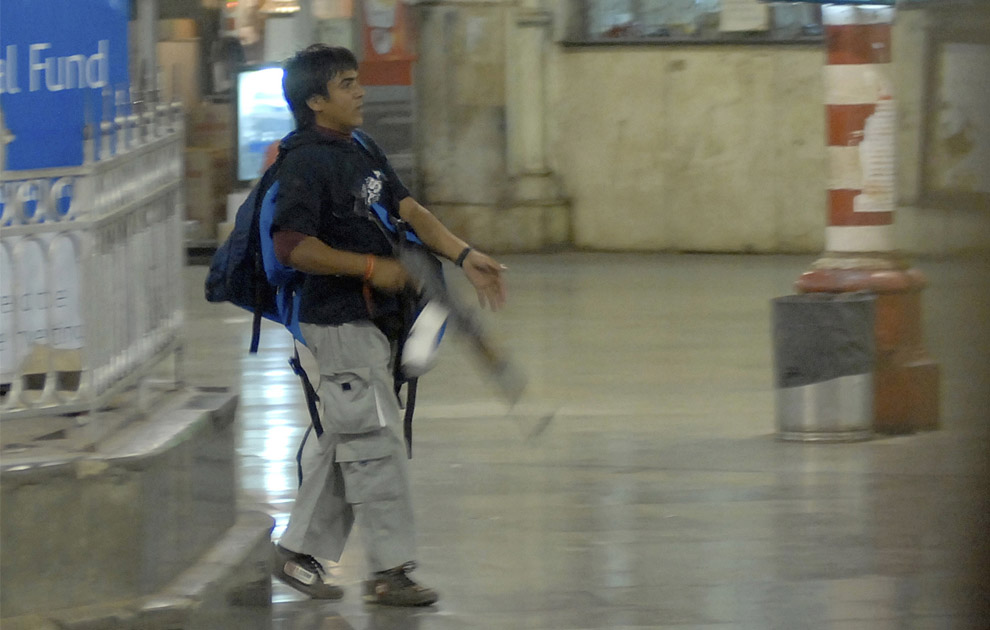
(A gunman walks through the Chatrapathi Sivaji Terminal railway station in Mumbai, India, Wednesday, Nov. 26, 2008. (AP Photo/Mumbai Mirror, Sebastian D'souza. Click here for a collection of photographs, including this one)
A colleague asked me whether my friends and family were okay, in the context of the recent terrorism nightmare in
I have been to
During that visit, when the city was officially only
In fact, if there is one thing I remember about
Over the recent years, many Indian cities, including
There is a Pakistani dimension in the latest terrorist attack too. Emerging details indicate that the terrorists were not “home grown” but might have been affiliated with, or trained by, a militant group called Lashkar-e-Taiba, often abbreviated as LeT, which was allegedly involved with the attack on the parliament building. Driving
LeT was overtly founded by
In these pages, I have expressed my concerns over
I have, therefore, always favored words and actions that will not provoke any of the many explosive issues. With this latest terrorist act in
I was, therefore, relieved to read news reports that Secretary Condoleezza Rice changed her plans and rushed to urge
Restructuring the economy .... or else ...?
- Autos
- Housing finance
- High finance
- Energy
- And the big one—health care