Friday, October 31, 2008

Thursday, October 30, 2008
Alcohol good during pregnancy?
Boys born to mothers who drank lightly during pregnancy are better behaved and score more highly in tests at the age of three than the sons of women who abstained, according to a study published today.
Researchers found there was no link between light drinking in pregnancy - defined as one to two units a week, or on occasion - and any behavioural or cognitive problems in children at the age of three.
Surprisingly, the University College London study found that some of the children of light-drinking mothers appeared to be doing better than the babies of those who abstained.
Leonard Bernstein and America
So, in Bernstein's memory, and to follow-up on his comments here, I suppose it is most appropriate to embed a YouTube clip of "America" from West Side Story--for which he was the composer:I have come here tonight to share with you something I learned on this fantastic three-week journey abroad: first, that I have never loved my country so profoundly and caringly as I do now; second, that because of that love I feel more than ever the compulsion and responsibility to re-examine our automatic enemy-concept; and last, that this is a great time to do it, during these 10 days of prayer and reflection.
There is a charming legend about this penitential period: It is said that on Rosh Hashanah, New Year’s Day, the golden Book of Life up there in the sky is inscribed with the name of every single human being, along with his or her destiny for the year: who will live and who will die, who by fire and who by water, who will prosper and who will not. But there are 10 days within which one can change that inscription for the better—by prayer and the practice of good deeds. Charity and faith can avert the evil decree (you see, it’s all just another version of Corinthians, chapter 13). In other words, it’s now or never, because on the 10th day, Yom Kippur, the big book is closed and sealed for the year. Sorry folks, that’s it.So here we are on the eighth night, and I want to make my own public confession of faith, hope, and charity. You see, a couple of years ago I had a bit of a falling-out with my esteemed and well-loved friend Derek Bok. I won’t bore you with the story, but the rumpus was basically about a book written and published at Harvard and blessed with a sizable preface by President Bok. I read and hated this book and became quite exercised about the preface, which didn’t exactly endorse the book, but the presence of which, up front and center, by so distinguished a thinker, gave the book a certain cachet I didn’t think it deserved. Dare I mention its name? Living with Nuclear Weapons—the title alone was discouraging enough. Well, I got real mad and, in a self-righteous huff, stopped further contributions to the Harvard scholarship fund I had established years before. I was wrong to do so; and even though Derek and I have never debated the matter publicly or privately—never even had that lunch we promised each other—nevertheless I have sinned, I re-examine, I re-evaluate, and I hereby return the withheld funds.
There is no enemy; there is the American principle of free debate; fighting against an invented enemy is wasteful; fighting for ourselves and one another is constructive, is sharing—otherwise known as love.Let me leave you with the thought that we all have until Monday night to meditate, rectify, re-assess, and get that celestial inscription changed. Try it, it’s worth it. And, as we say, shana tovah, a good year, and hatimah tovah, a good inscription. Bless you.
A nasty Halloween trick: recession :-(
Gross domestic product contracted at a 0.3 percent annual pace, less than forecast, a Commerce Department report showed today in Washington. ...
``The crisis really kicked up in late September,'' Ethan Harris, co-head of U.S. economic research at Barclays Capital Inc. in New York, said in a Bloomberg Television interview. ``We're going to be looking at a very unfriendly GDP number in the fourth quarter, with a drop of 2 to 4 percent.''
Wednesday, October 29, 2008
Creativity: What does Karl Marx pour on his pasta?
What does Karl Marx pour on his pasta?How creative these comedians are! Creativity is something that has always intrigued me--being far from creative myself, I suppose it is a natural fascination for me. I have always felt that formal education the way we offer it simply kills any creativity. Only the fortunate ones survive with their creative skills in tact.
The Communist Mani pesto :-)
Here is Sir Ken Robinson on this subject:
Anand retains world chess title
India's Viswanathan Anand has retained his FIDE World Chess Championship title by beating Russia's Vladimir Kramnik in the German city of Bonn.More here.
Anand won three games, drew seven times and lost once en route to winning the
competition by 6.5 points to 4.5. ...
Anand, who was born in the southern Indian city of Madras (Chennai), divides his time between India and Spain.
Known as the "Tiger from Madras", his achievements have triggered huge interest in the game in India with chess clubs mushrooming in many parts of the country.
Tuesday, October 28, 2008
A good sign for freedom of speech
Microsoft, Google and Yahoo have signed a global code of conduct promising to offer better protection for online free speech and against official intrusion. ....
[The Global Network Initiative] states that privacy is "a human right and guarantor of human dignity," and the agreement commits the companies to try to resist overly broad demands for restrictions on freedom of speech and the privacy of users.
They will also assess the human rights climate in a country before concluding business deals and make sure their employees and partners follow suit.
More here, and here
So, who are the bitterest members of academe?
The bitterest members of academe are the midcareerists, the snarlers who've gotten tenure but now discover that they don't have lifetime goals or passionate pursuits to buoy them through the next decades. They've gotten what they always thought they wanted — but what will they do for their next trick?
They should develop long-term research projects, or concentrate on deepening their teaching techniques, or create new programs in service learning. They could make their work lives startling, unpredictable, and full of genuine excitement.
But some will insist on boring, bedeviling, or frightening newbies with tales of old feuds and future disgraces. They're obsessed with former colleagues who flamed out, suffered student mutinies, or escaped to warmer climes or better-paying jobs in the Real World. Snarling remains the refuge for those who lack the energy or courage to do something really original or dastardly.
Monday, October 27, 2008
Economic crisis, and stratospheric earnings
Meanwhile, there are a few continuing to earn gazillions of dollars and the public simply does not worry about it. In fact, they actively contribute their hard-earned dollars to enrich these few.
Don't believe me? Well, that is because you are not thinking about entertainers, like movie stars and basketball players. Don't you think it is atrocious that these people earn multiple of millions? But, hey, that is what the market system is all about. So, I find it strange that we completely ignore some of the multi-million earners in this market system, while we get insanely mad about some other multimillionaires. And it gets worse: these are not even "free market" transactions. MLB, for instance, is a Congress sanctioned monopoly! Players don't get free-agent status until they have served their time. .... ah, the twisted logic in life!
How much are the earnings? Here is an example about Lebron James:
At the age of 18, he was selected with the first overall pick in the 2003 NBA Draft by the Cavaliers and signed a whopping $90m shoe deal with Nike before his NBA debut.
Since then his cachet has soared, with rich people's bible Forbes magazine putting his total earnings at $270m.
Want to know how much dead entertainers earn? Yes, they are no longer alive! Click here.
The dollar's sudden rise
Megan McArdle has some interesting observations:
Now, it seems like a race between the British Pound and the Euro on which will sink faster. So far, the Pound is winning, as this Bloomberg report shows!The yen has been strengthening fast against the dollar and other currencies, which is very bad news for Japanese exporters.
It's also wrecking the carry trade. That's when you borrow at low interest rates in one place just to lend at higher rates somewhere else. For a long time, Japan has been a popular place to do this, for two reasons: the longtime recession has kept its interest rates low, and the government's committment to keep the currency cheap in order to subsidize exports has seemed like a shelter against a sharp currency move that would force borrowers to repay the loan in suddenly-more-expensive yen. Now that the yen is rising seemingly uncontrollably, investors are racing to unwind their positions.
The sharp movements in the currency market are somewhat surprising, particularly the euro's decline. Not very long ago, we were asking whether the euro would replace the dollar as the world's reserve currency; not (sic) it's the "sick man of Europe", as confidence in banks and businesses has been badly shaken.
The pound fell against all 16 of its most-traded counterparts, dropping l.3 percent to $1.5420 as of 11:43 a.m. in London, from $1.5897 last week, when it had its biggest intraday decline in at least 37 years. Against the euro, the currency slipped to 80.73 pence, from 79.31. It traded at a record low of 81.96 pence per euro on Oct. 24.The Euro is keeping pace with the Pound:
Against the US dollar, the European currency traded down during early deals on Monday. At 5:10 am ET, the euro- dollar pair declined to 1.2336, compared to Friday's closing value of 1.2605. This set the lowest point for the pair since April 28, 2006. The pair is currently trading at 1.2443, with 1.21seen as the next target level.
Ballot measures prove a tough test
Like a diligent student, I try to follow national and local political issues as closely as possible so that I can provide the best possible answers at the civics test — the election.
Choosing a candidate for an office is easy. It is like the true-false questions in a test. But choosing an idea, which is what the statewide measures are, turns out to be a disaster for me, because ideas warrant discussions before a simple up or down vote.
It is through discussions that we further understand the issue and, more importantly, the complications that might be buried deep down. This is why when I test students on concepts, I don’t use true-false or multiple-choice questions. Instead, I force them to explore the fuzzy, gray areas through short essay responses.
Through reasoning and persuasion, and with evidence, students finally arrive at convincing answers, even if they don’t necessarily agree with my conclusions. At least, that is my hope.
Politics is overwhelmingly about the fuzzy, gray areas. For instance, according to the big fat voter’s pamphlet, Measure 61 “creates mandatory minimum prison sentences for certain theft, identity theft, forgery, drug and burglary crimes.” What a juicy piece for discussions! Even on the surface, the measure comes across as one with multiple effects, and with unintended consequences that we will come to know about only years later.
However, instead of having discussions, I am simply being asked to note whether I am for it or against it. Isn’t such a “yes” or “no” the most atrociously inappropriate way for society to decide on most of such ballot measures?
On the other hand, these are the kinds of questions I would love to have on an essay test — or better yet, for classroom discussions. Oh, yes, we do have a forum for classroom discussions in the political context: the Legislature! Not one, but two chambers of the Legislature — the Senate and the House.
Well unfortunately, there was no option to write a 700-word essay as my response to Measure 61. Maybe an opinion piece, if the editor publishes it, but that does not count as a vote anyway.
To complicate matters, the ballot warned me that voting a certain way on Measure 57 could nullify my vote on Measure 61. Shucks! Back to reading the pamphlet all over again. It was certainly one of those rare occasions when I wished I weren’t a teetotaler — a few drinks might have helped ease my frustrations.
Finally, I metaphorically held my nose and voted.
I imagined giving my students an exam with a few questions and warning them there that there would be a penalty if their answers to one question did not match up with their answers to another question. If I did that, I am sure that soon, my peers and the public would seriously question my sanity — which, come to think of it, some do even now!
I simply cannot understand how we have ended up with a political process where we have two measures about the same set of issues, and where a vote on one can negate the vote on the other. Perhaps that is proof enough that neither measure should have been on the ballot in the first place.
I am all in favor of initiative legislation, and want as much citizen participation as possible in our collective decision-making. I am immensely thankful that these citizen-empowering tools are enshrined in the constitutions both in Oregon and California, where I lived before relocating to Eugene.
But if the 2008 ballot is an indicator of how ugly the future tests might be for us civics students, well, I think it is time we overhauled the curriculum. At least to prevent the abuse of initiative legislation, if not for anything else, maybe we ought to revise our state Constitution as a part of Oregon’s sesquicentennial celebrations — before disgruntled voters abandon voting itself.
Published in the Register Guard, October 27, 2008
Sunday, October 26, 2008
Oil is becoming one strange story
Now, OPEC is trying to make sure that there would be some kind of a price floor. While the lowest cost producer, Saudi Arabia, couldn't care, Venezuela and Iran are completely messed up with prices seemingly ready to break through the $60 floor. (I am delighted that Venezuela and Iran are screwed with the falling prices. No wonder Ahmedinejad has sudden health problems now.)
Again, notice how the dollar and oil prices are inter-connected. When it went to $147, the US dollar was at its weakest. Now,as the dollar is gaining ground, and rapidly too, oil prices are falling, and way faster. I don't mean to suggest that the dollar is the only reason why oil prices are tanking--it is an important point to keep in mind.
The Houston Chronicle--home to America's big oil--reports that
Institutional investors and other speculators, who had waded into oil commodities and helped drive up prices to unheard-of heights, have largely fled the scene.
And now oil analysts are left to ponder just how low oil prices can go — perhaps $50 a barrel by the end of next year, suggests Deutsche Bank's Adam Sieminski.
So, now the "experts" will start the bidding war on how low oil prices will fall.
As oil prices fall, OPEC will begin to have a tough time keeping a tight leash on the quotas. Why? Over to James Surowiecki:
OPEC, like any cartel, has perennial problems with cheating. That’s because each individual cartel member wants to produce as much oil as possible, in order to keep raking in the cash, while all the other members cut back, helping to keep prices high. But since it’s in each member’s self-interest to cheat, the cartel as a whole ends up producing more than it says it will. And the real paradox is that the cheating problem gets worse the cheaper the price of oil gets. Since members are making less on each barrel of oil, they have to sell more barrels in order to keep government revenue high. It’s a tough cycle: cheaper oil begets more cheating, which makes prices fall, and so on. This will be a real test of whether the last few good years have made OPEC any more disciplined in the face of bad years.
Rising from the ashes: more on the US dollar
I mean, the story of the exchange rates of the American dollar is simply fascinating. The short story, I mean--the story just over the last two months. A year ago when we visited Australia, the American dollar was all fluff. We were sorry ass Americans trying to hold on to our wallets, which quickly ran dry. And now, the Australian currency
closed in US trade at US61.78 cents, down US4.5 cents on Friday night and 37 percent from the high of US98.49 cents it reached three months ago. The slump in
the currency has confounded even the most seasoned of market commentators. The dollar has even been strongly outperformed by Iceland's hapless krona and Brazil's real over the weekend.
I love it when I read something like how even the economic experts are confounded. It is just an euphemism that actually means nobody knows a damn thing and we merely bullshit all the time!
Is fiction inherently capitalist?
Unfortunately, the book review essay that got me thinking about this is bloody awful. I am glad that I never ventured into literary politics, cultural theory, if such crap is what results.
Climate change, and "per capita" atmospheric space
I suppose I am not the only one thinking along those lines. Here is Carla Wise, for instance.
India's prime minister, too, is on-board. But, his view immediately makes it clear how developed and developing countries might find it difficult to get along on this:
Addressing a special session of the summit of the Asia Europe Meeting devoted to sustainable development, Dr. Singh said climate change was threatening the environment and the prospects for development and a holistic approach was needed to deal with the problem. “We cannot do so by perpetuating the poverty of the developing industries, or by preventing their industrialisation.” He said the principle of common but differentiated responsibility had to be the “cardinal principle of negotiations” in the search for pragmatic solutions within the U.N. Framework Convention on Climate Change.While he calls for convergence, the real divergent issues are embedded right in his speech:
The Prime Minister added that the principle of convergence of percapita emissions of developing countries with advanced developed countries was “catching the imagination of the international community.” The world had to recognise that “each citizen of the world has equal entitlement to the global atmospheric space.”
- Need to uplift millions of poor from their abject poverty--possible, rapidly, through non-carbon energy?
- Will pressuring poor countries on limiting carbon usage essentially mean perpetuating poverty?
- When looking at "per capita", is there any scope for convergence? Is Singh way too optimistic here?
- If we look at aggregates, is there scope for convergence?
- Will countries really buy into this idea of "differentiated responsibility"?
The politics of climate change will, however, get horribly nasty before we begin to see any glimmer of real convergence.
How about this game-changing endorsement?
“Al Qaeda will have to support McCain in the coming election,” read a commentary on a password-protected Islamist Web site that is closely linked to Al Qaeda and often disseminates the group’s propaganda.Oregon native, and NY Times columnist, Nicholas Kristof brings this to our attention. He adds:
the endorsement of Mr. McCain by a Qaeda-affiliated Web site isn’t a surprise to security specialists. Richard Clarke, the former White House counterterrorism director, and Joseph Nye, the former chairman of the National Intelligence Council, have both suggested that Al Qaeda prefers Mr. McCain and might even try to use terror attacks in the coming days to tip the election to him.
“From their perspective, a continuation of Bush policies is best for recruiting,” said Professor Nye, adding that Mr. McCain is far more likely to continue those policies.
Saturday, October 25, 2008
From India to England to Japan: Curry
It was about the same time that I discovered that a Japanese fast food joint in the LA area--I have forgotten that name--had on its menu a beef curry with white rice. I would never have guessed, way back in India, that curry would have such a vaulted status in Japan.
These memories have been stirred by a short piece in the NY Times magazine. It notes that:
katsu curry dates to the Meiji era of the late 19th century, soon after the opening of Japan’s borders. Japanese trade with the West led to a national fascination with foreign flavors and textures — a kind of reverse-twist culinary version of the Japonisme that gripped Europe around the same time. (There was until recently a curry museum located in Yokohama, one of Japan’s most prominent ports.)
I wonder if there was any equivalent import of Japanese food habit into the Indian kitchen?
Falling in love with the US dollar, all over again
And, guess what? The dollar is going up. In fact, going up so fast that now there is talk of whether its ascent needs to be slowed down by central banks coordinating their action. I am not an economist, thankfully, but I have never seen such wild swings in every aspect of the global economy.
The NY Times reports that "On Friday, worries about how the financial crisis would affect Britain’s economy caused the pound to lose 8 cents against the dollar, falling to $1.53. ... And the downdraft of the pound and the euro — which fell to $1.26 against the dollar on Friday, its lowest level in two years"
$1.26 for one Euro. A 20% decrease in merely 3 months!
The NY Times piece also notes that:
So great are the concerns among policy makers about the turmoil in currency markets that it has prompted talk of a coordinated intervention by the leading industrial countries in coming days, to quell the soaring dollar and put a floor under emerging-market currencies.
Such a move — in which the Federal Reserve and other central banks would sell dollars and yen and buy other currencies — has been used extremely sparingly by the United States in recent years.
“The risk is huge, but it is appropriate at this point, because if the emerging markets go into default, the consequences would be catastrophic,” said Kenneth S. Rogoff, an economist at Harvard.
When a developing country’s currency loses value rapidly, it impedes the ability to pay back loans from Western banks. That could cause a rash of corporate or even government defaults — a feature of previous financial crises in Asia and Latin America.
That will be the next round in this global financial crisis--heavily leveraged countries going broke. It won't be countries like India and China, but the same old countries from a couple of decades ago--countries like Argentina, which are already there, for all purposes.
Stupid Britons, and not stupid Americans, for once!
That is what Britons do at home and abroad. They belch, vomit, copulate, litter and barge their way through public spaces, dressed like hookers and louts, defying the police without shame or modesty. British expatriates are some of the worst: overpaid, oversexed and all over the place
Hey, I thought this is what we Americans are supposed to be. No wonder there is always talk of Anglo-American alliance, eh! ha ha ha
The Times columnist goes nuts at how stupid the two Britons were when they got drunk, and engaged in sexual activities on a public beach in Dubai. I have been to Dubai and gone to at least one beach there--just bloody hot it was. And I remember at the receiving end of some hostile remarks even when I was fully clothed and having a conversation with my brother and his family--I was "jokingly" referred to as a terrorist because I was visiting from America. So, my thought on reading the news item a couple of days ago was rather simple: why invite trouble by such acts in the pubic, er, public? :-) The columnist, however, jumps into unnecessary moralizing ....
Is it surprising that so many Muslims around the world despise us for our decadence when we express our sympathy with British men and women who behave like this? There is something clearly despicable in the permissiveness and hyper-sexualisation of western culture; the result is broken families, unwanted children, sexual diseases and a state of agitation which drives the young into chaos and crime.
Friday, October 24, 2008


Guaranteed employment if working for a term paper mill?
I did not go after the student, however. Instead, I examined my course syllabus and how I had set up the assignments. I found that the instructions for the term paper were not rigorous after all--it was open ended, and students could write on a topic of their choice. I met the problem, and it was me after all!
So, the following term, I changed the structure. I required a 2,500-word paper at the end of the term--but, this time it had to be a response to a specific question that I gave them. And, they still had to search for new materials, cite them, .... all the things we typically require in a term paper. Well, there was no "funny" business that term.
Since then, I don't think I have ever set up a syllabus where students can write papers on topics of their own choosing. More so since the deluge of resources on the web--not only can students be tempted to doing a whole lot of copy/paste, they can do worse things: turn to a term paper mill for help! Now, the only problem I get every once in a while is when a student doesn't think carefully and brings in paragraphs from a source, and pretends that those sentences were his. Even this, I think the last I had such a problem was two (three?) years ago.
One might argue that this severely cramps the free thinking of students. That is exactly why I phrase the question such that there is still enough latitude for them to follow-up on an issue that really revs up their curiosity.
When we faculty give generic term paper tasks like "write a paper on the Chinese economy", we should not be surprised if some students resort to unfair practices. Because, there are plenty of "term paper artists" like this one who has written an interesting, and funny, piece on it. (I don't think he outsourced this one!) He writes:
Term paper work is also extremely easy, once you get the hang of it. It's like an old dance routine buried in one's muscle memory. You hear the tune — say, "Unlike the ancient Greek tragic playwrights, Shakespeare likes to insert humor in his tragedies" — and your body does the rest automatically. I'd just scan Google or databases like Questia.com for a few quotes from primary and secondary sources, create an argument based on whatever popped up from my search, write the introduction and underline the thesis statement, then fill in the empty spaces between quotes with whatever came to mind.This "inside scoop", so to say, further confirms my view that open-ended term paper guidelines are increasingly disasters waiting to happen. Anyway, the author adds that it takes special skills to be a term paper artist--to never get into writing a "real paper" because that is way too much work!:
The secret to the gig is to amuse yourself. I have to, really, as most paper topics are deadly boring. Once, I was asked to summarize in three pages the causes of the First World War (page one), the major battles and technological innovations of the war (page two), and to explain the aftermath of the war, including how it led to the Second World War (page three). Then there was this assignment for a composition class: six pages on why "apples [the fruit] are the best." You have to make your own fun. In business papers, I'd often cite Marxist sources. When given an open topic assignment on ethics, I'd write on the ethics of buying term papers, and even include the broker's Web site as a source. My own novels and short stories were the topic of many papers — several DUMB CLIENTS rate me as their favorite author and they've never even read me, or anyone else. Whenever papers needed to refer to a client's own life experiences, I'd give the student various sexual hang-upsNote: because it is about how term papers can be easily sold to multiple students, well, I have cross posted this on all my three current blogs :-) No, seriously, the cross-post is because of the relevance.
Thursday, October 23, 2008
The bastard--well, the English language, that is!
I, on the other hand, probably knew these words from coming across then while reading something, and then tried to figure out their meanings. I never ran into such problems in Tamil or Sanskrit, or even the three months of German that I did, because in all these languages one pronounces the word the way it is written. That simple. English, as Bernard Shaw famously pointed out with his satire on how to pronounce "ghoti", is awful. Because it is a bloody bastard language.
In writing about a bunch of books on the language itself, Christine Kenneally notes that
Perhaps more than any other tongue, English has been decisively shaped by the series of intense geopolitical events that mark its short but vivid history. In its first 600 years, English was the language of the invaded; later, it became a language of invasion. English began in 449 when marauding Saxons, Angles, Jutes, and Frisians sailed from their homeland (now Denmark, northern Germany, southern Norway, and Sweden) to invade a small island in the North Sea. The tribes settled there, replacing the land's Celtic languages with their own. The word English itself comes from Anglisc, the dialect of the Angles.
So, given the bastradization that has gone on for centuries, and given how English continues to import words from all over the world as it marches into every remote village, is it fair to torture students about spelling?
Wednesday, October 22, 2008
Satirizing book promotions
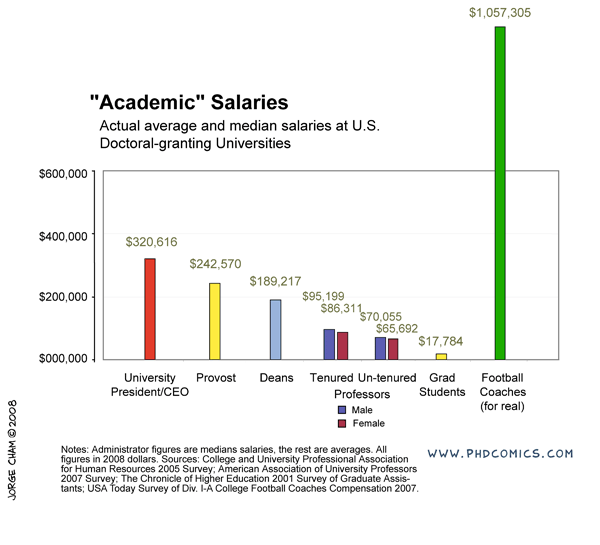
Salaries: academic versus football

Tuesday, October 21, 2008
Marx is back
This might seem like a believe it or not report ....
Marx is back
Hasan Suroor
LONDON: With capitalism in crisis, Karl Marx has become fashionable again in the West. Das Kapital, his seminal work, is set to become a best-seller in Europe.
In his native Germany, copies of Das Kapital are reported to be “flying off the shelves” as failed bankers and free-market economists try to make sense of the global economic meltdown.
Jorn Schutrumpf, head of the Berlin publishing house Dietz, is reported as having said that the sales of the works of Marx, and Friedrich Engels, have trebled. “Marx is fashionable again…We have a new generation of readers who are rattled by the financial crisis and have to recognise that neo-liberalism has turned out to be a false dream,” he told The Times.
A dramatic rise has been reported in the number of visitors to Marx’s birthplace in Trier. And film-maker Alexander Kluge is planning to turn Das Kapital into a movie.
Western leaders who once sneered at Marx’s dense tome, breezily dismissing it as a “doorstop,” have been seen flaunting Das Kapital in recent weeks. French President Nicolas Sarkozi has been spotted “flicking through” it, German Finance Minister Peer Steinbruck has said nice things about it, and even the Pope has praised the book for its “great analytical” quality.
Archbishop of Canterbury Rowan Williams recalled Marx’s analysis of capitalism , saying: “Marx long ago observed the way in which unbridled capitalism became a kind of mythology, ascribing reality, power and agency to things that had no life in themselves.”
Free-market cheerleaders such as The Times and The Daily Telegraph have become interested in Marx. There has been a wave of soul-searching analyses of whether he was right, after all.
Indian-Americans break out
According to reports, the 35-year old Kashkari is the son of Indians who immigrated to the United States from Kashmir. It’s a long way from the scenic Himalayas to the waters of the Cuyahoga River in Ohio, where Kashkari was raised.
Kashkari joins an impressive list of Indian-Americans who burst onto the American public sphere in quite a hurry over the past few years. I used to joke that we will know for sure that we have arrived on the U.S. scene when one of us got enmeshed in an embarrassing, high profile controversy. Well, not anymore. It has been simply fascinating to watch Indian-Americans exercising a remarkable level of influence.
It was an Indian-American who led the legal fight that profoundly changed our treatment of Guantanamo detainees. Neal Katyal, who is a law professor at Georgetown University, was barely 36 years old when he won Hamdan vs. Rumsfeld — a Supreme Court ruling that challenged the current administration’s interpretation of executive powers.
Another one almost became a vice presidential nominee. Bobby Jindal, who is the 37-year old governor of Louisiana, was a serious contender for the second spot on the Republican ticket.
Readers of Newsweek may be familiar with Fareed Zakaria, who also hosted a news show on PBS. A friend once described Zakaria as being sexier than Omar Sharif, and with brains on steroids!
Jhumpa Lahiri makes us think about profound issues through her award-winning narratives that are often about Indian-Americans. And director M. Night Shyamalan scares the daylights out of filmgoers with stories that are deceptively simple.
On the other hand, it was absolutely depressing to read that an Indian-American family was one of the first who lost their lives because of the current economic crisis.
Karthik Rajaram was a former employee of PriceWaterhouse Coopers and Sony Pictures in Southern California, but had been unemployed for a few months. He committed suicide, after killing his family — his wife, mother-in-law, and three children aged 19, 12 and 7. It is unfortunate that this Indian-American resorted to guns, reinforcing the notion that guns and violence, too, are as American as the oft-repeated apple pie and mom.
All these are absolute contrasts to the stereotypes that we run into on television and movies, where the typical Indian character is either a motel owner or a physician, both with accents far stranger than mine. After all, even from a statistical perspective, one would expect a lot more than just these two stereotypes when the population of India itself is more than a billion, and when a few million with Indian origins are scattered all over the planet!
Perhaps I am not different from other “ethnic” immigrants in getting pumped up. I clearly remember a fellow student in graduate school who was from Canada.
He was acutely aware of Jewish players in professional baseball, and his interest in this came from his passion for the game and from his Jewish background. To him, Sandy Koufax was not merely the best pitcher ever, but was almost a god. There is no Indian-American equivalent of Koufax. Yet.
There is no denying the fact that Kashkari, Katyal and others are fantastic testimony to the idea of America.
More than in any other country, it is in America that there is a high probability of anybody making it big in whatever they choose. It is that idea, an ideal even with its own blemishes, that continues to draw immigrants from all over the world, from thousands of miles away.
So, I don’t get depressed about the multi-trillion-dollar global economic crisis. After all, an Indian-American is in charge of straightening things out!
Published in the Register Guard, October 21st
Tenure as a 30-year contract
Stephen Joel Trachtenberg, who is the chairman of the higher-education practice at Korn/Ferry International and a president emeritus and university professor of public service at George Washington University, adds his views in an essay in the Chronicle. He opens with:
Something is wrong with tenure, and we need to make it right. Abolishing it altogether is not politically or culturally feasible, or even likely. Any such attempt would set the many academic constituencies against all the rest simultaneously and, like the famous circular firing squad, leave everyone at least grievously injured and possibly some higher-education institutions dead.
But that doesn't mean that we shouldn't at least consider changing some of the ways that tenure works.
Yes, I would love to discuss this with colleagues, if it were not the fact that I will "not be given the same level of consideration" because I am not one of them. In fact, I was told to "then please shut up." I suppose I should be happy that there was a 'please' added to the directive that I should shut up. ha ha ha. So much for the view from the outside that being tenured gives us real First Amendment rights :-)
Monday, October 20, 2008
The Market as God
In that 1999 article by Harvey Cox, who was (is?) a Professor of Divinity at Harvard, easily juggles with philosophical constructs, theological ideas, and compares them with how the Market has taken over as the new religion. I remembered feeling lost about some of the philosophical ideas he was talking about .... A neat piece that Cox concludes with:
No religion, new or old, is subject to empirical proof, so what we have is a contest between faiths. Much is at stake. The Market, for example, strongly prefers individualism and mobility. Since it needs to shift people to wherever production requires them, it becomes wrathful when people cling to local traditions. These belong to the older dispensations and -- like the high places of the Baalim -- should be plowed under. But maybe not. Like previous religions, the new one has ingenious ways of incorporating pre-existing ones. Hindu temples, Buddhist festivals, and Catholic saints' shrines can look forward to new incarnations. Along with native costumes and spicy food, they will be allowed to provide local color and authenticity in what could otherwise turn out to be an extremely bland Beulah Land.
There is, however, one contradiction between the religion of The Market and the traditional religions that seems to be insurmountable. All of the traditional religions teach that human beings are finite creatures and that there are limits to any earthly enterprise. A Japanese Zen master once said to his disciples as he was dying, "I have learned only one thing in life: how much is enough." He would find no niche in the chapel of The Market, for whom the First Commandment is "There is never enough." Like the proverbial shark that stops moving, The Market that stops expanding dies. That could happen. If it does, then Nietzsche will have been right after all. He will just have had the wrong God in mind.
Bonus if you read until here: it was in 1999 that the Atlantic also featured an article that argued that stocks were undervalued and that we would soon race towards a Dow Jones value of 36,000. Ha ha ha. I guess the Market God failed us, or got very very angry :-)
Their thesis was this:
Stocks are now, we believe, in the midst of a one-time-only rise to much higher ground -- to the neighborhood of 36,000 for the Dow Jones Industrial Average. After they complete this historic ascent, owning them will still be profitable but the returns will decline. You won't be able to make as much money from them each year. We believe that in the meantime, however, astounding profits will be made.
More Starbucks = more financial crisis. Really?
But, I do like intelligent and innovative takes on Starbucks. Which is why I liked this piece where the idea is simple: "The higher the concentration of expensive, nautically themed, faux-Italian-branded Frappuccino joints in a country's financial capital, the more likely the country is to have suffered catastrophic financial losses."
Pretty simple the idea, eh! I wish I had taken the trouble to correlate the location of Starbucks outlets with the real estate data and banks .... Some of these commentators are smart--unlike the motor mouths on talk radio and TV who spin the same ideological crap over and over and over .... Anyway, the theory is:
Having a significant Starbucks presence is a pretty significant indicator of the degree of connectedness to the form of highly caffeinated, free-spending capitalism that got us into this mess. It's also a sign of a culture's willingness to abandon traditional norms and ways of doing business (virtually all the countries in which Starbucks has established beachheads have their own venerable coffee-house traditions) in favor of fast-moving American ones. The fact that the company or its local licensee felt there was room for dozens of outlets where consumers would pony up lots of euros, liras, and rials for expensive drinks is also a pretty good indicator that excessive financial
optimism had entered the bloodstream.
Oil and other commodities becoming cheaper .... is bad?
How are commodities prices connected to civil strife? Poor farmers impoverished by lower crop prices may be eager recruits for rebel groups who can promise a better livelihood from stolen loot than what the soil can provide (not to mention protection from pillaging, since unaligned farmers may be easy prey for either rebels or government troops). A cheaper cup of joe may thus translate into conflict in the coffee-growing world. ....
Then again, lower prices may also mean less conflict. One of the great ironies of modern economic history is that natural resources can be less an economic blessing than a curse (the so-called natural resource curse). One reason for this apparent paradox is that resource-abundant countries suffer through frequent civil conflicts as competing factions struggle for control over oil wells, diamond mines, and other sources of natural wealth (and use the resulting revenues to fuel further conflict). If
resource prices fall, then there's less wealth to bicker over, less reason to fight, and less cash on hand to purchase further armaments.
Given these two opposing forces, when should we expect price drops to trigger more violence, and when should we expect less? [ Oeindrila Dube and Juan Vargas] argue that the critical difference is the "labor intensity" of extracting a resource—that is, the value of workers relative to the cost of buildings and machines. For example, a farmer tending his land may need little more than a strong back and a shovel, but an oil rig may cost billions and a pipeline billions more. Subsistence farming is labor-intensive; oil drilling is capital-intensive.
Brother, can you spare me a dime?
[The] idea of $25 billion for Africa suddenly doesn’t sound like so much after a $700 billion bailout in the United States or $2 trillion in bank guarantees in Europe. We’ve just been making choices to ignore the poor rather than calculations based on real resources available. We made a choice to let millions of people die and not honor our commitments. The crisis doesn’t change our quantitative ability to follow through. And now, I think everyone is more of a macroeconomist than they were before. They can evaluate for themselves that it’s just not a lot of money compared to the amounts mobilized in recent weeks.
In that argument, Jeffrey Sachs makes a fantastic point--we always offered excuses that we didn't have $25 billion to help out the poor in Africa. Anti-malarial medication, mosquito nets, TB medication, .... any of these was met with the same argument that we can't keep throwing money in Africa.
Well, hello, and we now have consensus that Uncle Sam is ready to spend 800 billion dollars to bail out banks and their bankers? The hypocrisy is too damn evident. But, as Ralph Nader likes to point out, as long we play a game of going back and forth between tweedledum and tweedledee, there will be only one message for the poor, whether they are in Africa or anywhere else: so long, suckers :-(
Sunday, October 19, 2008
Kinsley finds small business at The Beast
“Fifty percent of small business income taxes are paid by small business.”
— Senator John McCain, during the third presidential debate, October 15
I have been diligently researching this matter, in the hope of winning a Nobel Prize in Economics, and my preliminary conclusion is that the situation is even more extreme than John McCain suggests. Although I really should run this past Paul Krugman before going public, the evidence seems to suggest that as much as 100 percent of small business income taxes are paid by small business.
The latest insult word: Professorial!
Professorial must be the insult of the season. ... When and why did professorial become an insult or a political liability?That is Siva Vaidhyanathan trying to make sense of the idiocy with which the media uses the word "professorial" to imply that we are not "normal" and can't connect with "normal" people. He then writes,
The presumed communicative disorder of professorial speech seems to be the root of the problem. Of course, there is no such thing as a uniform professorial style. My field of media studies is filled with dull, timid, dense lecturers. But it also has its share of stirring orators and provocative interlocutors. Some of us are math geeks. Some of us are policy geeks. Some of us are poetry geeks. Many of us are not geeks at all.I should poll my students on whether I am a geek :-)
But, I think we have a wonderful context to think about what it means to be a professor these days. After all, as Vaidhyanathan notes, we are a diverse lot. But, there has to be something in common, right?
Well, that is the question that Stanley Katz tackled a couple of years ago. He asserted that:
we have lost something along the way. We have lost a sense of commonality as professors, the sense that we are all in this together — "this" being a dedication to undergraduate teaching and not just specialized research. We have lost a belief in the relevance of teaching undergraduates for the health of our democracy. We have lost confidence that what we do in teaching and research is inherently good, and not primarily a utilitarian occupation. We have lost the conviction that we have a calling, that as professors our duty is to profess.I think I don't have much to argue with his points. Well, except for one thing: if we think it is that highly valuable for democracy, then we--taxpayers--ought to pay for it. The current system stinks. Further, the context has changed--society and students see college education in strictly utilitarian terms, which means employment, and the health of democracy has no place in it.
We have also, manifestly, lost our sense of belonging to an ascertainable and manageable community of teacher-professors. Along the way, we have lost our commitment to the particular universities in which we work.
Anyway, Katz further notes that
Yes, now is the time to discuss these issues. Unfortunately, I can't see this happening at the university where I teach--what can be discussed is strictly defined by one group that shall not be named.Too frequently even the most thoughtful academics are fixated on academic freedom as the crucial challenge. Academic freedom — the freedom to teach and to learn — is central. But it must follow from an acceptance of the duties of professionalism. We have such academic "rights" only if we embrace the duties of a public profession — to instruct the untrained and to create knowledge. That includes the obligation to identify the standards by which practice can be assessed and to enforce adherence to them. Seen from that perspective, professionalism is the core of democratic behavior, since it entails the acceptance of the principled provision of public services, without
which a modern democracy cannot be expected to succeed. ....I would like us to consider whether there are not recoverable values and practices in the world that we have lost — and also new ones more appropriate to the 21st-century professoriate. Shouldn't we at least be asking Dewey's question: "But have we not come to a time when more can be achieved by taking thought together?"
Ideologues neither die nor fade away
Of course, we do not have a free market--not when government accounts for almost a fifth of the economy. And not when we have significant government involvement in economic decision making.
But, come on, can't we at least accept that the market is imperfect? Oh yeah, even if some of them will say that in the softest of whispers, they immediately come back with a much louder, the most imperfect market will be more perfect than the most perfect government. Which, again, is ideological speak.
Jacob Weisberg writes that this financial crisis is the end of libertarianism. I say he is way too optimistic. But, he has some good points:
the libertarian apologetics fall wildly short of providing any convincing explanation for what went wrong. The argument as a whole is reminiscent of wearying dorm-room debates that took place circa 1989 about whether the fall of the Soviet bloc demonstrated the failure of communism. Academic Marxists were never going to be convinced that anything that happened in the real world could invalidate their belief system. Utopians of the right, libertarians are just as convinced that their ideas have yet to be tried, and that they would work beautifully if we could only just have a do-over of human history. Like all true ideologues, they find a way to interpret mounting evidence of error as proof that they were right all along. .....
Like other ideologues, libertarians react to the world's failing to conform to their model by asking where the world went wrong. Their heroic view of capitalism makes it difficult for them to accept that markets can be irrational, misunderstand risk, and misallocate resources or that financial systems without vigorous government oversight and the capacity for pragmatic intervention constitute a recipe for disaster.
Saturday, October 18, 2008
Homeland (In)Security at Airports
An excerpt:
And because I have a fair amount of experience reporting on terrorists, and because terrorist groups produce large quantities of branded knickknacks, I’ve amassed an inspiring collection of al-Qaeda T-shirts, Islamic Jihad flags, Hezbollah videotapes, and inflatable Yasir Arafat dolls (really). All these things I’ve carried with me through airports across the country. I’ve also carried, at various times: pocketknives, matches from hotels in Beirut and Peshawar, dust masks, lengths of rope, cigarette lighters, nail clippers, eight-ounce tubes of toothpaste (in my front pocket), bottles of Fiji Water (which is foreign), and, of course, box cutters. I was selected for secondary
screening four times—out of dozens of passages through security checkpoints—during this extended experiment. At one screening, I was relieved of a pair of nail clippers; during another, a can of shaving cream.
During one secondary inspection, at O’Hare International Airport in Chicago, I was wearing under my shirt a spectacular, only-in-America device called a “Beerbelly,” a
neoprene sling that holds a polyurethane bladder and drinking tube.
Axis of Diesel: Falling oil prices good?
Ok, seriously, could this plunge resemble the kind of price drops that followed the peaks reached in the early 1980s? OPEC is worried about this and has called an emergency meeting to stablize prices in the 70-90 dollars price range. The Times has aptly referred to all this as the Axis of Diesel--the Brits are funny with their headlines :-)
Writing in the NY Times Magazine, Roger Lowenstein argues that we ought not be too thrilled with falling oil prices because it might just about take away the incentive to explore alternatives to oil. He notes there:
You can argue that last July’s $147 peak was irrational, but Aubrey McClendon, the chief executive of the Oklahoma-based Chesapeake Energy, says it was merely the answer to a real-world economics quiz: at what price would the world consume less oil? Americans began to cut back on their driving at $50 oil, and at something like $120 oil they garaged their S.U.V.’s en masse. People in many emerging nations were slower to react, because their governments subsidize local gasoline prices. But as the price rose, such a subsidy became costly, and beginning in May, China, India, Indonesia and others cut their subsidies. The upper bound had been reached.
Lowenstein concludes his essay with a forceful argument that if the price falls below $70, which it has, then we ought to have a comparable tax on oil. Good luck on that, Lowenstein--we lost that opportunity back in 2001 soon after the 9/11 attack--Americans would have gladly put up with that tax as a patriotic duty. The president lost that opportunity. In fact, he beckoned us to continue on with our shopping! Not now when the economy is tanking, when people are losing homes and jobs.
What the country doesn’t want is to remain dependent only on oil — to lose the urgency to develop alternatives. It happened once before. After the gas lines of the ’70s, Jimmy Carter declared that solving our energy problems was the moral equivalent of war. Then, in the 1980s, Americans forgot.
The way to avoid a repeat is to dust off an idea that Gerald Ford once proposed: a tax on oil. Ideally, it would kick in only if the price fell back to, say, $70 a barrel. The beauty of this tax is that, very likely, no one would have to pay it. The tax would merely serve as a floor — a new lower bound. Auto companies would never have to worry that cheap gas would tempt consumers away from efficient cars; investors could finance development of batteries and fuel cells, because cheap oil could never undercut them. Oil itself would be used more sparingly and last longer. The oil market did its part when it sent the price to almost $150. The government should make sure there is no going back.
Friday, October 17, 2008
"Greed is good"
Warren Buffett says that now is the right time to be greedy again:
Be fearful when others are greedy, and be greedy when others are fearful. And most certainly, fear is now widespread, gripping even seasoned investors. To be sure, investors are right to be wary of highly leveraged entities or businesses in weak competitive positions. But fears regarding the long-term prosperity of the nation’s many sound companies make no sense. These businesses will indeed suffer earnings hiccups, as they always have. But most major companies will be setting new profit records 5, 10 and 20 years from now.
Thursday, October 16, 2008
We are all postmodernists now
The mainstreaming of pomo thinking has been largely a stealth project,Tim Cavanaugh has a great point out at Reason. The postmodernist thinking of truth is subjective has taken over society so much that it is difficult anymore to convince people that facts themselves are different from how we interpret them. And, of course, some go one extra step and question the facts themselves. Which is what we find in the creationism issue, and how the media report the controversy--the media think it is their duty to report on the two sides of the evolution controversy, as if everybody is right on this and truth is subjective.
something Americans do without committing overt acts of academia. We thought we
were trying to clear away the cobwebs of shoddy analysis and elite hypocrisy,
but all along we were bringing the tools of critical thinking to the masses. Go
into any bar in the country, and you'll find somebody unpacking the assumptions
in someone else's text.
Wednesday, October 15, 2008
Stiglitz on The Colbert Report
Academe's Ax Murderers
"Remember that every department has at least one ax murderer, but you won't know in advance who it is so you'd better be on your guard."
... what has become a lamentable fact of faculty life: Many academics regularly engage in a kind of "gotcha" politics.
Abortion, presidential candidates, and Goldwater
More on the Booker Prize winner
And, hey, I am from Chennai. My brother lives in Australia. A bunch of relatives live in Mumbai. .... We are all global citizens, and the world will be a better place if we adopted that framework.Adiga was born in Chennai in 1974 and was raised partly in Australia.
Having studied at Columbia and Oxford universities, he became a journalist, and
has written for Time magazine and many British newspapers. He lives in
Mumbai.
But then, Rudyard Kipling reminded us that despite all the exposure, we choose to affiliate ourselves with a much smaller part of the world. He wrote:
Each to his choice, and I rejoice
The lot has fallen to me
In a fair ground—in a fair ground—
Yea, Sussex by the sea!
Tuesday, October 14, 2008
Booker Prize goes to an Indian
"Adiga is the third first-time novelist to win the prize. Previous debut winners were Arundhati Roy in 1997 for God of Small Things and DBC Pierre in 2003 for Vernon God Little.
Adiga is a former correspondent for Time magazine and has written for the Independent, and the Sunday Times."
Roy has gone from being a story-teller to an activist/essayist. Let us see what path Adiga takes, given that he is a journalist to begin with.
Monday, October 13, 2008
Harley-Davidson worth more than GM!!!
BBC:
GM's stock price has fallen to below $30, its lowest level in a decade, which means that on paper the company is now worth less than the motorcycle maker Harley-Davidson.
The end of the Reagan/Thatcher revolution?
Krugman's Nobel might well be the proverbial final nail. Reading some of the commentaries from the market-fundamentalist economists, including Mankiw himself, it appears that they are hopping mad that Krugman received the prize. My own suspicion is that they know that it will be years before they can regain the influence to shape intellectual fashions in economics. Or in social science, for that matter.
No, I have no false notions that this will lead to some big time leftist political policies. No Hugo Chavez, thank you very much. But, we might make some much needed corrections to the ultra-right approaches that preferred subsidies for the rich and cried against subsidies for the poor.
BTW, a reminder again that this is not a prize that is one of the original Nobel Prizes. In economics, it is an award in Nobel's memory, and the money for it comes not from Nobel's TNT wealth. The official name for the award is: The Sveriges Riksbank Prize in Economic Sciences in Memory of Alfred Nobel
Borrowing to consume: is it always bad?
Furthermore, I don't think that debt itself is the real issue. A former chancellor of the OUS once remarked over coffee that we need to make sure that students have financial literacy because being (economically) successful in the modern world depends a lot on how well we juggle our debts and revenue streams. The crisis was triggered by extreme leveraging--by homeowners, and by financial institutions.
Anyway, here is an excerpt from Zakaria:
This crisis has—dramatically, vengefully—forced the United States to confront the bad habits it has developed over the past few decades. If we can kick those habits, today's pain will translate into gains in the long run.
Since the 1980s, Americans have consumed more than they produced—and they have made up the difference by borrowing.
Two decades of easy money and innovative financial products meant that virtually anyone could borrow any amount of money for any purpose. If we wanted a bigger house, a better TV or a faster car, and we didn't actually have the money to pay for it, no problem. We put it on a credit card, took out a massive mortgage and financed our fantasies. As the fantasies grew, so did household debt, from $680 billion in 1974 to $14 trillion today. The total has doubled in just the past seven years. The average household owns 13 credit cards, and 40 percent of them carry a balance, up from 6 percent in 1970.
But the average American's behavior was virtue itself compared with the government's. Every city, every county and every state has wanted to preserve its many and proliferating operations and yet not raise taxes. How to square this circle? By borrowing, using ever more elaborate financial instruments. Revenue bonds were backed up by the prospect of future income from taxes or lotteries. "A growing trend is to securitize future federal funding for highways, housing and other items," says Chris Edwards of the Cato Institute. The effect on the projects, he points out, is to make them more expensive, since they incur interest payments. Because they "insulate the taxpayer from the cost"—all that needs to be paid now is the interest—they also tend to produce cost overruns.
Local pols aren't the only problem. Under Alan Greenspan, the Federal Reserve obstinately refused to inflict any pain. Russian default? Cut interest rates. Worried about Y2K? Cut rates. NASDAQ crash? Cut rates. The economy slows after 9/11? Cut rates. Whatever the problem, the solution was to keep the money flowing and goose the economy. Eventually, by putting the housing market on steroids, the strategy created problems too large to untangle.
What we call the news!
Paul Krugman's Nobel Prize
Am excited even more because most of the courses I teach are either directly or indirectly about economic geography .... and Krugman was one of the first neoclassical economists to systematically talk about a "new economic geography"
In his book Geography and Trade, which is a collection of his lectures, Krugman writes,
About a year ago I more or less suddenly realized that I have spent my whole professional life as an international economist thinking and writing about economic geography, without being aware of itIt will be neat if neoclassical economics alters its course thanks to Amartya Sen, Joseph Stiglitz, and Paul Krugman. but, maybe that is asking for too much, eh!
BTW, both Sen and Krugman were solo winners .... I think that these were also political statements by the committee--Sen's came after the collapse of LTCM, for which the previous year winner provided the brains! It was the committee's way of apologizing .... Krugman's selection reflects the need to change course from the maniacal approach to freer trade and less regulations.
Hey, this is my blog, and I am entitled to my opinions!
The video here is thanks to Google--it makes available on YouTube the talk and Q/A with authors who are invited to its SF headquarters
Professors, study thine own teaching
It is, therefore, logical that I should value the scholarship of teaching and learning--after all, in a teaching university my primary responsibility is to teach, and reflecting on that is nothing but the idea of scholarship of teaching and learning. I now have one more person to quote on this topic: Derek Bok, who was once the president of Harvard, for quite a few years actually.
In the Chronicle, Bok is quoted as saying:
Faculty members deeply believe in experimentation, learning through trial and error, and gathering evidence, "but they do not apply these methods of inquiry to their own teaching," Mr. Bok, who remains a professor of law at Harvard, said in an interview.All right, Dr. Bok, please spread this word :-) And he doesn't stop there ....
"They are genuinely concerned with the development and intellectual progress of students," he said, "but they are not willing to apply themselves to determining how much learning and engagement is going on."
If liberal education is to improve, Mr. Bok said, administrators and faculty members must work together to design, and then use, measures of how well students are acquiring key skills such as the ability to think critically and analytically and to write well.
Mr. Bok blamed much of the failure of faculty members to teach effectively on their graduate-school education.
Graduate education, he said, focuses almost entirely on the knowledge and research techniques of specific disciplines and devotes little attention to teaching students how to teach. Having earned their doctorates without the benefit of solid pedagogical training, many college faculty members end up simply emulating the professors who taught them best, which leaves them repeating the instructional methods of the past rather than adopting effective new approaches.
Sunday, October 12, 2008
Mapmaker, mapmaker, make me a map :-)
Here is an excerpt from an article in the Globe and Mail:
Much of the story of map-making over the past five years centres on the rise of amateurs such as Mr. Ajmani. Using powerful online mapping tools, they are redefining the millenniums-old field of cartography, earning both critics and admirers in the process.
Their products are not maps in the traditional sense, but mash-ups, which combine traditional charts - hosted by mammoth tech companies such as Google and Microsoft - with some unusual spatial data: UFO sightings, public toilet locations or the whereabouts of England's worst potholes, to name a few.
"We call it the democratization of spatial data," said Sally Hermansen, senior instructor in the University of British Columbia's department of geography. "They are redefining how we think about the world, how we organize the world." ....
Several years ago, such map-making powers were limited to relatively few
cartographers and geographers with years of training.
"Map-making used to be a real top-down process," said Jeremy Crampton, associate professor in the department of geosciences at Georgia State University. "Now, anybody in their spare time can contemplate making a simple map."
More power to the people, eh!
A woman saint in India, and it is not Indira Gandhi!
Given that it is a land of a zillion gods and gazillion saints, hey there is one more to add here. But, it is not in Hinduism. Over to BBC:
A Catholic nun, Sister Alphonsa, has been made India's first female saint, at an event presided over by Pope Benedict XVI at the Vatican.
The canonisation was greeted with delight by Christians in the southern Indian state of Kerala, where Sister Alphonsa lived until her death in 1946.
Saturday, October 11, 2008
Falling Dow Jones Index NOT the real nightmare
In "Hello, Dolly!"--yes, nothing like quoting from musicals while understanding crises!--Dolly Levi quotes her late husband: "Money, pardon the expression, is like manure. It's not worth a thing unless it's spread around encouraging young things to grow."
That is exactly what banking does--makes sure that the manure is spread around. With the economic crisis, there is pretty much no money to go around. Bernanke and Paulson, and central bankers around the world are trying their best to infuse liquidity into the system. But, doggone it, we are bloody scared to lend our money to anybody anymore. Which is why auto dealerships are closing down--no credit available. Even grain exports are stalling because of distrust in any piece of paper promising payment. So, forget the market indices for now. That is a symptom and not the problem.
About 2:30 into this YouTube clip, you will see Horace Vandergelder (Walter Matthau) say that very line about money and manure, which is when Dolly (Barbra Streisand) says she is ready to marry him :-)
Economic crisis means no money for elections?
- Icelanders turn from finance to fishing
- Grain piles up in ports as buyers can't get letters of credit
- Watching crime for signs of an upsurge
- Currency market goes crazy
- An interactive map of US financial troubles
- Ukraine wonders if it can afford an election
- GM now worth less than it was in 1929.
Friday, October 10, 2008
American History X on FX: bad timing
Bad, bad, scheduling.
I don't mean that they intentionally scheduled it this way, but the TV folks have a responsibility that they have conveniently overlooked.
Hot investment tips
If you had purchased $1,000 of AIG stock one year ago, you would have been left with $42 now.
With Lehman, you would have $6.60 left.
With Fannie or Freddie, you would have less than $5 left.
But if you had purchased $1,000 worth of beer one year ago, drank all of the beer, then turned in the cans for the aluminum recycling REFUND, you would have had $214.You now know where to invest
Non sequitur: president's speech and confidence!
President Bush is nearing what may be a new distinction: an historic 45-point spread between the voters who give his performance a thumbs down and those who are still giving him a thumbs up.
Though this may be an arcane calculation, it's interesting to ponder.
At one moment in his presidency, Richard Nixon registered 66% disapproval rating from voters, against a 24% approval, for a 42-point differential.
Harry Truman, often derided by critics, experienced a range of 43 points between the disapproval and approval numbers.
Santi Tafarella, who blogs at Prometheus Unbound, looked at years of the numbers from the Gallup Poll and concluded that George W. Bush has passed Nixon and Truman to become the president with the widest spread.As is apparent from the Roper Center for Public Opinion Research's chart above, at the moment, the president's disapproval ratings are at 70%, while only 25% gave him positive marks. Which would give him an historic margin of 45 points.